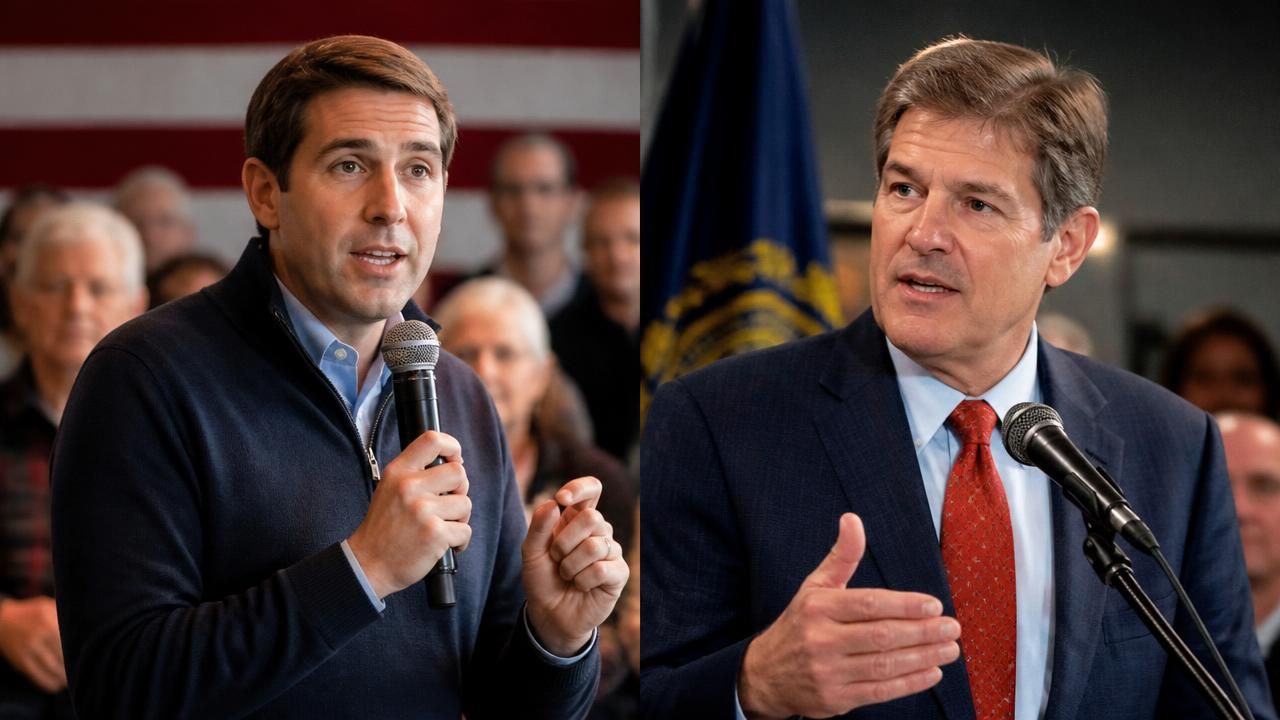
The battle for the U.S. Senate narrowed sharply this week as the Cook Political Report shifted New Hampshire's open-seat race toward Republicans, reclassifying the contest as a toss up. The move, first flagged in a Cook headline reading "In Move Toward GOP, New Hampshire Senate Race Shifts Into Toss Up," marks one of the most significant rating changes of the 2026 cycle and signals that a state Democrats have held comfortably is now genuinely up for grabs.
The shift centers on the race to replace a retiring Democratic senator, where Representative Chris Pappas has been the party's presumed standard-bearer. But the emergence of former Senator John Sununu as the Republican field's most prominent figure has changed the calculus, prompting Cook and other analysts to reassess what had been a lean-Democratic contest. Primary results pages from NBC News listed Pappas, Karishma Manzur and Sununu among the candidates competing for their parties' nominations, underscoring how unsettled both fields remained as voting concluded.
A Poll That Cuts Both Ways
The ratings shift arrived alongside new survey data that, on its face, favors Democrats. A New York Times/Siena College poll found Pappas leading his likely Republican opponent by five percentage points. Perhaps more telling than the margin was the motivation behind it: voters told pollsters they were more interested in electing a check on President Trump than in backing a candidate who supports him.
That finding fits a broader pattern emerging from the primaries. Brookings Institution analysts, summarizing the season under the headline "Electability over ideology," argued that primary voters in both parties repeatedly prioritized candidates they believed could win a general election over those who hewed most closely to ideological orthodoxy. In New Hampshire, that instinct has produced two relatively mainstream, well-known figures rather than insurgent outsiders.
"In Move Toward GOP, New Hampshire Senate Race Shifts Into Toss Up" — Cook Political Report
National Stakes: A Senate on a Knife's Edge
The New Hampshire shift is part of a wider scramble for Senate control. Aggregate polling coverage this week described Democrats holding a narrow lead in Senate races nationally, even as several models continued to project that Republicans would retain their majority. That apparent contradiction — Democrats ahead in the popular picture, Republicans favored in the chamber — reflects a map in which a handful of states, New Hampshire among them, effectively decide the outcome.
Money is flooding in accordingly. Reporting on super PAC activity described Trump- and Musk-aligned committees unleashing millions of dollars to boost Republican candidates in battleground states, a spending wave designed to capitalize on exactly the kind of tightening that Cook's rating change reflects. Democratic groups have countered with their own messaging, with the party's senatorial committee pushing weekly takeaways and Senator Mark Kelly publicly touting what he called "real opportunities" to flip seats in November.
Beyond New Hampshire: Three Races to Watch
- Maine: The contest involving Senator Susan Collins has become, according to Vox, the biggest midterm test for the abortion-rights movement — a referendum on accountability for the end of Roe v. Wade. An investigative story by ProPublica, discussed by Maine Public, added new scrutiny to Collins's record.
- Florida: A new poll showed Democratic Socialist Angie Nixon tied with Republican Senator Ashley Moody at 45 percent each, a striking result in a state Republicans have dominated.
- Michigan: A scheduled Senate debate was upended when Republican Mike Rogers declined to participate, while Democrat Abdul El-Sayed was confirmed — a scheduling fight that both campaigns will use to argue about who is avoiding scrutiny.
The Closing Sprint and a Wild Primary Season
The New York Times characterized the end of the primary calendar as a season of "snubs, flubs and dueling Dan Sullivans," a chaotic close that has left both parties racing to consolidate. The Hill framed the moment similarly, describing primaries ending and Trump's "final sprint" beginning — a phase in which the president's personal engagement is expected to intensify in states like New Hampshire.
Down-ballot, the campaign has even produced an unusual policy fight. New Hampshire Public Radio reported that Republicans in the state, in a notable shift, said they would pursue a moratorium on AI data centers — a sign that energy costs and land use are becoming live campaign issues in a state where technology infrastructure is expanding rapidly.
Why It Matters
Taken together, the sources sketch a race that is less about any single candidate than about two competing theories of 2026. One holds that voters, restless under unified Republican government, will reward Democrats who promise to serve as a check on Trump. The other holds that New Hampshire's historically independent electorate, combined with Sununu's name recognition and a surge of outside money, can overcome that national tide.A five-point poll lead is real but not safe; a toss-up rating is a warning, not a verdict. With primaries now concluded and the general election sprint underway, New Hampshire has become the clearest test of whether the midterms will be a referendum on the president — or a state-by-state grind in which either party can still lose a seat it once took for granted.