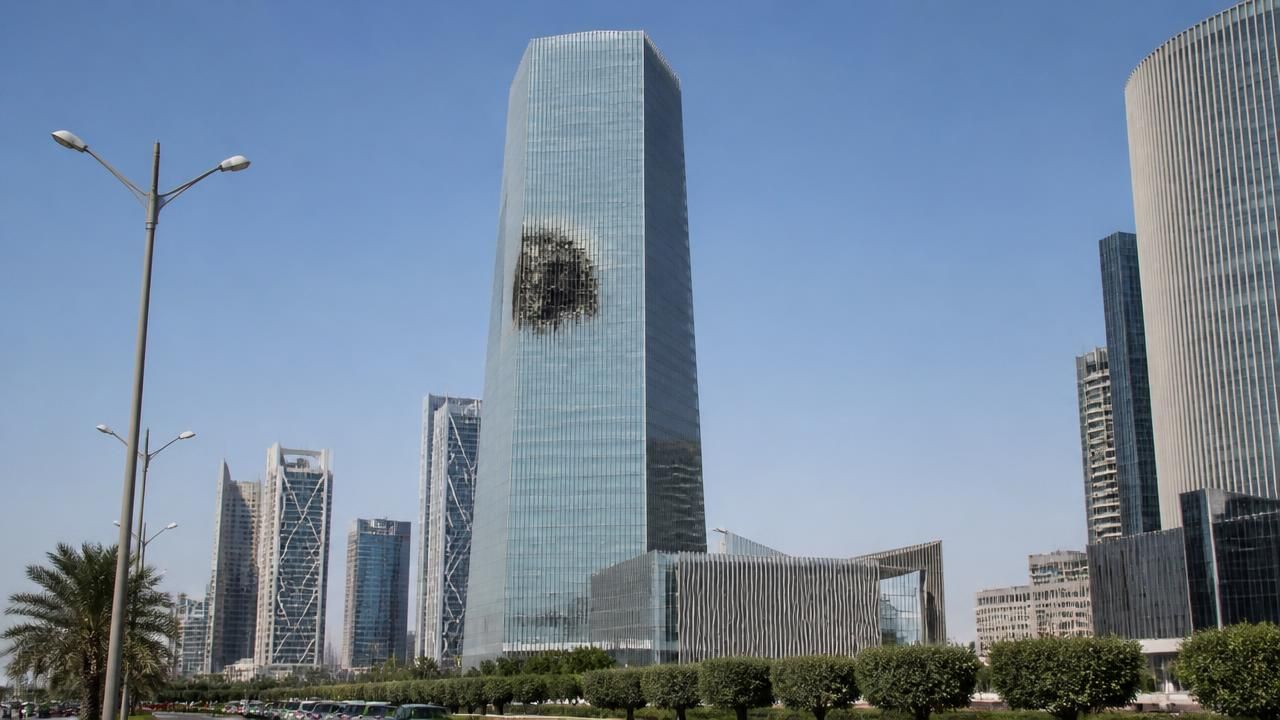
A Houthi attack struck the Saudi Arabian capital's financial district, damaging a tower linked to oil giant Saudi Aramco and rattling the kingdom's carefully cultivated image of stability as it pushes to attract foreign capital. Witnesses reported strikes hitting the district around the Aramco skyscraper, one of the defining landmarks of Riyadh's new business quarter, with reports from the scene describing visible damage to the building.
The assault marks a rare successful strike on the Riyadh financial hub, a heavily fortified zone that houses banks, consultancies, sovereign wealth entities and the regional headquarters of multinational firms. Bloomberg reported that the attack damaged "one of the landmarks of the Saudi Arabian capital's financial district," upsetting plans for a return to normal roughly a month after deadly strikes on Riyadh's airport disrupted travel and canceled showpiece events.
What Happened
According to accounts compiled from Bloomberg, Dawn and other outlets citing witnesses, missiles or drones reached the Riyadh financial district and struck the Aramco building. The full extent of casualties and structural damage was not immediately confirmed in the initial wave of reporting, and Saudi authorities had not issued a detailed statement by the time the first accounts circulated.
The Iran-aligned Houthi movement, which controls much of northern Yemen, has claimed responsibility for a long series of drone and missile attacks on Saudi territory since 2015, targeting airports, oil installations and, most spectacularly, Aramco's Abqaiq processing facility in 2019 — an attack that briefly knocked out roughly half of the kingdom's crude output and sent global oil prices soaring.
"A Houthi attack damaged one of the landmarks of the Saudi Arabian capital's financial district, upsetting plans for a return to normal about a month after deadly strikes on Riyadh's airport disrupted travel and canceled showpiece events." — Bloomberg Markets
Why the Target Matters
Aramco is the crown jewel of the Saudi economy and one of the most valuable companies on earth, having listed a sliver of its shares on the Tadawul exchange in Riyadh in 2019. Its Dhahran headquarters sit in the Eastern Province, but the company maintains prominent offices in the capital, where the financial district — anchored by the King Abdullah Financial District's cluster of glass towers — functions as the physical embodiment of Crown Prince Mohammed bin Salman's Vision 2030 diversification program.
Hitting that district is therefore as much an informational strike as a physical one. Riyadh has spent billions staging conferences, sporting events and investment summits designed to persuade global banks and asset managers to set up regional headquarters in the city. Each visible breach of the capital's air defenses complicates that pitch, raising questions about insurance costs, business continuity planning and the willingness of expatriate executives to relocate.
The Pattern of Escalation
The timing is significant. Bloomberg's framing places the strike in a sequence: first, deadly attacks on Riyadh's international airport that disrupted flight schedules and forced organizers to cancel high-profile events; now, a direct hit on the financial district. Together, the incidents suggest a Houthi campaign aimed not merely at infrastructure, but at the kingdom's reputation for normalcy.
- Air travel: Earlier strikes on Riyadh airport disrupted schedules and raised questions about the resilience of Saudi aviation hubs.
- Business events: Showpiece gatherings were canceled or curtailed following those attacks.
- Financial infrastructure: The latest strike reaches the symbolic core of the kingdom's economic reform agenda.
Differing Frames Across Outlets
Coverage varied sharply in emphasis. Bloomberg led with the disruption to the kingdom's return to normal, framing the attack through a markets and investor-sentiment lens — the concern being not just casualties but confidence. Dawn, citing witnesses on the ground, emphasized the physical damage to the Aramco building and confirmed the targeting of the financial district. Aggregators including MSN and Yahoo carried headlines stressing that Aramco's Riyadh office was hit as Houthi missiles targeted the kingdom, a more direct security framing. The New York Times headline highlighted the same core facts — Aramco tower damaged, Houthis attack Riyadh — though its full report was not accessible in the syndicated feed.
The divergence reflects a broader split in how such strikes are narrated: as a security escalation in a nine-year-old proxy war, or as a business-risk event in an emerging market's flagship reform story.
Implications
For markets, the immediate question is oil. Historically, attacks on Saudi energy infrastructure have produced sharp but often short-lived price spikes unless actual production is curtailed; a strike on an office tower in the capital is unlikely to affect crude flows directly, but it reinforces a geopolitical risk premium that traders had allowed to decay. Saudi Aramco's valuation and the pace of foreign direct investment into the kingdom are the medium-term variables to watch.
Diplomatically, the attack lands as Riyadh navigates a fragile regional environment, balancing its ongoing normalization talks and its relationship with Washington against a Houthi movement that has demonstrated repeatedly that it can reach deep into Saudi territory. Whether the kingdom responds with escalated airstrikes on Yemen, accelerated air-defense investment, or quiet de-escalation talks will shape the next phase of the conflict.
For companies operating in Riyadh, the calculus is more prosaic and immediate: revisiting evacuation protocols, reassessing insurance coverage for terrorism risk, and weighing whether a district that was marketed as the safest square mile in the Middle East still qualifies.