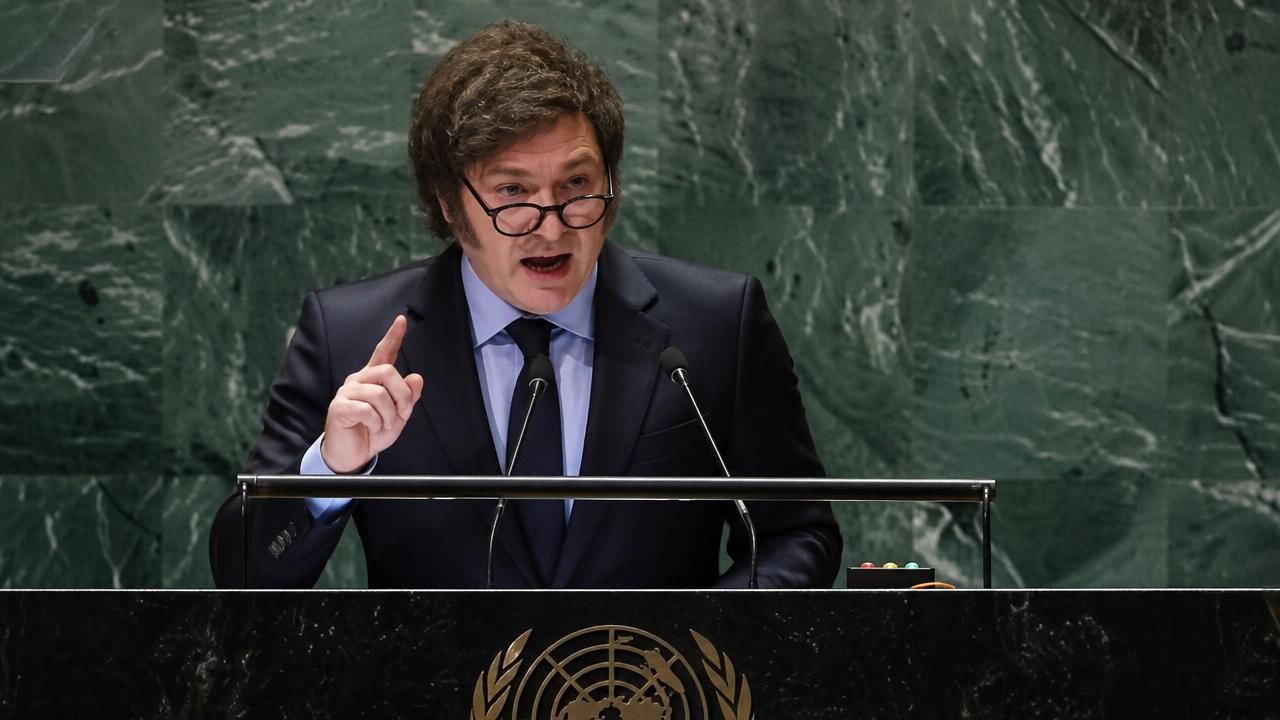
Argentina's president, Javier Milei, used the world's most prominent diplomatic stage to escalate his country's long-running sovereignty dispute with Britain over the Falkland Islands, warning that Buenos Aires would take "matters into our own hands" if international bodies continued to ignore the issue.
Speaking at the United Nations General Assembly in New York, Milei delivered a caustic attack on the institution itself, accusing it of being populated by "parasites" and of failing to act on the tensions simmering in the South Atlantic. The islands, which Argentina claims and calls the Malvinas, have been at the centre of a dispute with the United Kingdom since 1833 and were the subject of a brief but bloody war in 1982.
A bellicose turn at the General Assembly
According to the Guardian, Milei condemned the UN as ineffective on the Falklands question and warned that Argentina would pursue its claim through other means if multilateral channels continued to disappoint. The remarks marked a sharp departure from the more conciliatory tone Argentine diplomats have traditionally adopted in New York, where the country has for decades pressed its case through the UN's Decolonization Committee.
Reporting from MSN and Yahoo News framed the address around the same core threat — that Argentina would "take matters into our own hands" — while Al Jazeera and the trade publication Upstream Online placed the emphasis elsewhere entirely: on Milei's explicit threat to impose sanctions on companies involved in oil and gas exploration in waters surrounding the islands.
"We are going to take matters into our own hands."
The oil dimension
The sanctions threat is the most concrete element of the speech. The Falklands sit atop a portion of the South Atlantic that has drawn sustained interest from the hydrocarbons industry, most notably the North Falkland Basin, where successive exploration campaigns have identified significant reserves. Argentina has long argued that any drilling conducted without its authorisation constitutes an infringement of its sovereign rights and has previously sought to penalise companies operating there under domestic legislation covering hydrocarbons on what it regards as its continental shelf.
Upstream Online reported that Milei's warning was aimed squarely at the commercial partners of Falklands oil projects — the operating companies, their investors and the service firms that support them. Al Jazeera characterised the move as a threat of formal sanctions, raising the prospect that firms with Argentine exposure could face legal, financial or logistical consequences for participating in drilling north of the islands.
The framing difference between outlets is instructive. British and general-interest outlets covered the speech primarily as a diplomatic provocation, foregrounding the "parasites" insult and the challenge to the UN's authority. Energy-sector and Middle East-focused publications treated it as an operational risk story for oil companies, focusing on what sanctions would actually mean for joint ventures, licences and shipping.
Britain's position
The United Kingdom has consistently rejected Argentina's sovereignty claim, arguing that the islanders themselves — a community of roughly 3,500 people — have the right to determine their own future. A 2013 referendum saw voters on the islands overwhelmingly back continued British sovereignty, a result London cites as decisive and Buenos Aires dismisses as irrelevant to what it regards as a territorial question rather than a matter of self-determination.
Successive British governments have also made clear that the defence of the islands is non-negotiable, maintaining a permanent military presence at RAF Mount Pleasant. Any move by Argentina to impose economic penalties on oil partners would therefore test not only the commercial resilience of the Falklands' nascent energy sector but also the diplomatic bandwidth of both capitals.
Domestic politics and a wider pattern
Milei, a libertarian economist who took office promising radical economic reform, has increasingly fused his domestic agenda with nationalist symbolism. The Malvinas cause is one of the few issues on which Argentine politicians across the spectrum agree, and invoking it offers a president battling inflation and fiscal austerity a reliable source of patriotic legitimacy.
His broader assault on the UN fits a template familiar from his public appearances: hostility to what he casts as supranational bureaucracy, multilateral consensus and the "2030 agenda" of global governance. That rhetoric plays well with his base but complicates the quiet diplomatic work Argentina's foreign ministry has pursued for generations.
Why it matters now
- For the islands: Any sanctions threat could chill investment in Falklands energy projects, which are capital-intensive and dependent on international partners.
- For Argentina: Unilateral measures risk alienating the very governments whose support it needs if the sovereignty claim is ever to advance.
- For Britain: London must weigh whether to respond publicly to a rhetorical escalation or treat it as domestic theatre.
- For the UN: Milei's attack on the institution's credibility adds to a broader crisis of confidence among member states over its capacity to resolve entrenched disputes.
What happens next
The immediate question is whether Argentina follows through with formal sanctions or whether the threat remains, as so often in the Falklands file, a vehicle for domestic messaging. Legal action against oil companies would be difficult to enforce internationally, but the mere prospect of litigation, asset freezes or port restrictions can be enough to raise the cost of doing business in contested waters.
Britain, for its part, is unlikely to shift its position on sovereignty. The dispute, more than two centuries old and still raw four decades after the 1982 conflict, has entered a new phase in which energy, international institutions and the politics of grievance are all intertwined. Milei's speech did not resolve any of that — but it made clear that Argentina's president intends to keep the issue, and himself, at the centre of the world's attention.