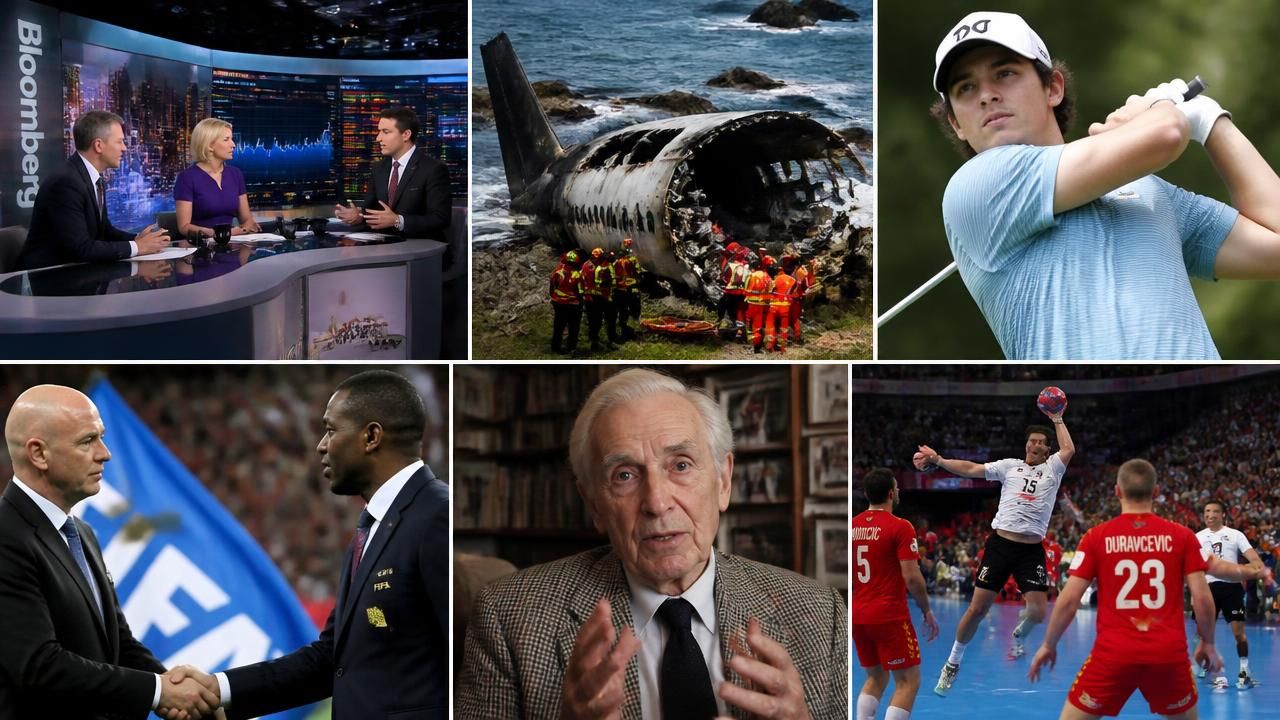
It is the season of the roundup — the annual ritual in which newsrooms and broadcast desks sweep the floor of the year and hand viewers the pieces that never made the front page. On Bloomberg Markets, that instinct took the form of a segment built around a simple, disarming premise:
a roundup of headlines you may have missed, but gotta see.The items listed were modest and domestic — how to choose who receives Christmas presents, a holiday-themed cruise, students who put down a college deposit and then never enrolled, and the arrival of AI cheating in the SAT and AP testing regime.
But set that segment beside the rest of the day's wire copy and a striking pattern emerges. The stories that slip through the cracks are rarely the trivial ones. They are the ones that arrive without a market ticker attached — a plane down in the Pacific, a 22-year-old rewriting golfing history, a football federation bending to public fury, and an 80-something master of nonfiction explaining why journalism keeps losing the room.
The roundup as an economic instrument
The Bloomberg format is itself a product of financial logic. Rolling 24-hour coverage of equities, bonds and currencies leaves almost no airtime for anything that cannot be priced intraday. Hence the compilation: a compressed, slightly wry digest delivered by a rotating cast of anchors and correspondents, in which consumer behaviour (the college-deposit problem is a quiet indicator of enrolment and debt trends) and technology (AI-assisted exam cheating is a live risk factor for testing companies and admissions offices) are folded into a few minutes of air.
The consumer-finance items are not as soft as they look. Deposit-forfeiture patterns feed directly into discussions of enrolment yield, student-debt exposure and the health of higher-education revenue — all of which show up, eventually, in the earnings of lenders and for-profit institutions. The AI-cheating story, meanwhile, sits at the intersection of assessment integrity, ed-tech spending and the credibility of credentials that underpin labour-market signalling.
A crash in the Juan Fernández Archipelago
Far from any trading floor, the wire carried a far grimmer item:
Military plane crashes in Chilean Juan Fernández Archipelago; reports say no survivorsThe loss of a Chilean Air Force aircraft on approach to the remote Robinson Crusoe Island — a small, weather-exposed outpost some 600 kilometres off the mainland — killed all aboard, among them a television presenter and a prominent entrepreneur closely associated with post-earthquake reconstruction efforts.
The economic dimension was immediate and human. Reconstruction programmes in Chile after the 2010 earthquake depended heavily on private-sector coordination, and the deaths removed key figures from that effort at a delicate moment. For markets, the crash registered barely at all; for the country's civic and business leadership, it was a genuine shock. The gap between those two responses is the story of attention itself.
Tseng, and the arithmetic of a record
Sport provided the year's cleanest narrative arc. Yani Tseng captured the Women's British Open, a result that made her, at 22, the youngest player — man or woman — to reach five major championships. The Taiwanese golfer's run had been building for two seasons, and the record was the kind of statistical milestone that tends to reframe an entire sport's marketing: a young, globally marketable champion from Asia at precisely the moment women's golf was chasing new broadcast territories and sponsorship money.
Yet outside specialist coverage, the achievement competed for space with transfer gossip and earnings season. The lesson is familiar to anyone who has watched rights-holders struggle to convert dominance into revenue: sporting excellence does not automatically translate into commercial attention, and the window in which a record is news is measured in hours.
FIFA's change of direction
Governance delivered a slower-burning story. Following the handball by Thierry Henry that helped eliminate Ireland from World Cup qualification, FIFA moved to make changes — a sequence that eventually fed into a broader debate over additional match officials, seeding arrangements and, ultimately, goal-line technology.
- Public outrage created pressure no federation could ignore.
- Reform arrived incrementally, and only after institutional resistance.
- The episode became a template for how fan sentiment can force regulatory change in a multi-billion-dollar rights market.
Set against the Bloomberg segment, the FIFA case is the mirror image of the college-deposit item: both concern rules that shape behaviour, but only one is routinely covered as a consumer issue rather than a scandal.
Talese on craft, Iraq and a lifetime of listening
The final thread is the most uncomfortable. In an interview, Gay Talese — the New Yorker and Esquire writer whose profiles helped define literary journalism — discussed the state of the profession, the Iraq war and his own career. His central argument, delivered with the patience of someone who has watched several news cycles come and go, is that reporting has drifted away from the slow, intrusive, uncomfortable business of spending time with subjects.
That critique lands hardest against the roundup itself. A digest can tell you what happened; it cannot tell you why a reconstruction programme collapsed after a plane went down, or what a 22-year-old champion's fifth major means for a sport's economics. Those answers require the expensive thing Talese practised: presence.
What gets missed, and why it matters
Taken together, the five stories describe a news ecosystem that is fast, aggregated and ruthlessly selective. Financial coverage optimises for priceable information; sports coverage optimises for spectacle; disaster coverage optimises for confirmation of casualties. Everything else — the consumer mechanics, the governance detail, the craft — arrives in the margins, if at all.
The practical implication for readers and investors is unglamorous but real: the items most likely to be overlooked are the ones whose consequences compound slowly. A handball rule, a college deposit, an AI-cheating workaround, a lost reconstruction leader — none of these move a market on the day. All of them shape the terrain on which markets, and the people inside them, operate.