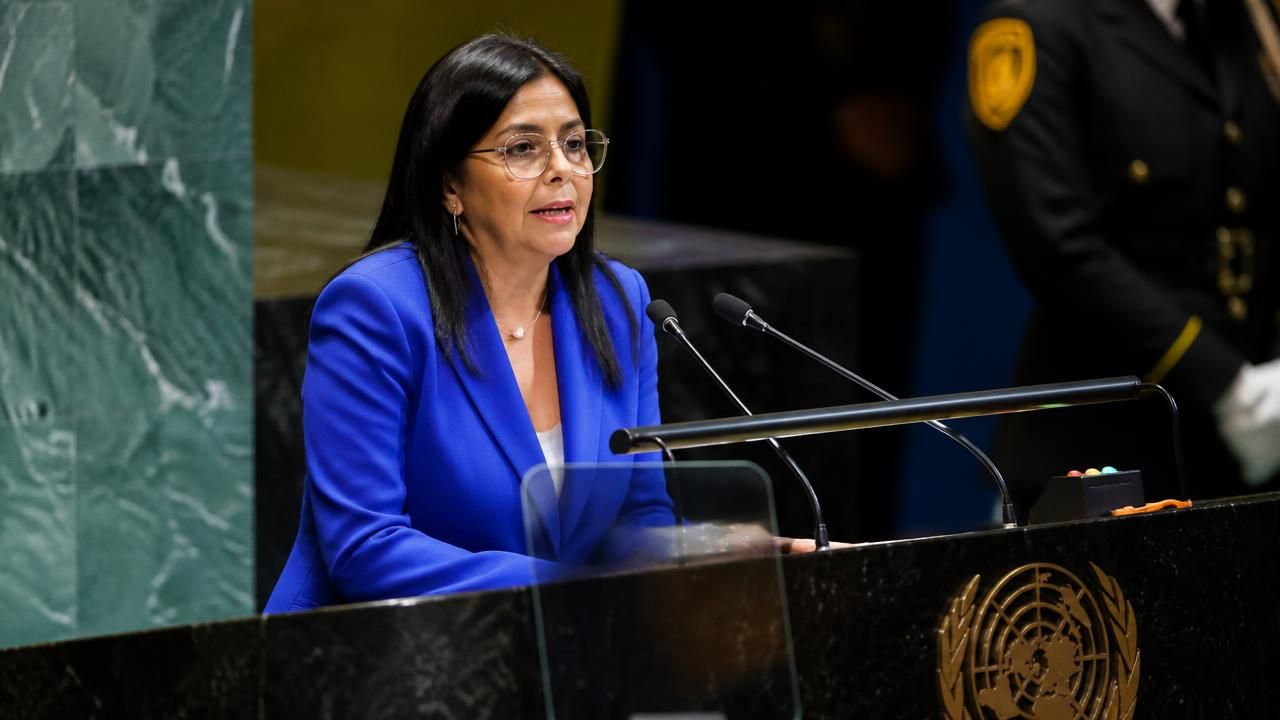
UNITED NATIONS — Venezuela’s acting president, Delcy Rodríguez, used her first address to the U.N. General Assembly since coming to power to promise that elections would be held, but she declined to set a date, saying the Venezuelan people will determine the “right moment.”
The speech, delivered to a packed hall of world leaders and diplomats, was one of the most closely watched moments of this year’s General Assembly. For a government facing persistent accusations that it has dismantled democratic competition, Rodríguez’s words carried immediate political weight — and immediate ambiguity.
“Democracy is measured by the quality of competition before elections,” Rodríguez said, according to Cuba Headlines, which highlighted the remark in its coverage.
That line became the centerpiece of some international coverage, while other outlets focused on what she did not say: when Venezuelans would actually go to the polls. NPR and Times Union reported that she promised elections at the “right moment.” MSN’s headline put it more bluntly: “At UN, Venezuela’s acting president promises elections without setting date.”
The competing emphases captured the central tension of the address. Rodríguez sought to present Venezuela as a sovereign democracy whose electoral calendar would not be dictated from abroad. Her critics heard a familiar tactic: a promise of future elections designed to relieve international pressure without binding the government to a concrete timeline.
A high-stakes debut on the world stage
Rodríguez’s appearance marked her first address to the U.N. General Assembly since she became Venezuela’s acting president. The setting was significant. The U.N. has been a key arena for Venezuela’s political battles, where Caracas has repeatedly denounced sanctions, accused Washington of intervention, and sought support from allies in the Global South.
By choosing the General Assembly as the stage for an election promise, Rodríguez appeared to be speaking simultaneously to three audiences: the Venezuelan public, which has endured years of economic hardship and political repression; the international community, which has demanded free and fair elections; and the government’s own base, which wants to see the leadership project strength rather than concession.
Venezuela’s electoral history is the backdrop. The country’s July 2024 presidential election was followed by widespread allegations of fraud. The opposition, led by María Corina Machado and candidate Edmundo González, said its tally showed González winning by a wide margin. The government-controlled electoral authority declared President Nicolás Maduro the winner, but it never published the full voting records. International observers, including the United Nations and the Carter Center, criticized the lack of transparency. Protests erupted, and thousands were arrested or fled the country.
That unresolved dispute has left Venezuela diplomatically isolated and under heavy sanctions. The United States, the European Union, and several Latin American governments have refused to recognize the official 2024 result. Opposition leaders have demanded a clear timetable for new elections, guarantees of fair competition, and the release of political prisoners.
Why the timing — and the silence on it — matters
Rodríguez’s phrase “the right moment” is likely to be parsed for months. It echoes language used by Venezuelan officials in the past to suggest that elections will happen only when conditions are favorable to the ruling party. Without a date, the promise remains a political signal rather than a binding commitment.
Analysts say the lack of a timetable is likely to fuel skepticism. A genuine electoral opening would require not just a date but a level playing field: independent electoral authorities, access for opposition candidates, international observers, and an end to the disqualification of prominent rivals. Rodríguez’s own framing — that democracy is measured by the quality of competition before elections — acknowledges that competition is the standard. The question is whether her government will meet it.
International reaction was muted and watchful. Western diplomats said they would judge Venezuela by actions, not words. Regional powers are likely to press for specifics. Meanwhile, the government’s allies may present the speech as evidence that Venezuela is open to dialogue and does not need external pressure.
How different outlets framed the story
- NPR News led with the promise itself: “Venezuela’s acting leader promises elections at the ‘right moment,’” emphasizing the phrase that leaves timing open.
- Times Union highlighted the historic nature of the address — her first since coming to power — while noting the same “right moment” caveat.
- MSN stressed the missing date: “At UN, Venezuela’s acting president promises elections without setting date.”
- Cuba Headlines focused on Rodríguez’s quote, “Democracy is measured by the quality of competition before elections,” framing the speech around her defense of democratic legitimacy.
Taken together, the coverage shows how a single speech can be read as both a concession to international pressure and a maneuver to buy time. The absence of a date was not lost on any outlet; the disagreement was over how much credit to give the promise.
What comes next
Venezuela’s opposition is likely to use the speech as a benchmark. If no date emerges in the coming weeks, it will argue that Rodríguez’s words were empty. If a date is set, the focus will shift to conditions: whether opposition candidates can run, whether voters can cast ballots freely, and whether the results will be respected.
The international community faces a similar test. Sanctions relief, diplomatic recognition, and economic re-engagement could be dangled as incentives. But after years of failed negotiations, many governments are wary of easing pressure without concrete steps.
For ordinary Venezuelans, the stakes are less abstract. The country’s economy has collapsed, inflation remains punishing, and millions have migrated. An election promise at the U.N. may resonate in diplomatic circles, but it will be measured at home in schools, hospitals, and polling stations.
Rodríguez told the world that the Venezuelan people will decide the right moment. The coming months will reveal whether that moment is a real opening — or another delay.