The International Atomic Energy Agency's Board of Governors voted on Friday to formally report Iran to the United Nations Security Council for failing to meet its nuclear non-proliferation obligations, a dramatic escalation that marks the first such referral in roughly two decades. The resolution, drafted by the United States and its Western allies, effectively places Tehran's nuclear file back before the world's most powerful deliberative body and raises the prospect of renewed international sanctions.
The vote follows more than a year of mounting frustration inside the Vienna-based watchdog, whose inspectors have been locked out of key Iranian facilities and denied the transparency that the Nuclear Non-Proliferation Treaty (NPT) requires. According to diplomats involved in the drafting, the resolution explicitly cites Iran's "non-compliance" — language the Islamic Republic has long resisted and which it argues is politically motivated rather than legally grounded.
Grossi: 'Completely Blind' for More Than a Year
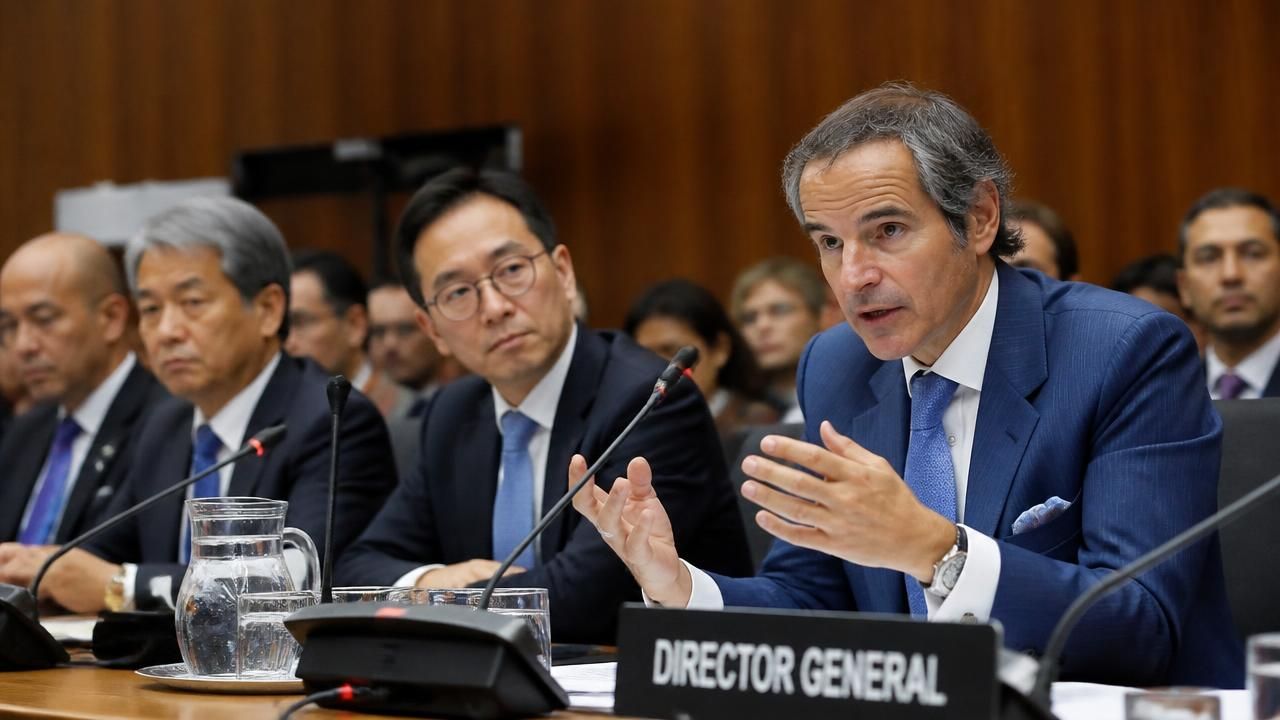
At the center of the crisis is IAEA Director General Rafael Grossi, who has spent months warning that the agency's so-called "continuity of knowledge" — the baseline understanding of a nuclear program that underpins all verification work — has eroded dangerously. Speaking on the sidelines of the UN General Assembly, Grossi said the IAEA has been "completely blind" to Iran's nuclear program for more than a year, adding that a "fairly important amount" of nuclear material remains inside the country.
"There is still a fairly important amount of nuclear material in Iran... the IAEA can get on the ground and assess pretty fast if there is the political will for it."
That conditional — if there is the political will — captures the central tension. Grossi has repeatedly stressed that the agency's technical capability is not in question; only Iranian cooperation is. The New York Times and other outlets reported this week that the status of Iran's nuclear program is now essentially unclear, a striking admission for a country that was once among the most heavily monitored in the world. Reuters and Yahoo News both carried the watchdog's assessment that the current state of Iran's enrichment and stockpile activities is unknown.
A File Returning to the Security Council
The decision to refer Iran echoes the path taken in the mid-2000s, when the Security Council imposed a series of sanctions resolutions over Tehran's refusal to suspend uranium enrichment. Those measures were later rolled back under the 2015 Joint Comprehensive Plan of Action (JCPOA), the landmark deal that curtailed Iran's program in exchange for sanctions relief. The Trump administration's 2018 withdrawal from the JCPOA unraveled that architecture, and Iran has since progressively breached its enrichment limits — reportedly enriching uranium to 60 percent, a short technical step from weapons-grade levels.
Analysts writing in The New Arab posed the obvious question now facing diplomats: what happens next? A referral to the Security Council does not automatically trigger sanctions, and both Russia and China — veto-wielding members — have historically shielded Tehran from punitive action. The resolution's passage at the IAEA board is therefore best understood as a diplomatic signal as much as a legal mechanism.
Signals of a Possible Off-Ramp
Yet the picture is not uniformly confrontational. Reports from The Times of Israel and India TV suggested that ongoing US-Iran talks could yield a deal granting UN inspectors renewed access to nuclear sites, with Grossi dropping hints that a return to the ground may be closer than the board vote implies. Bloomberg reported that Grossi believes the IAEA could deploy and assess "pretty fast" once political conditions permit.
That dual track — public condemnation paired with quiet negotiation — is a familiar feature of nuclear diplomacy. It also explains the divergent framings across outlets: wire services such as Reuters and the Associated Press emphasized the formal referral and its institutional weight, while Middle East-focused and Israeli outlets highlighted the possibility of renewed inspections and the role of back-channel talks.
Iran Pushes Back
Tehran has not been passive. The Associated Press reported that Iran formally denounced Austria for blocking its nuclear chief from attending a meeting in Vienna — a procedural confrontation that underscores how the dispute has spilled beyond the technical realm into broader diplomatic tensions. Separately, Wikinews noted Iran's inauguration of a heavy-water production plant, a facility type that raises proliferation concerns because of its role in producing plutonium pathways and reactor-grade materials.
Iranian officials have consistently framed the IAEA board's actions as Western coercion, arguing that the agency has been politicized. That argument resonates with some non-aligned states on the board, though not enough to block the resolution.
The Stakes Ahead
The referral places enormous weight on the Security Council's next steps. If the Council moves toward sanctions, Iran could respond by further restricting inspections or even threatening NPT withdrawal — a step it has flirted with rhetorically for years. If, instead, the referral becomes a lever for a negotiated inspections agreement, it could open a narrow diplomatic window.
For Grossi, the priority remains practical: getting inspectors back on the ground before the agency's knowledge gap becomes irreversible. "We can get on the ground and assess pretty fast," he said. Whether that happens depends less on the IAEA's technical readiness than on a political decision in Tehran — and, increasingly, on capitals far from Vienna.