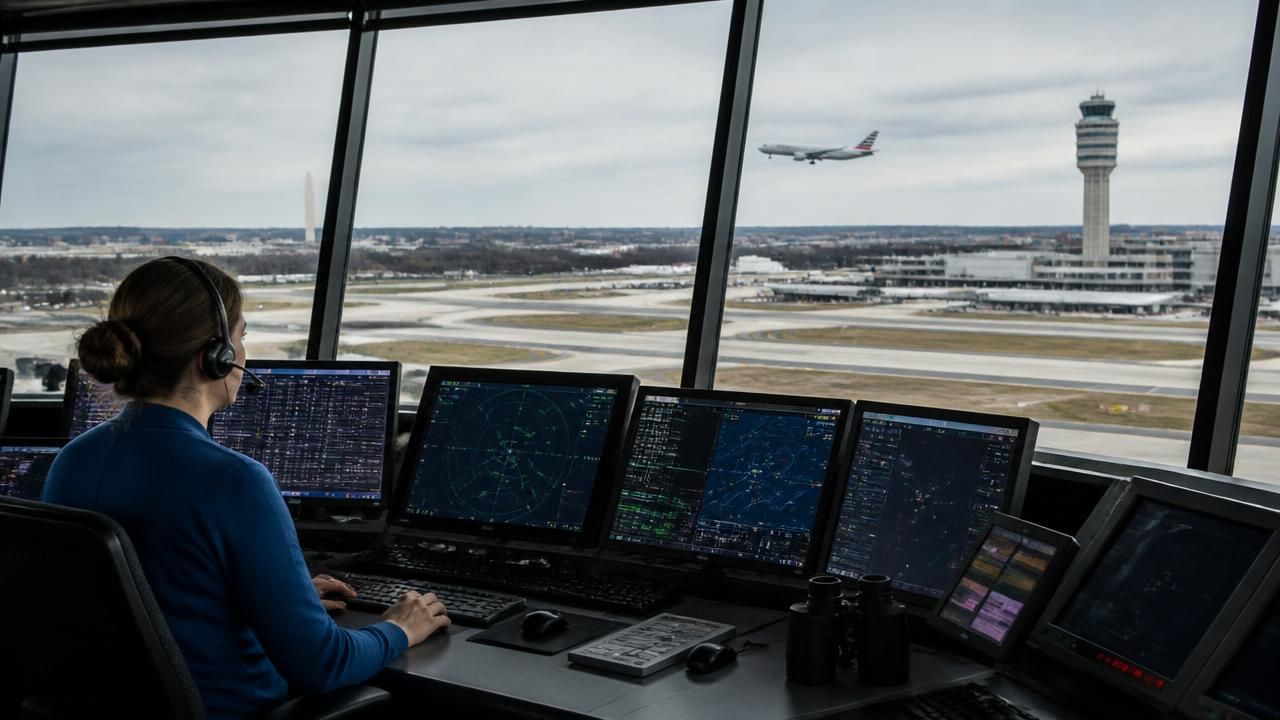
The Federal Aviation Administration is preparing to launch an artificial intelligence system designed to help air traffic controllers manage congestion, beginning with a limited debut over the Washington, D.C., area as soon as Monday, Sept. 21, according to government and industry officials. The tool, known as SMART, is part of an $875 million FAA bet that AI can predict air traffic flows and flag potential conflicts before they cascade into delays.
The initial rollout would cover the three major airports serving the Washington region and mark the first operational step toward a planned nationwide deployment across the 29 million square miles of U.S. national airspace the FAA oversees. The scope of that ambition — and the price tag attached to it — has made the project a closely watched test case for how the federal government integrates AI into safety-critical infrastructure.
What SMART would do
According to Ars Technica, SMART uses AI models to forecast air traffic flows and identify potential conflicts based on operational factors including airline schedules, weather, airport capacity, and airspace conditions. Rather than replacing human controllers, the system is designed to advise them, offering a data-driven layer that could help anticipate bottlenecks in one of the busiest and most complex airspace corridors in the country.
The FAA has not released a full technical specification, but the concept fits a broader push across aviation to move from reactive to predictive operations. Modern air traffic management already relies on sophisticated software, radar, and flight-plan data. SMART would add machine-learning models that can process many variables at once and generate probabilistic forecasts of where demand will exceed capacity.
A limited start, by design
The decision to begin in the Washington area rather than nationwide is deliberate. “The decision to launch SMART in a limited scope before going nationwide is the ‘right call,’” said Philip Mann, principal consultant at Vector Strategic Consulting LLC, who advises on aviation safety and AI governance and previously worked at the FAA for 17 years.
“The decision to launch SMART in a limited scope before going nationwide is the ‘right call.’” — Philip Mann, Vector Strategic Consulting
Mann’s view reflects a common principle in aviation: prove new systems in controlled conditions before expanding them. The Washington airspace offers a demanding but bounded laboratory, with high traffic volume, multiple major airports, and frequent weather disruptions. If SMART can help there, the FAA will have evidence to support a wider rollout.
Why the FAA is betting on AI
The agency faces persistent pressure to reduce delays and modernize a system that often strains under demand. Air travel rebounded strongly after the pandemic, and controller staffing shortages have compounded congestion at key facilities. The FAA has spent years pursuing modernization efforts, most notably the NextGen program, which sought to shift from ground-based radar to satellite-based navigation. Those efforts delivered improvements but fell short of transforming the system.
SMART represents a different approach: instead of rebuilding the physical infrastructure, it applies AI to the data and decisions that already shape traffic. The $875 million investment signals that the FAA sees potential for meaningful gains. Forbes framed the project as a bet on AI to reduce flight delays, while Yahoo and MSN coverage emphasized the agency’s plan to cut delays through automation. Ars Technica focused more on the technical and governance questions raised by an AI system advising controllers.
- Who: The Federal Aviation Administration, with contractors and aviation industry partners.
- What: SMART, an AI tool that predicts air traffic flows and identifies potential conflicts.
- When: Expected to debut in the Washington area as soon as Monday, Sept. 21.
- Where: Initially the three major Washington-area airports, then potentially nationwide across 29 million square miles.
- Why: To reduce congestion and delays and to modernize air traffic management.
- How: AI models analyze schedules, weather, airport capacity, and airspace conditions to advise controllers.
The safety and governance questions
For all the promise, the project raises familiar questions about AI in high-stakes environments. If SMART advises controllers, how transparent are its recommendations? What happens when the model is wrong? How does the FAA validate and update the system? And how will controllers’ unions and safety advocates be involved?
The FAA has long maintained a conservative safety culture, and that is likely to shape the rollout. The agency will need to demonstrate that SMART does not introduce new risks or erode controller situational awareness. Mann and other experts have argued that AI governance must be built in from the start, with clear lines of accountability and mechanisms for human override.
There are also operational challenges. AI models depend on data quality, and aviation data comes from many sources with different update rates and formats. Integrating SMART with legacy systems will be as much an organizational challenge as a technical one. Cybersecurity is another concern: a system that predicts traffic flows could become a target if not properly protected.
What to watch
The Washington debut will be scrutinized by airlines, airports, controllers, and technology vendors. If SMART performs well, the FAA could accelerate its nationwide rollout and expand the tool’s role. If problems emerge, the agency may slow down or narrow its ambitions. The outcome will also influence how other governments approach AI in air traffic control.
For now, the FAA is moving carefully. The limited launch is a recognition that even useful AI must earn trust in a domain where errors can be catastrophic. The $875 million question is whether SMART can deliver fewer delays without compromising the safety record that makes U.S. aviation the envy of the world.