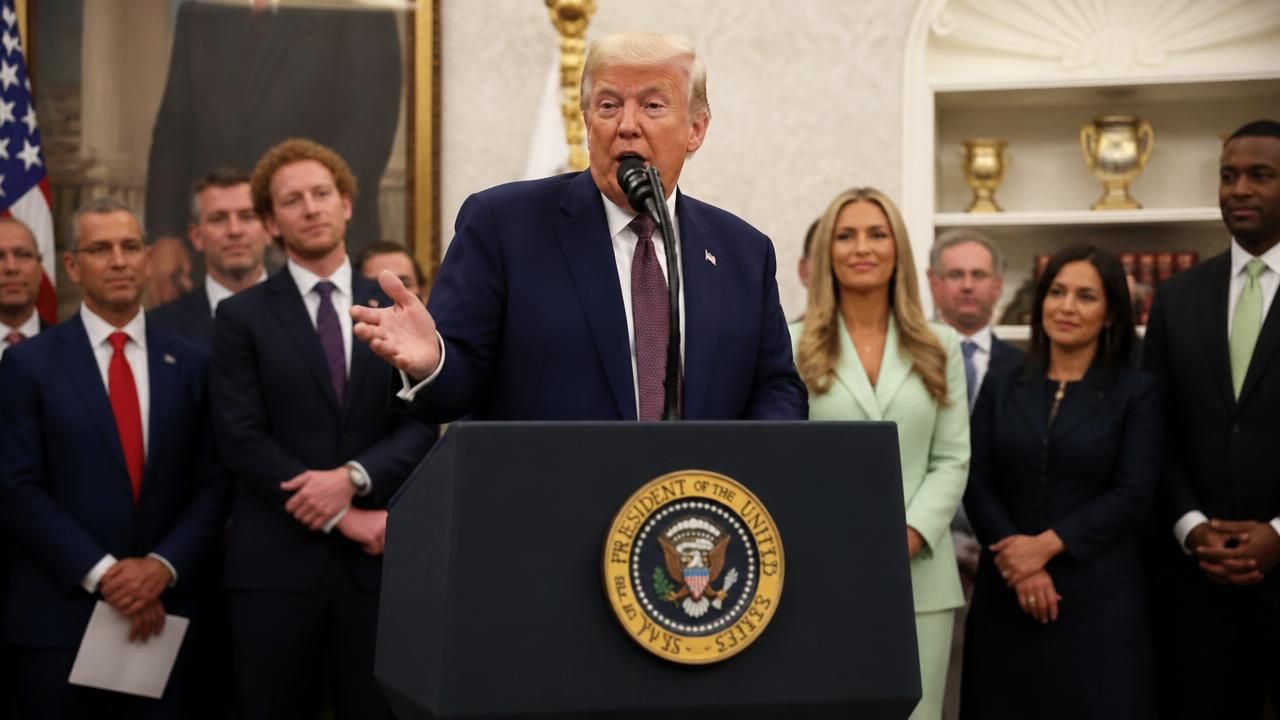
President Trump has spent the past several weeks assembling an unusual midterm coalition message: part Silicon Valley boosterism, part pulpit politics, part hard-line immigration enforcement. The result, according to reporting across more than a dozen outlets, is a White House push that is at once ambitious and uneven — drawing applause from tech investors, skepticism from parts of his own party, and legal challenges from the courts.
From Skeptic to A.I. Evangelist
At the center of the story is Trump's conversion on artificial intelligence. According to The New York Times, the president had little interest in the subject until a fateful meeting in Las Vegas roughly two years ago. Since then, he has come to describe A.I. as "the defining technology of our age," a framing that has reshaped his public appearances and, increasingly, his political pitch.
Not everyone in the Republican tent is sold. The Hill reported that Trump's A.I. advocacy "landed with a thud, even among some in GOP" circles, where concerns about job displacement, national security and unregulated development still run deep. Meanwhile, MSN characterized the president's posture as "I am the Hoax Buster," describing a personal war on A.I. doomers — a reference to the faction of researchers and policymakers who warn that rapid deployment of advanced models poses existential risks.
Trump "sees A.I. as the defining technology of our age," the Times reported, tracking a journey from indifference to full-throated evangelism.
The tension is familiar: a president who relishes framing himself as a disruptor in chief, at odds with a base that is more comfortable with the status quo on technology than with its upheaval.
Faith, Diplomacy and the Culture War
Parallel to the tech push is a sustained courtship of religious constituencies. Trump has nominated Cissie Lynch, a granddaughter of the evangelist Billy Graham, as his ambassador for international religious freedom — a pick that signals continuity with the administration's emphasis on faith-based diplomacy. In Dallas, pastor Mark Burns' Spiritual Diplomats are set to convene global faith and diplomatic leaders for what organizers describe as an exclusive peace summit.
The religious outreach has not been frictionless. Coverage of a video aired at a Trump convention drew the headline "Actual Blasphemy," with critics calling the imagery "repulsive" — a reminder that the president's cultural messaging often energizes supporters and alienates others in equal measure. Religious-liberty litigation against the administration's immigration policies has also been tracked by Religion News Service, which found a growing docket of faith-based challenges.
That friction has deep roots. More than a decade ago, televangelist Pat Robertson ignited a firestorm by comparing same-sex marriage to child molestation and pedophilia — an episode that still shapes how religious conservatives' rhetoric is received. The current cycle suggests that such flashpoints have not disappeared; they have simply migrated to new venues.
The Immigration Backlash
If A.I. and faith outreach define the administration's forward-leaning message, immigration enforcement defines its rear guard. In central Pennsylvania, a pastor pulled over for a broken headlight is now facing deportation, while another pastor remains in ICE custody and, contrary to earlier reports, was not sent to Haiti. In Springfield, ICE quietly shifted away from ankle monitors in one case, releasing a pastor. Meanwhile, as a Trump-Xi meeting approaches, the family of a detained Uyghur doctor is pressing for his release — a case that ties the administration's China policy directly to its immigration apparatus.
Maps, Money and the Midterms
The electoral mechanics are equally contested. The U.S. Supreme Court again rejected a push to use a Trump-backed congressional map in Missouri — the latest in a series of redistricting fights. In North Carolina, Trump rallied in a speech focused on crime, slamming Governor Roy Cooper and boosting Michael Whatley. Data checks on the president's claim that North Carolina is "one of the worst" on crime produced a more mixed picture than the rhetoric suggested.
Trump has also floated $5,000 checks to Americans if Republicans hold Congress after the midterms — a proposal that The New York Times framed as both a stimulus-style enticement and a potentially costly campaign promise. On the trade and investment front, Bank of Canada Governor Mark Carney pitched Canada to global investors as Trump simultaneously tried to pull investment south of the border, underscoring how the midterm agenda intersects with international economics.
What It Adds Up To
Across outlets, the framing diverges sharply. Conservative-leaning coverage emphasizes momentum: a president unifying faith leaders, courting technology and pressing an enforcement agenda. Mainstream and progressive outlets focus on friction: a Senate ally who praised Trump's signature policy and then "begged for a break," per The New Republic; a midterm convention whose ability to turn out GOP voters remains unproven; and a redistricting strategy repeatedly rebuffed in court.
- Technology: Trump positions A.I. as his legacy issue, but GOP enthusiasm is uneven.
- Religion: A Graham-family ambassador and a Dallas faith summit extend the outreach; cultural flashpoints persist.
- Immigration: Pastor detentions and a Uyghur doctor's case keep enforcement in the spotlight.
- Elections: Redistricting losses and a $5,000-check proposal define a volatile midterm landscape.
The through-line is a presidency betting that disruption — technological, cultural and legal — will mobilize its coalition rather than fracture it. Whether that bet pays off will be settled not in Las Vegas or Dallas, but at the ballot box.