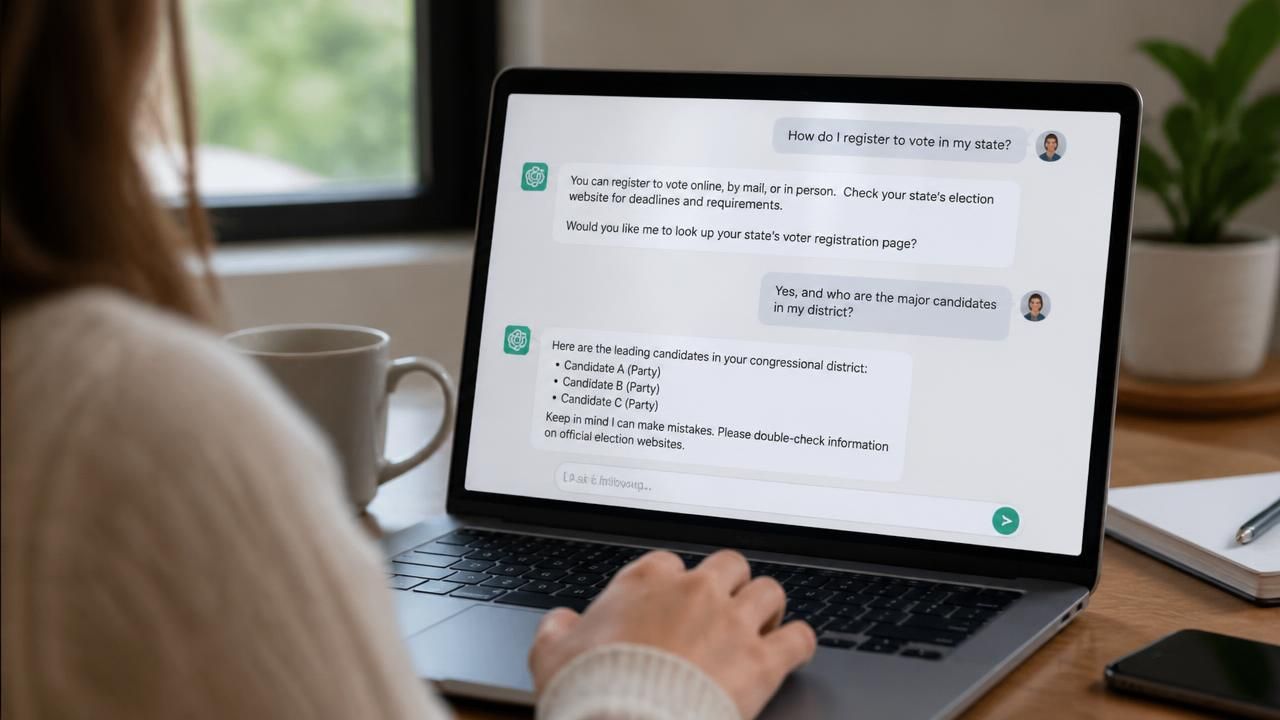
Millions of Americans are turning to artificial intelligence chatbots for help navigating elections, asking them everything from how to register to vote to which candidate best matches their views. But as the midterm campaign season intensifies, reporters, researchers and election officials are warning that the same tools can deliver wrong voting facts, recommend candidates and vary their answers from one user to the next—raising fears that AI could quietly shape political decisions.
NPR News reported that chatbots are already getting voting facts wrong and in some cases recommending candidates, a problem that could mislead voters who treat the answers as neutral guidance. The Atlantic framed the moment starkly with the headline “America Is About to See What Happens When Voters Turn to AI.” The warning is not hypothetical: The New York Times reported that voters are asking AI about elections and that the answers can vary by user, meaning two people asking identical questions may get different political guidance.
“The answers can vary by user,” The New York Times reported, underscoring how the same question can produce different political guidance depending on the model, the prompt and the person asking.
From search engine to campaign adviser
The shift is part of a broader change in how people find information. Instead of scanning search results or visiting a local election website, voters increasingly ask a chatbot to summarize the stakes. That convenience is precisely what worries consumer advocates. MSN published a blunt warning—“Why You Shouldn’t Use AI Chatbots to Decide Who to Vote For”—arguing that election decisions are too important to outsource to systems that can hallucinate facts or reflect hidden biases.
Campaigns have noticed. Reuters reported that U.S. political candidates are tailoring messages for AI models used by voters, effectively writing for the machines that summarize and answer political questions. MSN also reported that campaign texts powered by AI are shaping voter outreach. The practice blurs the line between persuasion and algorithmic optimization: campaigns can package claims in language that models are likely to retrieve, repeat or paraphrase, reaching voters through an interface that may appear objective.
At the same time, Politico reported that “pink slime” is infecting AI chatbots ahead of the midterms. The term refers to partisan, algorithmically generated or low-quality websites that masquerade as local news. When chatbots scrape or retrieve from these sources, they can recycle misleading claims with the appearance of citation. The problem is compounded by local news deserts and by AI systems that often do not clearly disclose source quality.
The optimists’ case
Not all evidence points in one direction. Phys.org reported research suggesting AI chatbots may increase accurate political knowledge. For voters who lack time or civic resources, a well-designed bot can explain procedures, compare policies and correct misconceptions. That potential is real, especially for people who find official election websites confusing or inaccessible.
But the positive findings come with caveats. An average improvement can hide wide variation. The same model may answer well one day and poorly the next; different prompts elicit different answers; personalization may create echo effects. The New York Times’ finding that answers vary by user is central to the debate. Accuracy is not a fixed feature of a chatbot. It depends on the model, its training data, the sources it retrieves, the prompt, the location and the user’s history.
Why it matters beyond this cycle
The stakes are not only whether a bot gets a fact right, but whether voters know when it is wrong. Election information is time-sensitive: deadlines, polling places and eligibility rules can change. A wrong answer can cost a ballot. Candidate recommendations raise a different concern: bots may present opinions as neutral summaries. If campaigns optimize for AI, voters may encounter messages laundered through a seemingly objective interface.
Different outlets frame the story differently. NPR and MSN emphasize consumer risk and advise voters not to outsource decisions. The Atlantic frames it as a democratic experiment. Reuters focuses on campaign strategy; Politico on the information supply chain; Phys.org on potential benefits. Together they describe a fragmented information ecosystem where AI is both a shortcut and a source of uncertainty.
What to watch
- Disclosure: AI companies should label political answers clearly and explain when an answer is generated rather than retrieved from an authoritative source.
- Source quality: chatbots should cite reliable election offices and avoid pink-slime sites that mimic local news.
- Campaign tactics: regulators and platforms need to track AI-tailored political messaging and algorithmic persuasion.
- Voter literacy: voters should cross-check chatbot answers with state election offices, local election officials and trusted news sources.
For now, the safest conclusion is also the most practical: AI can be a useful starting point, but not a final authority. Voters who ask a chatbot about an election should treat the answer like a tip from a stranger—verify it, especially before casting a ballot. The midterms will test whether Americans can use the technology without letting it use them.