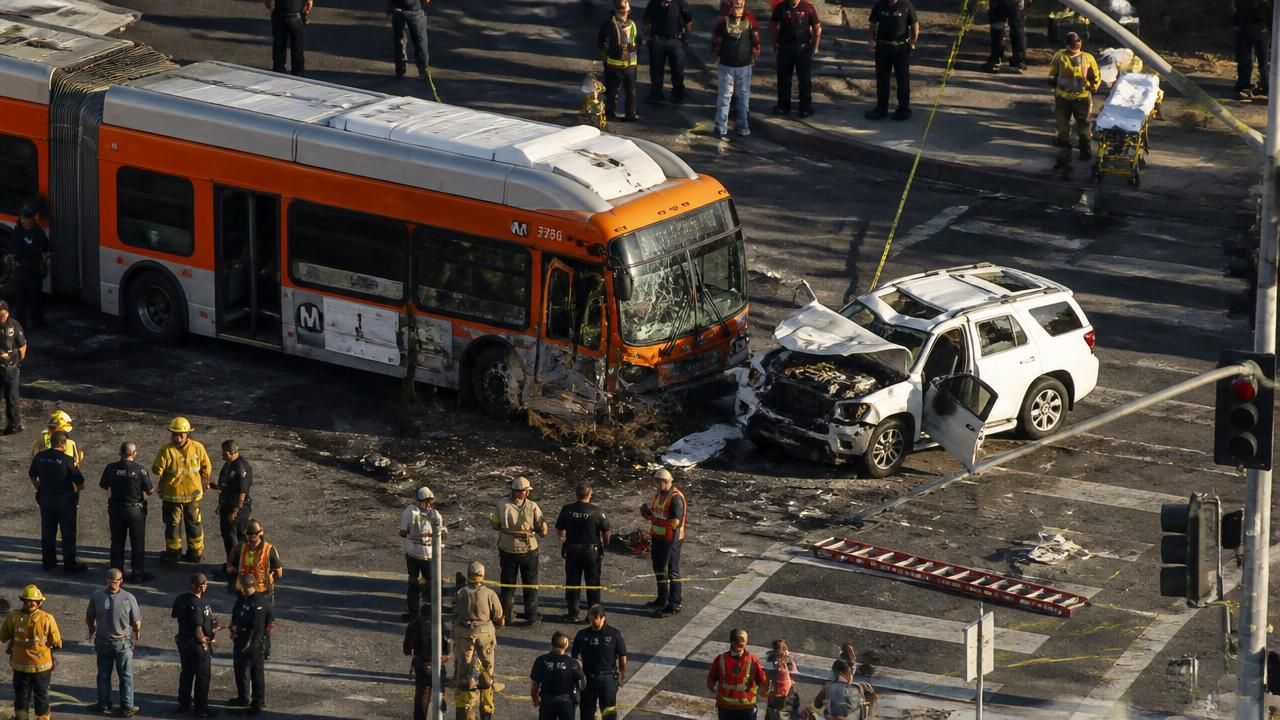
LOS ANGELES — A woman who authorities say was driving under the influence of drugs when her SUV swerved into oncoming traffic, ran a red light and slammed into a Los Angeles Metro bus in Chatsworth has been charged with second-degree murder, prosecutors announced, capping a sequence of events that left two bus riders dead and culminated in the crash of a television news helicopter sent to cover the wreckage.
The case, which began as a routine traffic investigation on a busy San Fernando Valley thoroughfare, quickly became one of the most closely followed stories in Los Angeles this year — first because of the carnage on the roadway, then because of the second catastrophe that unfolded above it. The story has since been picked up by outlets far beyond Southern California, from The New York Times to Australia’s ABC News.
A crash, then a second catastrophe
According to the Los Angeles County District Attorney’s Office and the Los Angeles Police Department, the driver was behind the wheel of an SUV when she crossed into the wrong lane in the Chatsworth area, blew through a red light and struck the Metro bus broadside. Two passengers aboard the bus were killed; the victims were later publicly identified by local officials.
Because the collision involved a city bus and blocked a major intersection, it drew the kind of rapid, aerial coverage that Los Angeles television stations have long specialized in. A news helicopter dispatched to the scene went down near the crash site, killing at least one person aboard. Local reports said a vigil held in the aftermath honored five victims — those killed on the bus and those killed in the helicopter — drawing an emotional crowd of mourners and first responders.
Murder charges and a drug-impairment finding
The LAPD initially arrested the driver on suspicion of murder, a step that signaled early on that investigators viewed the collision as something more than negligence. Prosecutors subsequently filed formal second-degree murder charges, alleging that the woman was impaired by drugs at the time of the collision and that narcotics were found inside her SUV.
Prosecutors alleged the driver “swerved into the wrong lane, blew a red light and slammed into” the bus, an account that forms the core of the murder case against her.
Second-degree murder charges in fatal traffic collisions are relatively rare and typically require prosecutors to show that a defendant acted with implied malice — awareness that the conduct was dangerous to human life. In impaired-driving cases, prior convictions, excessive speed and evidence of recklessness often become central to that argument.
The Los Angeles Police Department confirmed the arrest on suspicion of murder before the district attorney’s formal filing. Local outlets including NBC Los Angeles, which has deep roots in the Valley, led with the LAPD’s investigative steps, while wire-style aggregators and national outlets such as The New York Times and NPR moved quickly to the charging decision and the impairment allegation.
How different outlets framed the story
Coverage has diverged in emphasis, reflecting each newsroom’s proximity to the events.
- National outlets such as NPR, The New York Times and ABC News in Australia foregrounded the murder charge and the driver’s alleged drug impairment, treating the helicopter crash as a dramatic secondary element.
- Local Los Angeles stations emphasized the victims, the vigil and the identification of those killed, as well as the geography of the crash in Chatsworth.
- Aggregators and tabloid-leaning sites such as Newser leaned on the police finding that the driver was on drugs, framing the story around the shock of a crash that spawned a second disaster.
- Headline phrasing varied widely: some described a driver who “slammed into” a bus, others a “deadly collision” that a “TV news helicopter was covering when it crashed,” underscoring how much the aerial tragedy shaped the story’s identity.
That framing matters. For viewers and readers encountering the story for the first time, the sequence — bus crash, then helicopter down — made it feel like a single cascading event rather than two separate tragedies with distinct victims and distinct investigations.
The broader context
Los Angeles has one of the nation’s most helicopter-saturated news markets, a legacy of decades of live aerial coverage of police pursuits, freeway closures and disasters. The practice has long been defended as a vital public service and criticized as a magnet for spectacle. Its risks were made grimly clear in 2007, when two television news helicopters collided over Phoenix while covering a police chase, killing all four journalists aboard — a tragedy that prompted industry-wide reviews of airborne safety.
Fatal crashes involving Metro buses are comparatively uncommon, but the region’s streets remain among the deadliest in the country for pedestrians, cyclists and transit riders. Impaired driving — by alcohol or drugs — is a persistent factor: national highway safety data have long attributed roughly a third of U.S. traffic deaths to alcohol-impaired driving, and authorities say drugged driving is an increasingly significant contributor as cannabis and prescription narcotics become more prevalent.
For Metro riders, the Chatsworth collision is also a reminder of the vulnerability of passengers who have no control over the vehicle they are riding in. Transit agencies have invested in hardened bus designs, camera systems and driver training, but they cannot fully shield riders from a vehicle that crosses a centerline or runs a signal.
What comes next
The driver now faces a murder prosecution that will hinge on toxicology results, evidence recovered from the SUV and the reconstruction of the seconds before impact. The helicopter crash is being investigated separately, likely by federal aviation authorities, with questions about weather, mechanical condition and the flight path over an active emergency scene.
For the families of the dead, meanwhile, the twin disasters have merged into a single period of mourning, marked by a vigil that local coverage described as emotional and raw. That fusion — of an everyday street collision and an airborne tragedy watched in real time — is likely to keep the Chatsworth case in the public eye long after the initial headlines fade.