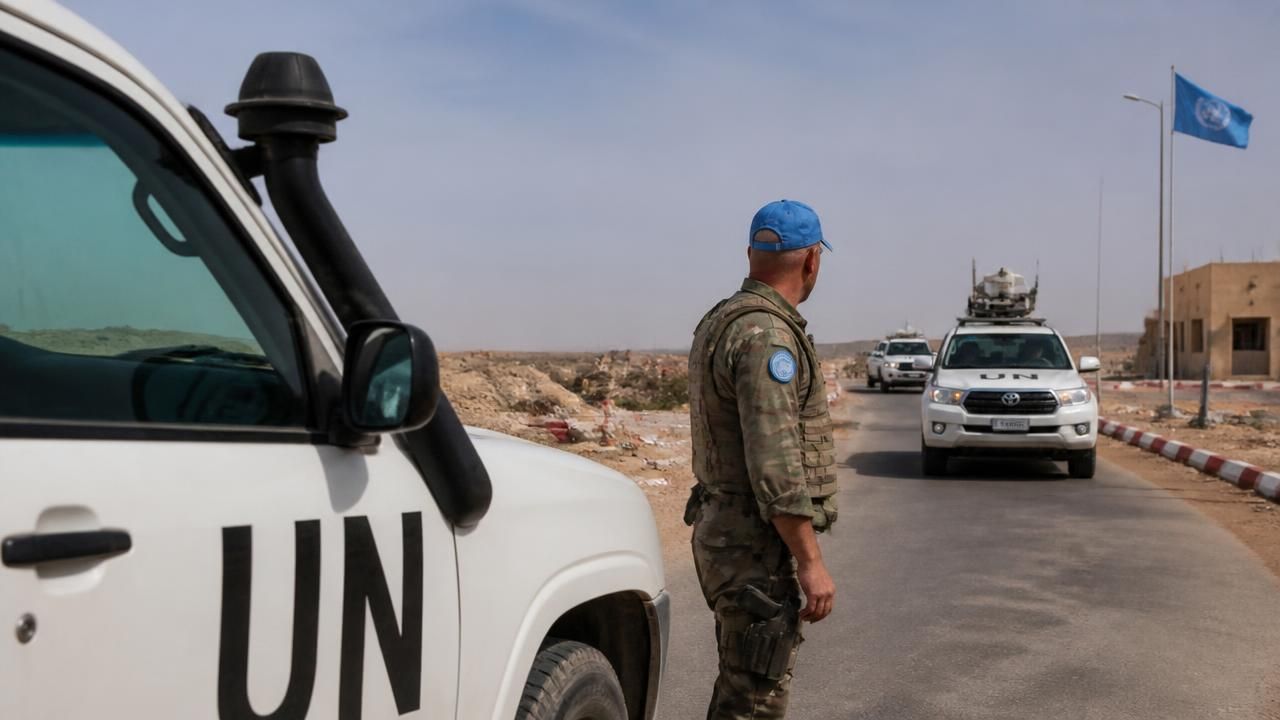
The United Nations' peacekeeping mission in Western Sahara ceased operations on Sunday, closing a 35-year chapter in one of the world's longest-running and least resolved territorial disputes. The mission, known by its French acronym MINURSO, was established in 1991 to monitor a ceasefire between Morocco and the pro-independence Polisario Front and to prepare a referendum on the territory's future — a vote that was never held.
The end of the mandate drew immediate, sharply divergent reactions. Morocco's government hailed the shutdown as vindication of its claim to the territory, which it calls its "southern provinces." The Polisario Front and its supporters framed it as an abdication by the international community. And the UN Secretary-General warned that the withdrawal raises the risk of a new escalation in a conflict that has been simultaneously frozen and combustible for more than three decades.
A dispute left over from decolonization
Western Sahara, a strip of Atlantic coastline and desert roughly the size of Britain, was ruled by Spain until 1975. When Madrid withdrew, Morocco moved in from the north and Mauritania from the south; Mauritania renounced its claim in 1979, and the Polisario Front — backed for decades by Algeria — declared the Sahrawi Arab Democratic Republic. A 16-year guerrilla war ended with a UN-brokered ceasefire in 1991, the same year MINURSO was created by Security Council Resolution 690.
The mission's core promise was a referendum offering Sahrawis a choice between independence and integration with Morocco. It never happened. Disagreements over who was eligible to vote — and Morocco's subsequent insistence that only autonomy, not independence, was on the table — deadlocked the process. MINURSO instead spent three decades as a relatively small, low-profile observer force monitoring a 2,700-kilometer berm and the buffer strip along the Moroccan-Mauritanian border.
The ceasefire itself effectively collapsed in November 2020, when Morocco moved into the Guerguerat buffer zone to clear a blockade of the road link to Mauritania. Polisario declared the truce over and resumed armed action, though large-scale fighting has not returned. MINURSO's mandate had been rolled over in increasingly short increments ever since, a sign of waning consensus in New York.
How the mandate unraveled
The decisive blow came at the Security Council, where competing draft resolutions failed. According to reporting by RFI and the Northwest Arkansas Democrat-Gazette, the United States and Russia blocked rival texts — one backed by Washington, the other by Moscow — leaving the Council unable to agree on a renewed mandate. Bloomberg characterized the standoff as an "unprecedented" break in the Council's long habit of rolling the mission over, even when it could agree on little else.
The push from Washington has been explicit. According to Morocco World News, U.S. officials — including Ambassador Mike Waltz — confirmed that the United States sought to end MINURSO's peacekeeping role, arguing the mission no longer served a purpose and that the dispute should be handled through political negotiation rather than a blue-helmet deployment. The shift builds on the December 2020 decision by the first Trump administration to recognize Moroccan sovereignty over Western Sahara, a policy the Biden administration left in place.
Russia's counter-draft was expected to reaffirm the goal of self-determination and preserve the mission's ceasefire-monitoring function. Neither text survived. The result is a rare instance of a UN peacekeeping operation being terminated not by a negotiated wind-down but by institutional deadlock.
Rabat celebrates, the Polisario warns
For Morocco, the outcome is a diplomatic victory that reinforces its long-standing position that the Sahara file is a matter of territorial integrity, not decolonization. Moroccan officials have argued that MINURSO's presence perpetuated a false symmetry between a sovereign state and a non-state movement.
For the Polisario Front and Algeria, the end of the mission removes the principal international mechanism for observing the ceasefire and reporting on human rights and military movements — a loss of transparency that Sahrawi representatives say leaves civilians in the territory and in the Tindouf refugee camps in Algeria more exposed.
Reporting from en.tempo.co and other outlets focused on the Secretary-General's warning that the mission's termination creates a heightened "risk of escalation" — a caution that the buffer zones patrolled for 35 years now have no neutral observer on the ground.
What comes next
The practical consequences are both immediate and long-term.
- Monitoring gap: With no observers deployed, violations of the 1991 ceasefire lines would be difficult to verify independently, raising the risk that isolated incidents escalate unchecked.
- Diplomatic vacuum: The Security Council remains divided, and there is no obvious successor mechanism. The Secretary-General's personal envoy process, restarted in 2021, has yet to produce talks.
- Regional stakes: Western Sahara sits atop phosphate reserves and rich Atlantic fishing grounds, and its status shapes Morocco's relations with Algeria and the broader Maghreb.
- Refugee dimension: Tens of thousands of Sahrawis live in camps near Tindouf, dependent on humanitarian aid and on a political process that has now lost its most visible international anchor.
The way outlets framed the story reveals how contested even the basic facts remain. NPR and MSN emphasized the quiet end of a 35-year mission and the decades of failed diplomacy behind it. Moroccan outlets treated the shutdown as a milestone of national vindication. RFI and Bloomberg foregrounded the great-power mechanics — vetoes, competing drafts, and a Council unable to act. The UN chief's warning, carried by Indonesian and other outlets, framed the same event as a new source of danger rather than a resolution.
What is not in dispute is that a mission built to deliver a referendum has ended without one. For Sahrawis, Moroccans, and the diplomats who spent a generation on the file, the question now is whether the absence of MINURSO accelerates a political settlement — or removes the last guardrail from a dispute that has never truly been settled.