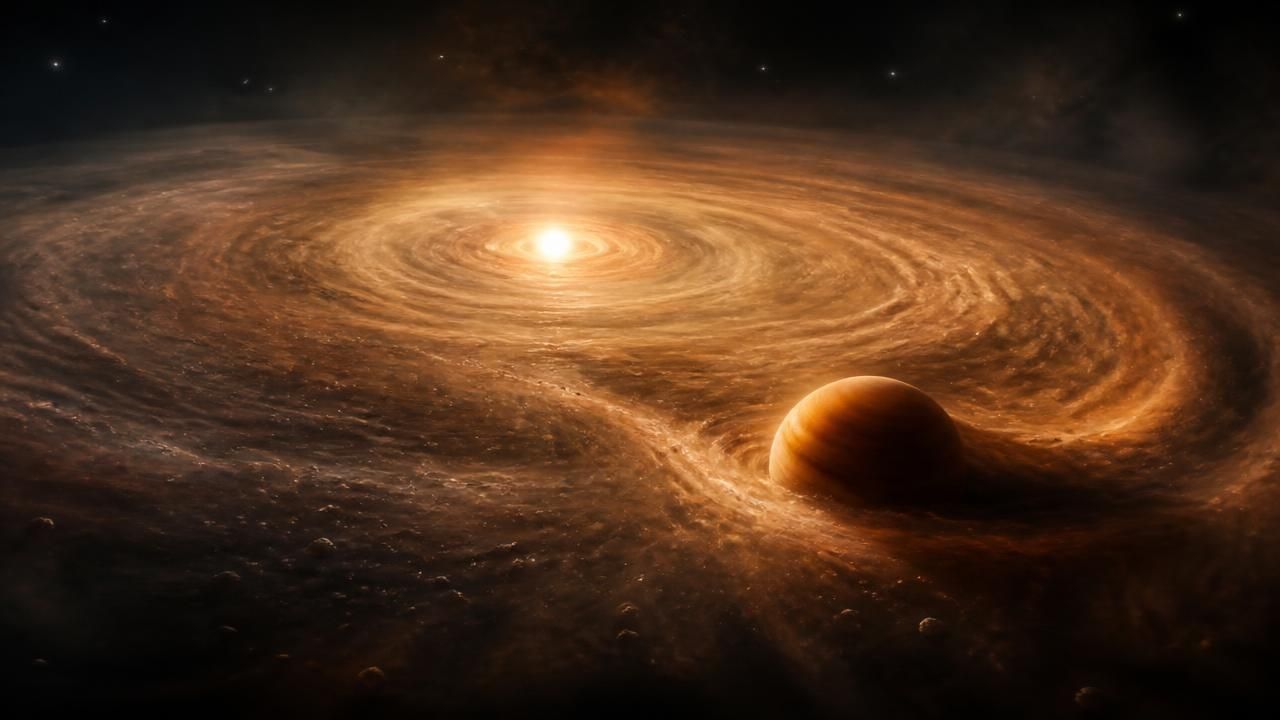
Astronomers have confirmed the youngest planet ever detected: a Jupiter-size world called Elias 2-24 b that is less than a million years old and appears to still be assembling itself from the gas and dust around its infant star. The discovery, reported across science outlets this week, gives researchers something they have almost never had — a direct look at a planet caught in the act of being born.
At roughly one million years old or younger, the planet is a toddler by cosmic standards. Earth, by comparison, is about 4.5 billion years old. Even the youngest previously confirmed exoplanets were typically several million years old, meaning astronomers usually study fully formed worlds and infer their origins after the fact.
A planet in the Ophiuchus nursery
Elias 2-24 b orbits a young star in the Ophiuchus star-forming region, a stellar nursery about 450 light-years from Earth where dozens of protoplanetary disks — the swirling platters of gas and dust that seed planets — have been catalogued. The host star's disk is famous in its own right for the dramatic spiral arms seen in radio observations, structure that hinted at a hidden, massive companion shaping the material around it.
That companion now appears to be confirmed. The planet is a gas giant on the order of Jupiter's mass, orbiting its star at a wide separation — well beyond the distance at which the solar system's own giants sit. It is precisely that combination of youth and distance that has researchers excited, and a little unsettled.
Why the find matters
The leading theory of giant-planet formation, known as core accretion, holds that a rocky core must gradually sweep up material until it is massive enough to grab a thick envelope of hydrogen and helium. That process is generally expected to take several million years — a timeline that sits awkwardly with a fully grown gas giant in a disk less than a million years old.
Its surprisingly rapid formation challenges leading theories about how giant planets come together, especially so far from their stars.
The alternative model, gravitational instability, proposes that a massive, cold disk can fragment directly into planet-size clumps in a relative blink. That mechanism works best far from the star, exactly where Elias 2-24 b sits — but it has long struggled to explain the many close-in giants found elsewhere. The new world does not settle the debate so much as sharpen it.
How the story was framed
Coverage of the announcement varied sharply in tone, reflecting how different outlets translate the same result for different audiences. Science-focused outlets led with the technical stakes: a rare observational window and a direct challenge to formation models. Aggregators and general-interest sites emphasized the record itself — the "youngest world ever seen" — and the vivid image of a planet "still taking shape."
Mashable leaned into the delight, calling it a "widdle biddy baby world" that is "breaking planet formation theories," a framing that trades precision for accessibility. Knowridge kept it plain: "Astronomers Discover the Youngest Planet Ever Seen." The convergence across all of them underlines a simple fact — a genuinely unprecedented object had been found, and the headline practically wrote itself.
What comes next
Confirmation of the planet rests on multiple lines of evidence: the gravitational signature of a massive body in the disk, the disk's disturbed kinematics, and the spiral structure that a companion would naturally induce. Follow-up observations with radio arrays and next-generation telescopes are expected to pin down the planet's mass, orbit, and the temperature and density of the material still falling onto it.
- Age: Less than one million years — the youngest confirmed planet on record.
- Type: Gas giant, roughly Jupiter-size.
- Location: A wide orbit around a young star in the Ophiuchus star-forming region, about 450 light-years away.
- Significance: Its rapid formation and distant orbit strain the standard core-accretion timeline and bolster arguments for disk fragmentation.
For planet hunters, the discovery is also a proof of concept. If a giant world can be spotted this early in a disk's life, then the youngest stages of planet formation — the phases that models describe but nobody has directly watched — are finally within reach of observation. Elias 2-24 b may be a baby, but it is already telling astronomers something important about how worlds like our own get their start.