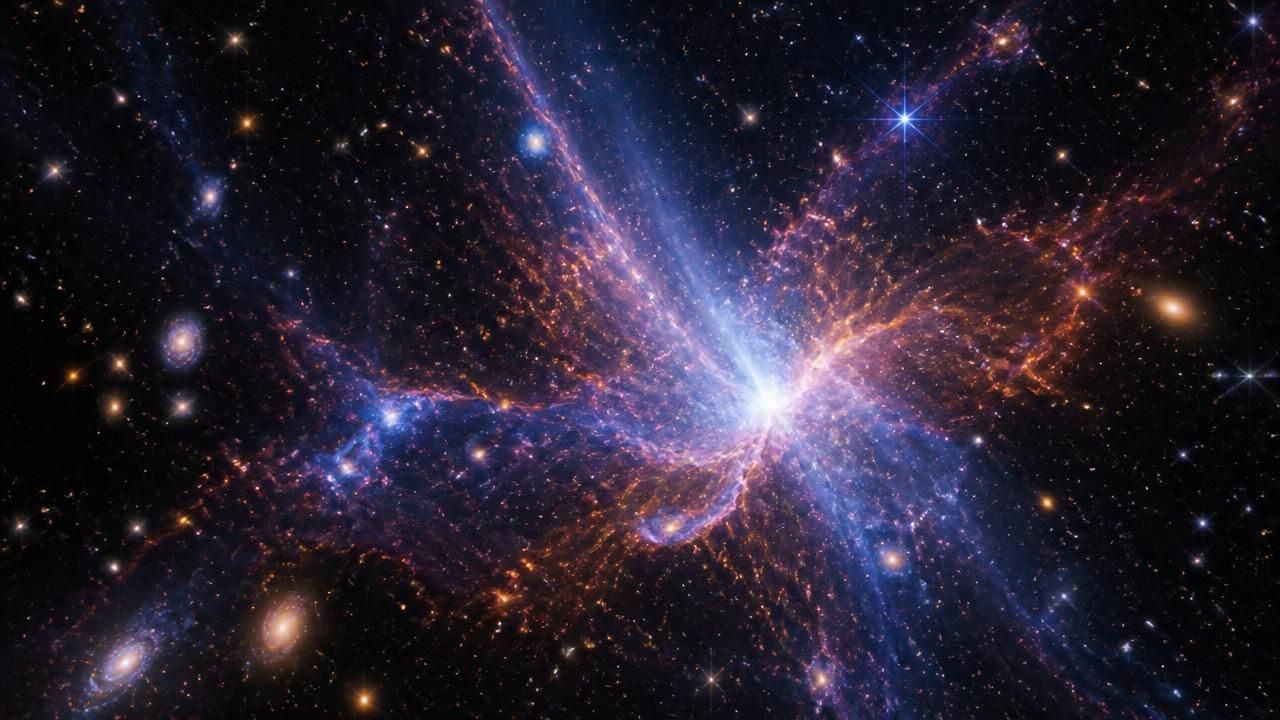
For decades, one of the universe’s most basic facts has also been one of its deepest mysteries: there is something rather than nothing. The Big Bang should have produced matter and antimatter in nearly equal amounts, setting the stage for mutual annihilation. Yet a tiny excess of matter survived, and from that residue came stars, planets, and life. Now physicists are revisiting a long-overlooked particle—often described as a forgotten neutrino—that may have tilted the early universe toward matter and left detectable gravitational-wave fingerprints behind.
The matter-antimatter mystery
The Standard Model of particle physics describes the known particles and forces with extraordinary precision, but it does not fully explain why matter won. In the first instants after the Big Bang, matter and antimatter pairs would have annihilated in vast numbers. Only about one extra matter particle for every billion pairs needed to survive to produce the cosmos we see. That imbalance, known as baryogenesis, requires new physics beyond the Standard Model—some process that treated matter and antimatter differently in the extreme heat of the early universe.
Neutrinos are a natural place to look. Once thought to be massless, they are now known to oscillate between flavors, a discovery that implies they have mass and that the Standard Model is incomplete. Theoretical models have long proposed additional, heavier neutrino-like particles that interact extremely weakly with ordinary matter. Some of these hypothetical particles could have decayed asymmetrically in the early universe, producing a surplus of matter over antimatter through a process called leptogenesis.
A forgotten particle returns
According to Science Daily, the particle in question may be a neutrino that was overlooked for decades—one that could have reshaped the early universe and possibly left gravitational-wave signals detectable today. The idea is not that this particle alone solves every cosmic puzzle, but that it could connect several unexplained features of the universe: neutrino masses, the matter-antimatter imbalance, and perhaps the nature of dark matter.
“Why is there something rather than nothing?” The question is old, but the proposed answer is a particle that physicists have largely ignored.
The “forgotten” label reflects the sociology of physics as much as the science. For years, searches for new physics focused heavily on weakly interacting massive particles, or WIMPs, as dark-matter candidates and on supersymmetric partners of known particles. When those searches came up empty, attention began to shift toward neutrinos and other weakly coupled “hidden sector” particles. The revived interest also follows progress in gravitational-wave astronomy, which can probe violent transitions in the early universe that conventional telescopes cannot see.
Three ways to test a cosmic idea
- Collider searches: The New York Times reported that scientists are overhauling a giant particle collider in search of the universe’s hidden building blocks. Upgraded detectors and higher collision rates could reveal heavy neutral leptons or other new particles that decay into known particles in distinctive ways.
- Gravitational waves: If the early universe underwent a phase transition tied to the mysterious particle, it could have generated a background of gravitational waves. Future observatories might detect those ripples, offering a window onto energies far beyond what colliders can reach.
- Antimatter tests: Smithsonian Magazine reported that scientists, for the first time, trapped an elusive antimatter particle and contained it for months. Such feats could enable precision comparisons of matter and antimatter, testing whether their behavior differs in ways that help explain the survival of matter.
The approaches are complementary. A collider can produce new particles directly, if they are light enough to be accessible. Gravitational waves can probe the cosmology of the early universe, even if the relevant particles are too heavy for Earth-based machines. Antimatter experiments can test fundamental symmetries with increasing precision. Together, they turn a speculative idea into a multi-front experimental program.
How the story is being framed
Coverage of the research reveals different emphases. Science Daily foregrounds the cosmic stakes and the possibility of gravitational-wave evidence, framing the particle as a key to why stars, planets, and life exist. Mirage News, MSN, and Yahoo versions lean into the existential hook, with headlines asking whether a forgotten particle explains why we exist. The New York Times approaches the same frontier through the machinery of discovery, emphasizing the overhaul of a giant collider and the search for hidden building blocks. Smithsonian Magazine highlights the antimatter-containment breakthrough, a laboratory achievement that could test an enduring physics theory.
Those frames are not competing stories so much as different doors into the same room. The existential question is the why; the collider, gravitational-wave, and antimatter experiments are the how. Researchers caution that no single result will settle the matter quickly. A new particle must be found, its properties measured, and its cosmological effects modeled. A gravitational-wave signal must be distinguished from astrophysical backgrounds. An antimatter anomaly must survive scrutiny.
What would count as proof
Physicists would look for a consistent pattern. If a heavy neutrino-like particle exists, collider experiments might detect its decays into electrons, muons, or neutrinos. Cosmological data might reveal its imprint on the expansion of the universe or on the abundance of light elements. Gravitational-wave observatories might find a stochastic background matching predictions. Antimatter experiments might uncover a tiny violation of charge-parity symmetry or of the equivalence principle. Any one clue would be intriguing; several converging lines would be transformative.
The implications would extend far beyond particle physics. Understanding why matter survived would help explain the existence of galaxies, stars, and planets—and therefore the conditions for life. It would also sharpen the case for new physics beyond the Standard Model, a theory that has passed every experimental test but cannot explain the universe’s matter excess, dark matter, or neutrino masses on its own.
For now, the forgotten particle remains a hypothesis, not a discovery. But the renewed attention reflects a broader shift in physics: away from a single favored candidate and toward a wider search for hidden particles and cosmic signatures. The universe’s existence may ultimately be explained not by one dramatic revelation but by the slow convergence of collider data, gravitational-wave astronomy, and tabletop antimatter experiments—each probing a different face of the same profound asymmetry.