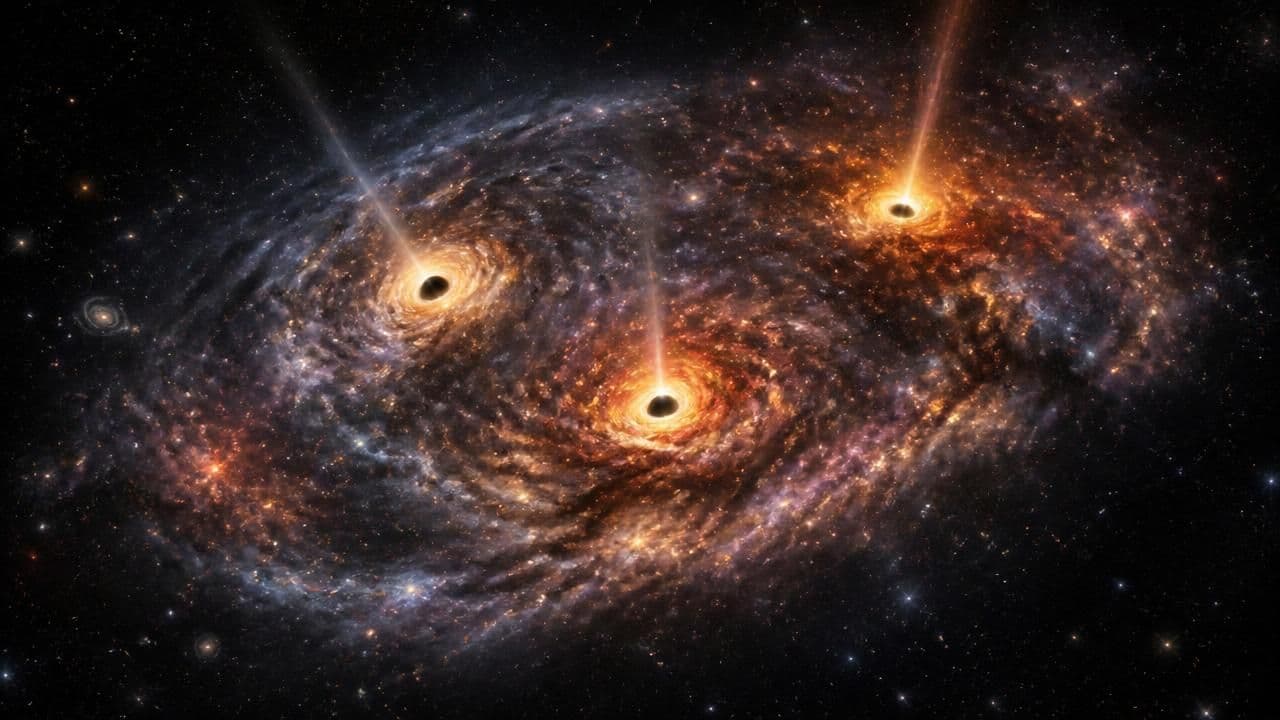
Astronomers using NASA's James Webb Space Telescope have detected water and oxygen-rich silicate dust clinging to a dying star that sits perilously close to Sagittarius A*, the supermassive black hole at the center of the Milky Way. The finding, drawn from mid-infrared observations of a star known as IRS 3, challenges the long-held assumption that the extreme environment surrounding a galactic core is simply too violent for complex chemistry to survive.
The image, dated Aug. 11, 2026 and released by NASA, the European Space Agency and the Canadian Space Agency, shows a brilliant concentration of stars in the galactic center with IRS 3 — a star near the end of its life cycle — occupying center stage. Webb's mid-infrared instruments resolved the clear spectral signature of oxygen-rich silicate dust in the star's surrounding envelope, and, for the first time, the fingerprint of water.
Image credit for the observation goes to ESA/Webb, NASA & CSA, and the research team of F. Peißker, J. Lu, F. Yusef-Zadeh, N. B. Sabha and C. Chan.
What Webb Actually Saw
IRS 3 is not an ordinary star. It belongs to the dense stellar population that swarms the galactic center roughly 26,000 light-years from Earth, where stars orbit Sagittarius A* at extraordinary speeds and where gravitational tides, intense ultraviolet radiation, X-rays and cosmic rays bathe everything in the neighborhood.
Dying stars of IRS 3's class shed their outer layers into a circumstellar envelope — a cocoon of gas and dust that normally goes on to seed the next generation of stars and planets. The surprise is not that IRS 3 has such an envelope. It is that the envelope still contains water.
Water molecules are fragile. In the harsh radiation fields typical of galactic nuclei, they are readily broken apart. Detecting them intact — in the mid-infrared, where Webb excels — implies either that the envelope is unusually well shielded, that the water is being replenished, or that the region is less hostile than models predict.
A Galactic Core That Does Chemistry
The result reframes a question that has dogged astrophysics for decades: does the presence of a supermassive black hole sterilize its immediate surroundings, or can chemistry — even prebiotic chemistry — persist at its doorstep?
JWST found water at Sagittarius A*'s doorstep — galactic cores do chemistry after all.
That framing, advanced by observers poring over the new data, captures the significance of the detection. If a dying star can hold onto water mere light-years from a black hole of more than four million solar masses, then the chemical inventory available to the galactic center's star-forming regions may be far richer than previously assumed.
As one line of coverage put it, our galaxy's supermassive black hole does not devour everything. Matter, molecules and even water can persist in its vicinity, at least temporarily and at least in shielded pockets.
The Star Factory at the Heart of the Galaxy
IRS 3 sits within one of the most productive — and most mysterious — star-forming environments in the Milky Way. The galactic center hosts dense clusters of young, massive stars whose formation is difficult to explain given the tidal shear that should tear gas clouds apart before they can collapse.
Astronomers have proposed several workarounds: gas may collapse in dense, compact disks; it may be funneled along magnetic filaments; or it may be compressed by shock waves from stellar winds and supernovae. The new Webb data adds a chemical dimension to that puzzle, suggesting the raw material for star formation near Sagittarius A* includes water ice and silicate grains that survived the journey.
Understanding this star factory matters beyond the galactic center. The conditions there — high density, high radiation, strong gravity — resemble those in the nuclei of distant galaxies, where similar physics may govern how efficiently galaxies build stars and how they enrich themselves with the elements needed for life.
How Different Outlets Framed the Story
- Institutional releases from NASA, ESA and CSA emphasized the technical achievement: Webb's mid-infrared sensitivity made the silicate and water signatures detectable at all.
- Science and general-interest outlets led with the drama — water surviving "right beside the Milky Way's monster black hole" and dust "clinging" to a star in one of the galaxy's most hostile neighborhoods.
- Analysis-driven coverage pushed further, arguing the result shows galactic cores are chemically active, not sterile, and that the black hole's reputation as an all-consuming vacuum is misleading.
- Feature coverage zoomed out, treating the galactic center as a star factory whose mysteries — and importance — extend well past this single detection.
Why It Matters
The discovery sits at the intersection of three research fronts. First, it tests models of how molecules survive in high-energy environments, with implications for the chemistry of the early universe and of distant galactic nuclei. Second, it informs the debate over how stars form in the galactic center at all. Third, it sharpens the question of where the ingredients for life can exist — not just in quiet, sun-like neighborhoods, but in the most extreme places a galaxy has to offer.
Water in a dying star's envelope is not evidence of life. But it is evidence that the chemistry that ultimately leads to water — and to the molecules life is built from — can proceed in places astronomers once wrote off as purely destructive.
Open Questions
Several puzzles remain. How long can water persist in IRS 3's envelope before the galactic center's radiation destroys it? Is the water native to the star, or was it delivered by a companion, a disk, or a passing cloud? And how common is this kind of survival across the hundreds of stars packed into the central parsec?
Follow-up spectroscopy with Webb and, eventually, ground-based extremely large telescopes should help answer those questions by mapping the envelope's chemistry in finer detail and comparing IRS 3 with its neighbors. For now, the message from the galactic center is unexpectedly simple: even next to a monster black hole, chemistry finds a way.