For most of the past two million years, the planet has swung between vast sheets of ice and the warmer intervals between them. According to a new study published in Science, the most recent swing was already underway—quietly, gradually, and entirely without human help—when industrial civilization inadvertently put a stop to it.
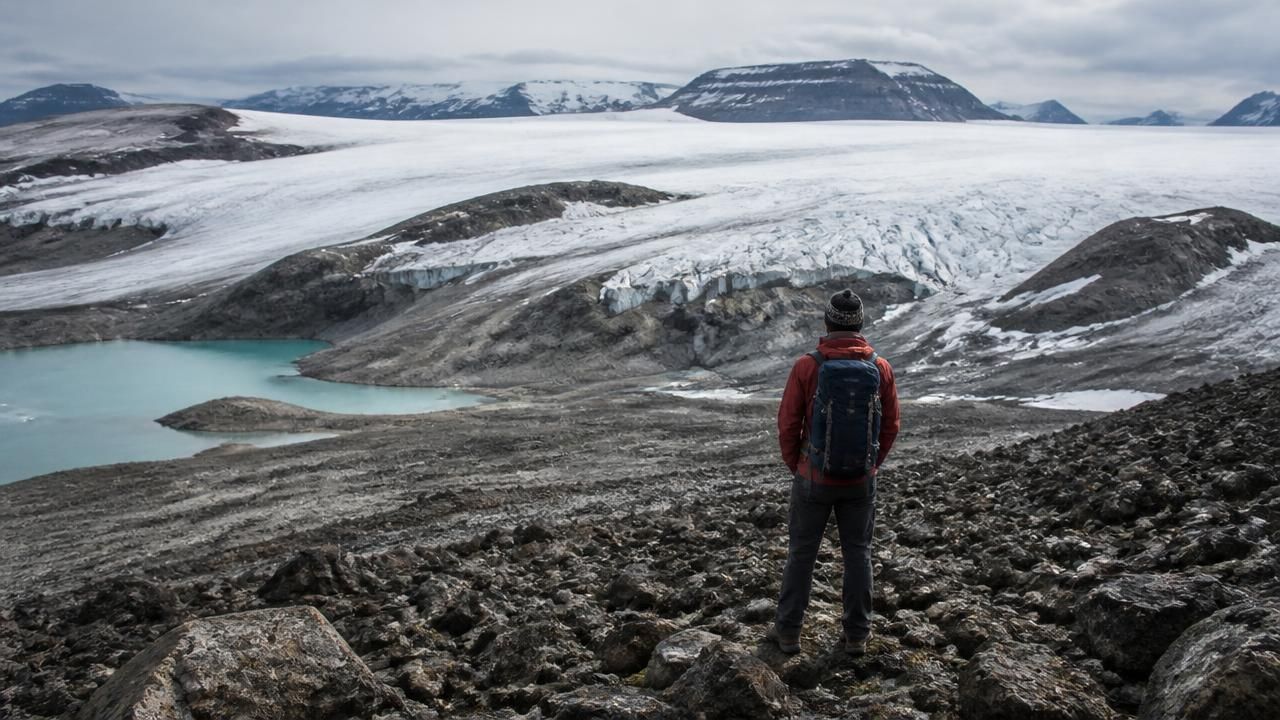
The research centers on the Barnes Ice Cap, a modest dome of ice sitting on the central plateau of Baffin Island in the Canadian Arctic. Barnes is unremarkable to look at. It is, however, the last surviving fragment of the Laurentide Ice Sheet, the largest of the Pleistocene ice sheets, which at its peak buried most of Canada beneath two miles of ice and locked away enough water to lower global sea levels by roughly 80 meters.
That remnant, it turns out, has been keeping a diary.
A Fragment That Remembers
As the Laurentide thinned and collapsed through the Holocene, its margin withdrew westward and northward until it shrank onto Baffin Island. What remains today is, in the words of the study's lead author, the deflated core of something that was once two miles thick.
“Barnes is the last remaining piece of one of the domes of the Laurentide Ice Sheet,” said Nicolás Young, a geologist at Columbia University's Lamont-Doherty Earth Observatory and the study's lead author.
Barnes can testify about its own history for a deceptively simple reason: its base is frozen to the bedrock beneath it. Because the ice is frozen to the bed rather than sliding over it, the glacier does not erode away the landforms and deposits it leaves behind. Its margins, in effect, are pinned in place and preserved—a rare archive of advance and retreat that most glaciers destroy as they move.
The Turn Toward Glaciation
Using that archive, Young and his colleagues reconstructed the ice cap's dimensions over thousands of years. Their conclusion: the Laurentide remnant reached its smallest extent roughly 3,600 years ago. Then, about 2,000 years ago, the ice stopped shrinking and began to grow again.
The team interprets that reversal as the opening move of the next glaciation—the first tentative expansion of an ice age that, under natural conditions, would have continued for millennia. In the language of paleoclimatology, it looks like the early stirrings of what scientists call a neoglacial transition, driven by slow, predictable wobbles in Earth's orbit known as Milankovitch cycles, which gradually reduced the amount of summer sunlight reaching the high northern latitudes.
The 1960 Pivot
Then the record bends sharply. The re-expansion appears to have continued until about 1960, when human-caused climate warming reversed it. What the orbital cycles began thousands of years ago, a few decades of fossil fuel combustion has undone.
That framing explains why the story traveled so widely, and why different outlets emphasized different halves of it. WIRED put the causal agent in its headline—“A New Ice Age Was Beginning. Then Humans Started Burning Fossil Fuels”—casting the finding as a story about anthropogenic interference in a planetary cycle. MSN's framing, by contrast, was more neutral and process-oriented: global warming may have halted an emerging ice age. Martin Cid Magazine leaned into the counterintuitive hook, declaring that the next ice age began 2,000 years ago and that global warming stopped it. Ars Technica, meanwhile, focused on the mechanics—how a frozen bed allowed a dying glacier to preserve direct physical evidence of its own reversal, and what that says about ice-sheet behavior more broadly.
The differences are stylistic, not factual. All four accounts describe the same sequence: shrinkage, a natural turn toward growth, and then a human-caused interruption.
What It Does—and Does Not—Mean
The finding should not be read as a prediction that a glaciation is imminent, or that one has been narrowly averted. Under natural conditions, the onset of a full ice age would unfold over many thousands of years; the orbital forcing that nudged Barnes back into growth is slow and weak. What the study demonstrates is something subtler, and in some ways more striking: that human influence has grown large enough to redirect a trajectory that operates on timescales of tens of thousands of years.
- The timescale: Glacial cycles are paced by orbital cycles spanning roughly 20,000 to 100,000 years; anthropogenic warming has unfolded over roughly 150 years.
- The archive: Barnes is the last remaining fragment of the Laurentide Ice Sheet, which once covered most of Canada.
- The pivot point: Ice-cap growth appears to have continued until about 1960, when warming reversed it.
- The caveat: The reversal marks a shift in trajectory, not the cancellation of a near-term ice age.
The study also adds a data point to a broader scientific debate about the so-called Anthropocene—the proposed geological epoch defined by human impact. Few candidates for a golden spike are as literal as this one: a small, frozen remnant in the Canadian Arctic whose margins record the moment humanity overrode the planet's natural glacial rhythm.
For now, Barnes continues to shrink. The last piece of the ice sheet that once buried Canada is retreating, and the ice age it had quietly begun will not be resuming on any schedule its own orbital mechanics intended.