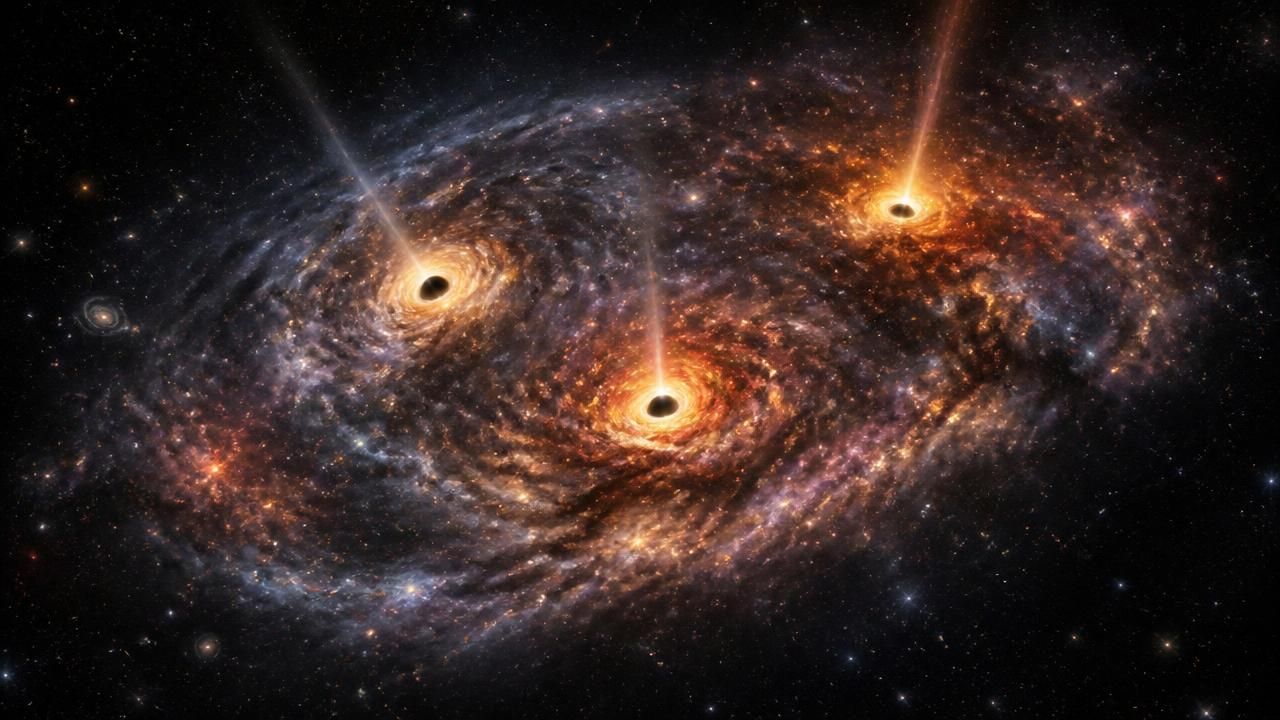
Astronomers have discovered three actively feeding supermassive black holes inside a single galaxy more than 12.5 billion light-years away, a rare snapshot from the universe's infancy that could reshape how scientists explain the growth of the first giant black holes. Coverage from Science Daily, MSN, Notebookcheck and Phys.org converges on a striking core fact: a single distant galaxy appears to host a trio of supermassive black holes, the first such system reported at this early cosmic epoch.
Because the galaxy's light has traveled for more than 12.5 billion years, astronomers are seeing it as it existed when the universe was less than a billion years old. At that time, galaxies and their central black holes were assembling rapidly, and the discovery offers a direct look at the crowded, violent conditions that may have shaped the first supermassive black holes.
A crowded galactic core
Two of the black holes are separated by just 620 light-years and are expected to eventually merge. A third lies farther away in the same galaxy. One of the black holes weighs an astonishing 80 million suns, while another is growing faster than conventional theories predict, according to Science Daily. All three are actively feeding, meaning they are pulling in matter and radiating energy as active galactic nuclei.
The 620-light-year separation is remarkably small on galactic scales. By comparison, the Milky Way's disk spans roughly 100,000 light-years. Such close pairing is a natural outcome of galaxy mergers: when galaxies collide, their central black holes can sink toward the new galaxy's center, form binaries, and eventually coalesce. A third black hole in the same system would make the environment even more dynamic, with complex gravitational interactions capable of driving matter toward the black holes and accelerating their growth.
Why the discovery matters
Supermassive black holes sit at the centers of most massive galaxies, including the Milky Way. Yet how the first giants grew so large so early remains one of astrophysics' central puzzles. Conventional models allow black holes to grow by accreting gas and by merging with one another, but the process is thought to be slow and inefficient. Finding three actively feeding black holes in one young galaxy suggests that mergers and clustered black-hole growth may have been more common, or more efficient, than previously assumed.
The unusually rapid growth of one black hole is particularly provocative. If it is accreting faster than standard theory predicts, it could point to poorly understood feeding mechanisms, mergers, or conditions in early galaxies that allowed black holes to pack on mass quickly. The MSN headline describes the find as solving a cosmic mystery, but the result is best understood as an important clue rather than a complete answer: it supports the idea that hierarchical merging and dense black-hole environments played a major role in early black-hole growth.
The finding turns a single distant galaxy into a natural laboratory for studying how black holes merged and grew when the universe was young.
Different headlines, same signal
The sources frame the story somewhat differently. Science Daily emphasizes the cosmic-dawn setting and the surprising growth rate. MSN highlights the mystery-solving angle and describes the host as a young galaxy. Notebookcheck and Phys.org stress the first-time discovery of three supermassive black holes in a single galaxy. The Phys.org page itself returned a server error in the provided material, but its headline and the other reports align on the central claim: this is a rare multiple-black-hole system in the early universe.
That consistency matters because the result's significance depends on follow-up confirmation and detailed measurements. Astronomers will need to determine whether all three black holes are physically associated with the same galaxy, how massive each one is, and whether the two close neighbors are truly gravitationally bound. The third black hole's greater distance raises questions about its orbit and whether it is part of the same bound system or merely in the same general region.
What remains unknown
- Whether the two close black holes will merge within a cosmologically short time, and when that merger might occur.
- How the 80-million-solar-mass black hole and its rapidly growing companion formed so early in cosmic history.
- Whether triple supermassive black-hole systems were common in the early universe or are simply rare and hard to detect.
- How much of the black holes' growth comes from gas accretion versus mergers.
Future observations with space telescopes and ground-based instruments could help measure the black holes' masses, accretion rates and separations more precisely. X-ray and radio observations can reveal active feeding, while deep infrared observations can study the host galaxy's stars and gas. Gravitational-wave observatories may one day detect the eventual merger, although the timescale could be far longer than a human lifetime.
For now, the discovery stands as a remarkable preview of the early universe's crowded centers. If galaxies frequently merged and delivered multiple black holes into the same core, then the first supermassive black holes may have grown through a messier, more collective process than many models assume. The trio does not close the case on early black-hole growth, but it sharpens the question and gives astronomers a concrete target for the next generation of observations.