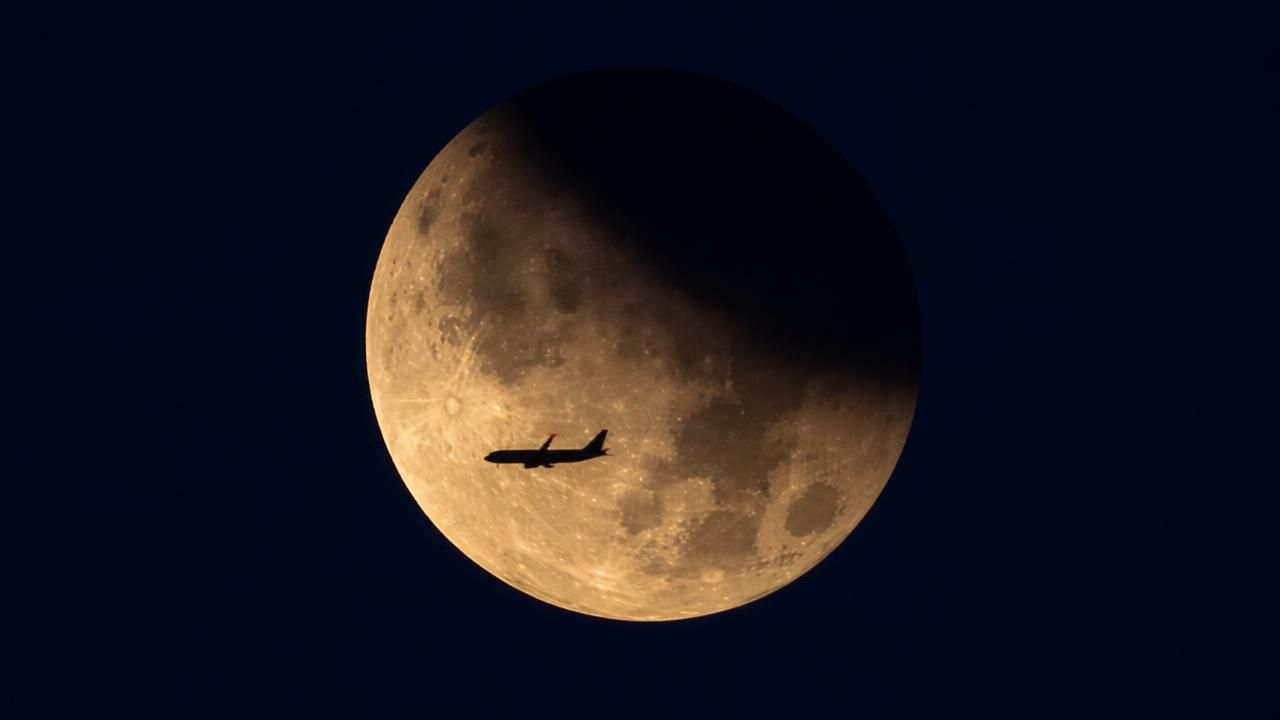
The Astronomy Picture of the Day (APOD) for September 1, 2026, features a striking image titled "A Plane Lunar Eclipse," captured from Portugal by photographer Paulo Ferreira. The photograph, taken during the lunar eclipse that occurred in late August 2026, shows an airplane silhouetted against the partially eclipsed Moon, creating a unique juxtaposition of human technology and celestial mechanics. The image has sparked widespread interest, not only for its aesthetic appeal but also for the broader discussion it raises about the accessibility and beauty of lunar eclipses.
The Image and Its Significance
The APOD explanation, written by a professional astronomer, emphasizes that lunar eclipses are among the most commonly witnessed astronomical events. Unlike solar eclipses, which require special eye protection and are visible only from a narrow path, lunar eclipses can be seen from anywhere on the night side of Earth. The featured image, taken last week from Portugal, captures a dramatic moment: an airplane crossing the Moon during the eclipse. The explanation humorously notes that if you were on the left side of that airplane during takeoff, you might initially have trouble seeing the eclipse, but since lunar eclipses typically last for hours, you could safely cross the aisle to see it after the flight leveled off.
"Lunar eclipses are routinely seen from the half of the Earth facing the Moon when the eclipse occurs, making them some of the most commonly witnessed astronomical events. You don't even need any special equipment to see one — just your unaided eyes."
This quote from the APOD highlights the central message: that the universe is accessible to all, and that one does not need a telescope or expensive gear to appreciate these events. The fact that a commercial airplane was captured in the same frame serves as a reminder that astronomical phenomena often overlap with everyday life.
The Science of Lunar Eclipses
A lunar eclipse occurs when the Sun, Earth, and Moon are precisely aligned, with Earth passing between the Sun and the Moon. Earth's shadow falls on the Moon, causing it to darken and often take on a reddish hue due to Rayleigh scattering — the same effect that makes sunsets red. The August 2026 eclipse was a total lunar eclipse, meaning the Moon passed entirely through Earth's umbral shadow. Such events are safe to view with the naked eye, and cameras can capture them with standard settings, making them a favorite subject for both amateur and professional photographers.
The image from Portugal is part of a gallery of lunar eclipse photos, and the APOD website reminds readers that the main NASA site is moving from apod.nasa.gov to science.nasa.gov/apod. This transition reflects NASA's ongoing effort to consolidate its science communication platforms.
Why This Image Stands Out
While many lunar eclipse photos show the Moon alone, Ferreira's image includes the airplane, adding a dynamic element that tells a story about human activity continuing beneath the cosmic show. The composition captures the eclipse at a specific moment, with the airplane's silhouette clearly defined against the glowing lunar disk. This is not just a picture of an astronomical event; it is a snapshot of a moment in time, blending the terrestrial and the celestial.
Broader 2026 Eclipse Calendar
While APOD focused on the August eclipse, other outlets, such as MSN, have published broader guides to the 2026 eclipse season. According to MSN's "2026 lunar and solar eclipses: Dates and influences," 2026 features a rich array of celestial events. The August lunar eclipse was one of two lunar eclipses in 2026, with another expected later in the year. Solar eclipses are also on the calendar, including a total solar eclipse visible from parts of the Northern Hemisphere. These guides often blend astronomical data with astrological interpretations, a perspective that NASA and scientific institutions generally avoid. This contrast in framing highlights how the same event can be discussed in vastly different contexts: one purely scientific, another with cultural and zodiacal significance.
How Different Outlets Frame the Story
NASA's APOD presents the eclipse as a natural phenomenon to be observed and photographed, with a lighthearted tone about the airplane's passengers. MSN, by contrast, approaches the event as part of a yearly calendar of eclipses, discussing "influences" that may appeal to readers interested in astrology. This divergence is typical of science communication vs. lifestyle journalism. For science enthusiasts, the APOD image is a reminder of the wonders of the universe; for those following astrological trends, the eclipse may hold personal or collective meaning. Neither perspective is inherently right or wrong, but they serve different audiences.
Implications and Public Engagement
The viral appeal of images like this one underscores the importance of public engagement with astronomy. As space agencies and observatories increasingly rely on citizen contributions and shareable content, the boundary between professional and amateur astronomy continues to blur. Lunar eclipses are particularly democratic: anyone on the night side of Earth can view them, and with modern smartphones, capturing a decent photograph is easier than ever. The APOD program, which has been running since 1995, is a prime example of how NASA uses stunning imagery to educate and inspire.
- Who: Photographer Paulo Ferreira captured the image from Portugal.
- What: A total lunar eclipse with an airplane crossing the Moon.
- When: Late August 2026; featured on APOD September 1, 2026.
- Where: Portugal, Europe.
- Why: To showcase the beauty of lunar eclipses and their accessibility.
- How: A standard camera capture during the eclipse, with the airplane passing at the right moment.
As 2026 continues, astronomers and skywatchers alike will be looking forward to the next eclipses. Whether one views them through a scientific lens or through the lens of astrology, events like the August lunar eclipse remind us of our place in the cosmos. And thanks to images like Ferreira's, we are offered a moment to pause, look up, and appreciate the universe's grandeur — even from an airplane window.