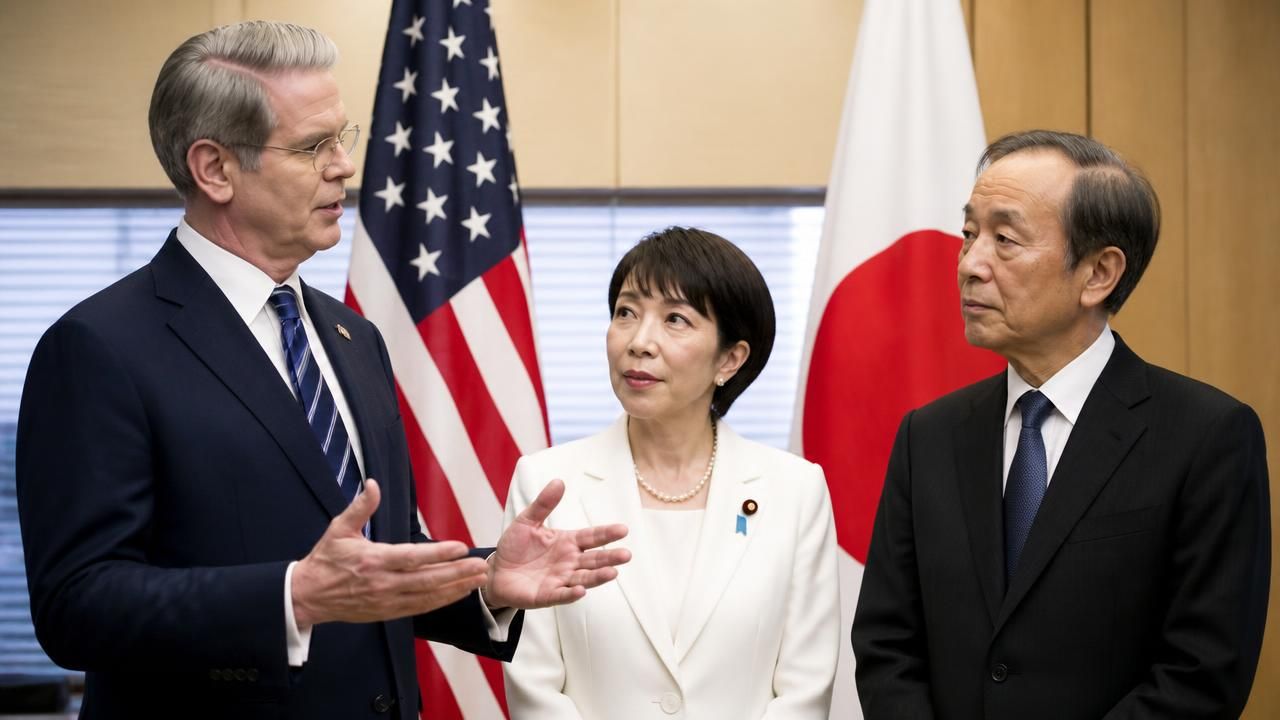
US Treasury Secretary Scott Bessent used a high-stakes meeting with Japanese financial leaders to deliver a clear message: Japan's next move should be higher interest rates. Speaking with Finance Minister Satsuki Katayama and Bank of Japan (BOJ) Governor Kazuo Ueda, Bessent also praised joint efforts to shore up the yen, striking a chord of coordination between the world's largest and third-largest economies.
According to Japanese broadcaster NHK, Bessent told Japanese officials that raising rates is the logical next step for the country, which has long struggled with ultra-low interest rates and a weakened currency. The comments come as the US and Japan finalize a new trade arrangement that sets a "reciprocal" tariff rate at 15%, a deal that adds another layer of complexity to already delicate negotiations.
"I am sure BOJ Governor Ueda will do what is best," Bessent said, according to Reuters, signaling trust in the central bank's autonomy while still offering a clear policy nudge.
Bessent's remarks were notable for their directness. US Treasury secretaries have historically avoided overt commentary on another nation's monetary policy, but Bessent broke with convention to express support for a BOJ rate hike. That stance, analysts say, is aimed at strengthening the yen and reducing global trade imbalances.
A Symbolic Joint Action
Bessent hailed the recent coordinated intervention in currency markets as "symbolic," underscoring the unprecedented cooperation between Washington and Tokyo. CNBC reported that the US backed Japan's yen intervention specifically to help stabilize Asian financial markets, which have been rattled by the yen's slide to multi-decade lows.
During a press appearance, Bessent described yen movements as "pretty contained" and not disorderly, pushing back against fears that the currency's fluctuations were chaotic. His assessment, carried by multiple outlets including MSN, suggests the US sees no immediate need for further drastic action, while still acknowledging the importance of the joint effort.
The Tariff Dimension
Interwoven with the currency discussion is the new tariff agreement. The Japan Times reported that Japan and the US have reached a deal pegging reciprocal tariffs at 15%, a compromise that avoids an escalating trade war but still leaves Japan with significant export costs. The timing of Bessent's visit—and his emphasis on rate hikes—is widely seen as an attempt to use monetary policy as a lever to enhance the competitiveness of Japanese exports under the new tariff regime.
A weaker yen makes Japanese goods cheaper abroad, offsetting tariff costs, but it also inflates the cost of imports and raises concerns about capital outflows. Bessent's message suggests the US prefers Japan to rely on higher interest rates, which could support the yen and ease trade tensions, rather than repeated intervention.
Market Implications and the September Rate Hike Case
Financial markets are now pricing in a higher probability of a BOJ rate hike at its September meeting. According to Yahoo Finance, Bessent's nudge has "firmed the case" for such a move, with economists pointing to a convergence of domestic inflation pressures and external diplomatic expectations.
- Japan's core inflation has remained above the BOJ's 2% target for over two years, giving the central bank cover to normalize policy.
- The yen's depreciation has driven up import prices, squeezing households and businesses, and raising the political cost of inaction.
- Bessent's public endorsement of rate hikes removes a potential diplomatic barrier, as Tokyo may have previously feared US backlash to tighter policy.
However, the BOJ faces a tricky balancing act. While rate increases could strengthen the yen, they also risk derailing Japan's fragile economic recovery and increasing the burden of the nation's massive public debt, which exceeds 200% of GDP.
Framing the Story: How Press Covered It
The same set of facts was filtered through distinct lenses across global media:
Bloomberg Markets led with the blunt message about rate hikes, framing it as Bessent "telling" Japan officials what they need to do. Reuters focused on his confidence in Ueda, quoting his remark that the BOJ chief would "do what is best," suggesting a softer, trust-based approach. NHK emphasized the "symbolic" joint intervention, highlighting the synchronized nature of the action. CNBC, in turn, stressed the US motive of stabilizing Asia, placing the intervention within a broader regional security context. The Japan Times tied the currency talks to the tariff deal, showing the linkage between trade and finance.
Historical Context and Expert Views
US Treasury secretaries intervening in Japan's monetary policy is not without precedent. In the 1980s, the Plaza Accord saw the US push Japan to appreciate the yen to reduce trade surpluses. However, the current situation is reversed: the yen has been too weak, and the US is urging Japan to tighten policy rather than loosen it.
"This is an extraordinary moment," said Yasunari Suwa, a former BOJ official now at a Tokyo-based think tank. "The US is essentially giving Japan a green light to exit negative interest rates, which would have been unthinkable just a few years ago."
Others caution that Bessent's remarks, while significant, may not have an immediate impact on BOJ decision-making.
"The BOJ values its independence," said Toshihiro Nagahama, chief economist at a Japanese research institute. "Ueda will listen, but he will ultimately decide based on domestic data. Still, having the US Treasury secretary publicly supportive of normalization certainly strengthens the case for a move."
What Happens Next
The coming weeks will be critical. The BOJ's policy board is scheduled to meet in September, and traders are closely watching for signs of a shift. Meanwhile, the 15% tariff deal is set to reshape US-Japan trade flows, with implications for supply chains and consumer prices.
Bessent's visit has demonstrated that the US-Japan relationship is evolving from a purely trade-focused dynamic to one that embraces coordinated economic policy. Whether that coordination extends to future interventions—or a shared commitment to higher interest rates—remains to be seen.
For now, the signal is clear: the era of ultra-cheap money in Japan is drawing to a close, and the US is not just comfortable with that—it is actively encouraging it.