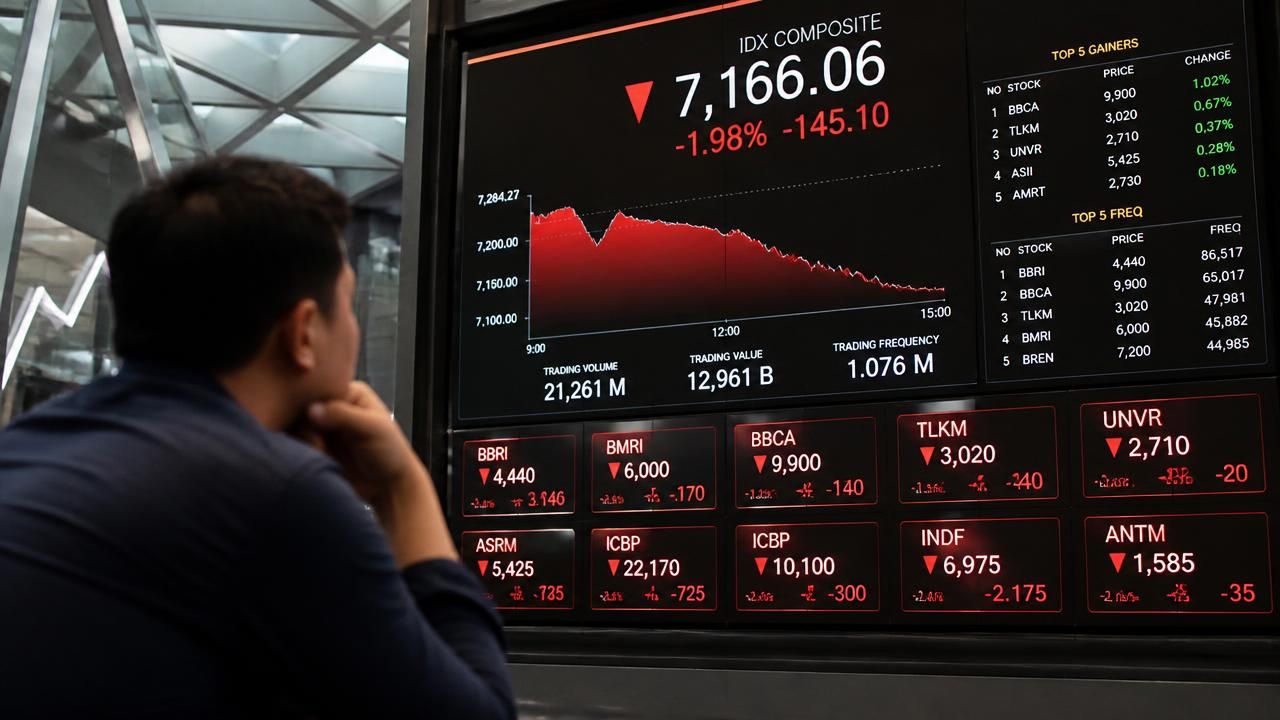
Indonesian equities posted their sharpest one-day decline since January after MSCI Inc. signalled that Southeast Asia's largest economy may no longer qualify for emerging-market status — a move that could eject the country from the index provider's global benchmarks and force a wave of foreign capital out of Jakarta.
The selloff rippled across the market as investors digested the prospect of a reclassification, with the benchmark Jakarta Composite Index sliding and foreign investors leading the retreat. Bloomberg Markets reported that MSCI had told clients Indonesia "no longer merits emerging-market status," a verdict that, if confirmed, would place the country on a path toward standalone-market classification — the lowest tier in MSCI's hierarchy, below both emerging and frontier markets.
What MSCI Is Actually Proposing
At the centre of the turmoil is MSCI's periodic market classification review, the process by which the index compiler decides which countries belong in which of its global benchmarks. Those benchmarks anchor trillions of dollars in assets, and inclusion or exclusion determines whether passive funds tracking the MSCI Emerging Markets Index are obliged to hold a country's stocks at all.
Standalone status is the harshest outcome available. Unlike a demotion to frontier markets — which still qualifies a country for dedicated funds — standalone markets are excluded from MSCI's flagship composite indexes entirely. For Indonesia, that would mean losing the automatic demand generated by exchange-traded funds, sovereign wealth allocations and index-tracking portfolios that currently hold Indonesian shares purely because MSCI tells them to.
The Reuters framing of the story emphasised the trigger: MSCI has raised new transparency concerns ahead of its emerging-markets verdict. That language matters. It suggests the review is not a mechanical recalculation of market size or liquidity thresholds, but a qualitative judgement about how accessible and legible Indonesian markets are to foreign institutions.
MSCI said the country no longer merits emerging-market status, risking an ejection from its global indexes and triggering fears of foreign capital flight.
Why Transparency Is the Sticking Point
MSCI's classification framework rests on three pillars: economic development, market size and liquidity, and — critically — market accessibility. That last pillar covers everything from the ease of repatriating capital and settling trades to the reliability of ownership data, the availability of short-selling and securities lending, and the consistency with which regulators communicate policy.
Indonesia has repeatedly run into friction on these metrics. Successive reviews have flagged concerns over free-float disclosure, the opacity of beneficial ownership in a market where concentrated corporate families dominate, and periodic regulatory interventions that foreign investors say make position-sizing unpredictable. The latest round of concerns, according to Reuters, arrives with unusual urgency, suggesting the index provider has grown less patient with incremental reform.
The aggregator versions of the story that circulated on MSN pushed the headline further, framing the development as MSCI "planning to dump" Indonesia from its indexes and "weighing downgrading" it to standalone status. That escalation in tone — from a review to an apparent decision — reflects how quickly the market has moved from assessing probability to pricing in consequences.
The Stakes for Jakarta
Indonesia occupies roughly a low-single-digit percentage of the MSCI Emerging Markets Index, but the absolute sums involved are substantial. Even a modest index weight translates into billions of dollars of passive exposure, and active managers who benchmark against MSCI indices would face pressure to reduce holdings as the country's investability rating deteriorates.
The knock-on effects extend well beyond equities:
- Currency pressure. Equities outflows typically accompany rupiah weakness, complicating Bank Indonesia's efforts to keep the currency stable while managing inflation.
- Bond markets. A credibility hit at the index level can spill into local-currency government debt, where foreign ownership is already sensitive to sentiment.
- Valuations. Without the structural bid from index funds, Indonesian companies may trade at a persistent discount to regional peers such as Thailand, Malaysia and Vietnam.
- Corporate funding. Lower valuations and thinner liquidity raise the cost of equity for firms considering initial public offerings.
Historical Precedent — and a Warning
Index reclassifications are rare but consequential. Argentina has been moved between emerging, frontier and standalone categories multiple times as its capital controls and economic policy shifted. Turkey was downgraded to frontier status after authorities restricted short-selling and securities lending during market stress — a sequence that bears uncomfortable similarities to concerns now raised about Indonesia.
The direction of travel is not always downward, however. Countries including Qatar, the United Arab Emirates, Saudi Arabia and, more recently, Egypt and Nigeria have been upgraded as they liberalised market access. MSCI's framework rewards predictability, and its verdicts are typically announced in June with implementation phased over subsequent index reviews.
What Happens Next
Attention now turns to Indonesia's regulators and exchange authorities, who have historically responded to MSCI criticism with technical fixes: tightening free-float reporting, widening disclosure requirements and easing rules on foreign participation. Whether such measures arrive in time to influence the current review is an open question.
For global investors, the immediate calculation is defensive. Even if MSCI ultimately stops short of a full standalone downgrade, the review itself has introduced a risk premium into Indonesian assets that is unlikely to dissipate until the verdict is delivered.
The episode also carries a broader lesson for emerging markets: index inclusion is not a permanent entitlement. It is a renewable contract with the world's capital, and it can be revoked when transparency slips.