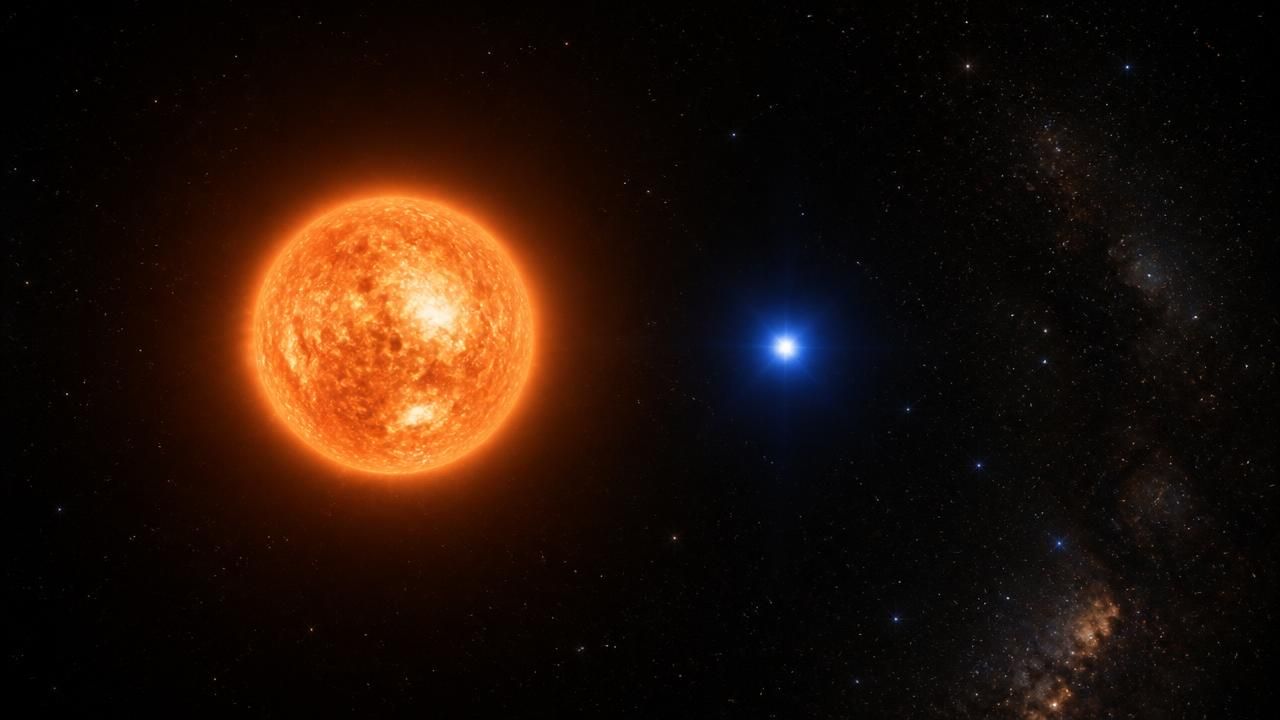
In a breakthrough that has electrified the astronomical community, researchers have captured the clearest image yet of a long-suspected companion star orbiting Betelgeuse, the red supergiant that marks the shoulder of Orion. The discovery, reported by multiple outlets including Science Daily, Space.com, and Scientific American, could finally explain the star's bizarre changes in brightness — and may rewrite our understanding of how massive stars evolve and die.
A 100-Year-Old Mystery
Betelgeuse has been a fixture of human observation for millennia. It is one of the brightest stars in the night sky, easily visible to the naked eye, and its distinctive orange-red hue has fascinated astronomers since the invention of the telescope. But for roughly a century, something about Betelgeuse has not added up. Its brightness fluctuates in ways that do not perfectly match the pulsations of a single star, leading some scientists to hypothesize the presence of a companion — a star too close and too dim to be seen directly.
That hypothesis has now been confirmed with stunning clarity. According to Science Daily, astronomers have obtained the first direct image of the companion, a star that has been nicknamed "Betelgeuse B." The team behind the observation described the moment of detection with palpable excitement: one researcher said,
"I jumped from my chair"when the image appeared on screen.
What the New Image Shows
The newly imaged companion is not the small, faint object many expected. Instead, it is a surprisingly massive star, possibly dozens of times the mass of the Sun. Its presence in such close orbit around Betelgeuse has profound implications. As Space.com notes, this is the clearest view yet of the elusive companion, resolving a mystery that has persisted for about 100 years. The image was captured using a technique called interferometry, which combines light from multiple telescopes to achieve the resolution of a much larger instrument. This allowed the team to separate the faint companion from the blinding glare of the primary red supergiant.
The discovery is being hailed as the strongest evidence yet that Betelgeuse is not a solitary star but a binary system. Several outlets, including Nanowerk and Phys.org, used that exact phrase in their headlines, underscoring the significance of the find.
Why Did Betelgeuse Dim So Dramatically?
Interest in Betelgeuse spiked in late 2019 and early 2020, when the star experienced a historic dimming event that was visible to the naked eye. For months, its brightness plummeted by more than 60%, leading to speculation that it might be about to explode as a supernova. The star eventually recovered, and astronomers now believe that a large dust cloud may have temporarily obscured the star's light. But the new evidence of a companion star adds another layer to the story.
The companion could be directly influencing Betelgeuse's variability, according to the researchers. Its gravitational pull might induce tidal distortions or cause the primary star to undergo periodic changes in shape and luminosity. This could explain why Betelgeuse's brightness oscillations have long confused scientists trying to model the star's behavior. In fact, some models of the 2019-2020 dimming have suggested that a passing companion could have stirred up dust or altered the mass-loss rate of the supergiant, making the dust cloud explanation even more plausible.
A Future Supernova on the Horizon?
Betelgeuse is expected to end its life in a massive supernova within the next 100,000 years — a blink of an eye in cosmic terms. When it does, the blast will be so bright that it could be visible during the day from Earth. The presence of a companion star could change the way that explosion unfolds. If the two stars are close enough, the companion could accrete material from the dying supergiant, potentially triggering an earlier collapse or altering the direction of the ejected material. Scientists emphasize that the discovery is not just a curiosity; it is a crucial piece of the puzzle for predicting the final fate of one of the Milky Way's most watched stars.
As Scientific American put it, this is the "best-yet glimpse" of Betelgeuse's companion. The image is more than a technical achievement — it represents a significant step forward in our understanding of stellar evolution. Every star in the night sky may have a story of its own, and for Betelgeuse, that story just became far more complex.
What's Next for Betelgeuse?
The discovery opens up a host of new questions. How did Betelgeuse and its companion form together? How much mass is the supergiant losing to its smaller sibling? And could there be other, even more distant companions that have yet to be found? The team behind the observation plans to continue monitoring the system with instruments like the Very Large Telescope and the Atacama Large Millimeter/submillimeter Array (ALMA) to refine their measurements and track the companion's orbit.
For the casual stargazer, Betelgeuse will still appear as a single point of light in the constellation Orion. But the knowledge that it shares its cosmic stage with a hidden partner adds a new layer of wonder to a star that has been part of human culture for thousands of years. As the The Times of London succinctly put it, "After centuries of study, Betelgeuse is revealed to be two stars."
With this discovery, astronomers are not just looking at Betelgeuse — they are looking at a two-star cosmic dance that holds clues to the life and death of the largest stars in the universe. And the search that began a century ago has finally borne fruit, reminding us that the sky still holds secrets even among the most familiar objects.