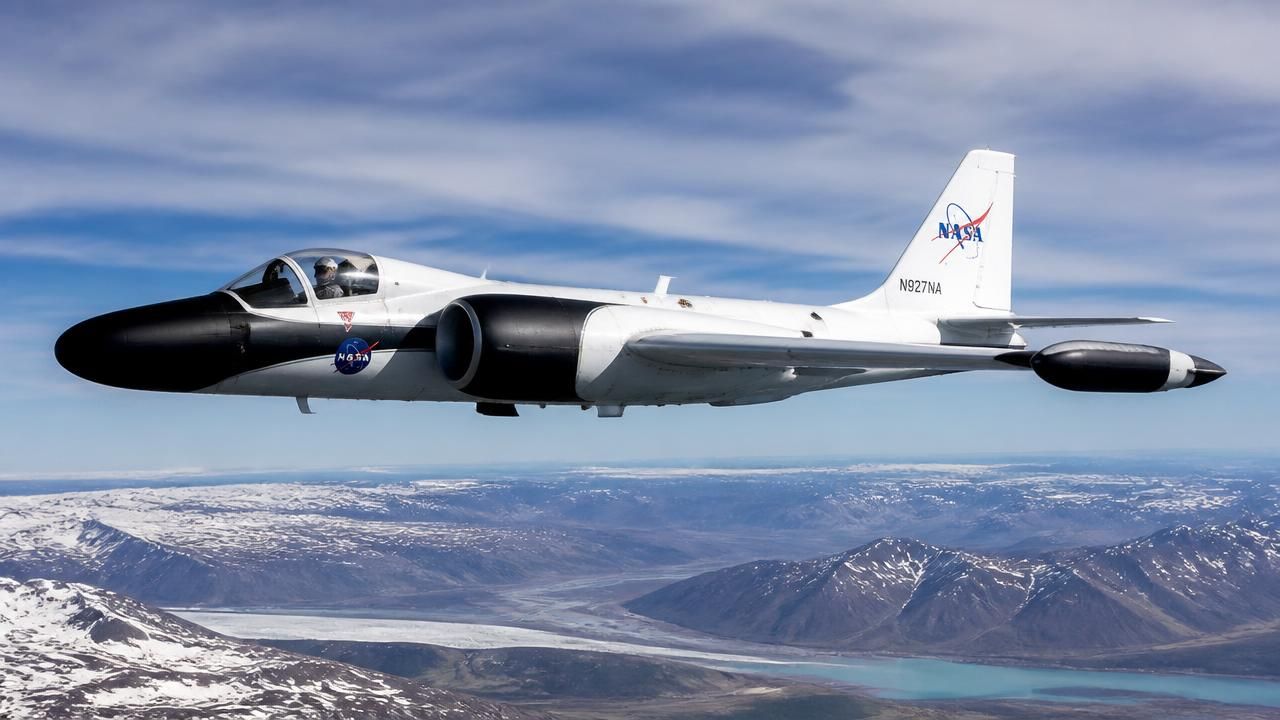
On Aug. 12, 2026, a total solar eclipse will sweep across Europe, plunging the continent into a brief, eerie twilight. For most onlookers, it will be a spectacle. But for a team of NASA pilots and scientists, it will be a carefully planned scientific expedition—one that involves chasing the Moon's shadow from the cockpit of a high-altitude research jet.
A Mission to Touch the Corona
NASA's WB-57F aircraft, a twin-engine jet originally built for military reconnaissance, will take off from Ellington Field in Houston and fly to Iceland, its base for the eclipse chase. From there, pilots John Gustine and Cary Klemm will steer the plane into the path of totality, flying at 50,000 feet to give onboard sensors a clear, unobstructed view of the Sun's outer atmosphere—the corona.
"A total solar eclipse provides a unique opportunity to examine the corona because the Moon temporarily blocks the Sun's bright surface, revealing its fainter outer atmosphere," NASA explained. The agency's Johnson Space Center manages the WB-57F program, and the mission is part of a long-running effort to solve one of solar physics' most stubborn puzzles: why the corona is millions of degrees hotter than the Sun's visible surface.
By observing the corona at visible and infrared wavelengths, scientists hope to trace how energy and material move away from the Sun. This, in turn, improves our understanding of space weather—the stream of charged particles and magnetic fields that can disrupt satellites, GPS, and power grids on Earth.
Why 50,000 Feet?
The WB-57F's altitude is key. At 50,000 feet, the aircraft flies above most of Earth's atmosphere, reducing atmospheric turbulence and water vapor that can blur and absorb sunlight. It also allows the plane to move quickly to extend the duration of totality. While ground observers will see a total eclipse for just a few minutes, the plane can chase the Moon's shadow across the Earth's surface, extending its view to more than 10 minutes of totality—a golden window for data collection.
"I am stoked," one pilot told the BBC of the prospect of flying through the Moon's shadow. "It's the ultimate chase."
The view from the cockpit is described as surreal: a rapid plunge into darkness, with the corona blazing around the silhouette of the Moon, and the horizon glowing in a 360-degree sunset.
The Legendary Predecessor: Concorde
NASA's mission builds on a storied legacy of airborne eclipse chasing. In 1973, a modified Concorde supersonic airliner raced the Moon's shadow across Africa, flying at Mach 2 and staying in totality for an astonishing 74 minutes—far exceeding the 7 minutes possible from the ground. That flight carried scientists and instruments to study the Sun's corona in a way that was once considered impossible.
The WB-57F is slower but more versatile. It can carry multiple instruments, including high-resolution cameras and spectrometers, and it can be repositioned to different altitudes. The flight from Houston to Iceland is a staging mission, allowing the crew to be in the right place at the right time—something that requires precise planning, veteran piloting, and a bit of luck with the weather.
What the Science Means
The corona's superheating has puzzled astronomers for decades. The Sun's visible surface, the photosphere, is about 5,500°C, but the corona reaches temperatures of 1 to 3 million degrees. Understanding this energy transfer is not just an academic exercise. Solar flares and coronal mass ejections are driven by the same magnetic processes that heat the corona. By learning how the corona heats and accelerates particles, scientists can better predict space weather events that pose risks to astronauts and technology.
The Aug. 12, 2026 eclipse offers a rare chance to gather data at the exact moment the Moon blocks the brightest part of the Sun, revealing the corona's faint structures in sharp detail. NASA's WB-57F will be there, chasing the shadow, continuing a tradition of scientific adventure that spans from the Concorde to the high-altitude jets of today.
Looking Ahead
After the eclipse, the data will be analyzed for years. But the immediate reward is the experience itself—and the knowledge that the team had front-row seats to one of nature's most spectacular shows, doing what humans have done for centuries: reaching for the sky to understand the stars.
For the pilots, it's a personal mission. "It's not every day you fly into the shadow of the Moon," Gustine said in a NASA release. "We're ready to go."