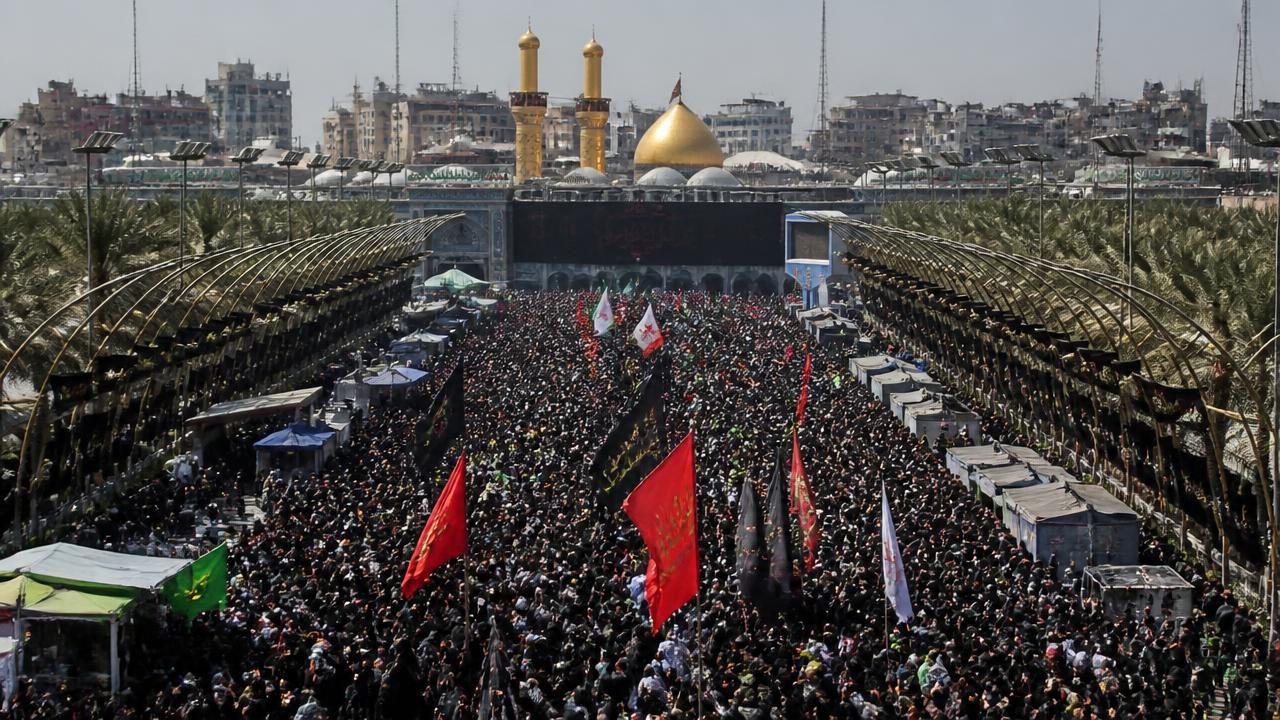
In the heart of Iraq's Karbala province, an overwhelming sea of humanity converged this August for the annual Arbaeen pilgrimage, one of the largest religious gatherings on Earth. Despite blistering temperatures, ongoing Mideast conflicts, and heightened fears of a US-Iran escalation, an estimated 20 to 22 million Shia Muslims — including hundreds of thousands of Iranians — flooded the holy city to commemorate the 40th day after the martyrdom of Imam Hussein, the grandson of Prophet Muhammad.
The pilgrimage, which draws participants from around the globe, transformed Karbala into a sprawling, festive sprawl of black-clad mourners, colorful flags, and impassioned hymns. For many, the journey itself is as sacred as the destination. Pilgrims from Iraq and Iran walked hundreds of miles in extreme heat, often taking a week or more to reach the shrines of Imam Hussein and his half-brother Abbas. Along the way, volunteers operate rest stops, offering water, food, and shade to weary travelers — an often-cited example of the communal hospitality that defines the event.
A Journey of Devotion and Sacrifice
Arbaeen marks 40 days after the Battle of Karbala in 680 AD, where Imam Hussein, his family, and supporters were brutally killed by the forces of the Umayyad caliph Yazid. For Shia Muslims, this event crystallized their identity as a people who oppose tyranny and injustice. The pilgrimage is both an act of mourning and a declaration of loyalty to Hussein's principles. As one widely repeated saying goes,
"Every day is Ashura and every land is Karbala."
The scale of this year's gathering is staggering. Multiple news outlets reported figures ranging from 20 million to 22 million participants. The variance is typical for such an enormous and fluid event, where official counts are difficult to verify. Local authorities and Shia religious institutions often rely on aerial imagery, security checkpoints, and mobile phone data to estimate numbers. Regardless of the exact count, the pilgrimage is widely recognized as the largest annual gathering of Shia Muslims and among the largest religious assemblies in the world.
Amid Tensions: Fears of US-Iran Escalation
The 2024 Arbaeen occurred against a backdrop of severe regional instability. Sources highlighted fears of a potential US-Iran military confrontation, as well as ongoing tensions between Iraq and Iran. While the pilgrimage is fundamentally a religious event, it carries geopolitical weight. Iran is a major sponsor of Shia religious tourism, and the presence of hundreds of thousands of Iranian pilgrims underscores the deep cross-border ties that bind Shia communities. Some analysts noted that the peaceful conduct of the pilgrimage, despite the heated political atmosphere, demonstrated the resilience of religious practice amid potential conflict.
Coverage elsewhere framed the event as "despite war and strife" or "amid fears of US-Iran escalation," reflecting the precarious security environment that has long defined the region. Yet NPR described the atmosphere outside the shrines as "almost festive," a reminder that for most pilgrims, this is a time of spiritual renewal, not political commentary. The contrast between the joy of the faithful and the anxiety of the geopolitical landscape is a recurring theme in reports from Karbala.
Historical Context: A Pilgrimage Once Suppressed
The sheer scale of the modern Arbaeen is a relatively recent phenomenon. During Saddam Hussein's regime, the pilgrimage was heavily restricted, and processions were violently suppressed. After his fall in 2003, the event exploded in size, with millions attending annually. This year's numbers, according to some religious authorities, rival or even surpass the Hajj in Mecca, which is typically limited to 2 million to 3 million official pilgrims. The comparison highlights how Arbaeen has become a defining expression of Shia identity in the 21st century.
The pilgrimage also serves as an economic and logistical marvel. For weeks, Iraqi authorities deploy tens of thousands of security personnel, while volunteers and charitable organizations build temporary water stations, kitchens, and medical clinics along the major routes. The event is a powerful symbol of grassroots organization and communal solidarity, often transcending sectarian and national divides.
How Different Outlets Framed the Story
The varied coverage of Arbaeen reflects the diverse interests of international media. Some outlets, like MSN, focused on the record-breaking numbers and the Iraq-Iran tensions, using straightforward headlines to convey magnitude and political implication. Others, including public radio stations like KSJD and WWNO, emphasized the resilience of faith "despite Mideast wars," portraying the pilgrimage as a defiant act of devotion in a region torn by conflict. Meanwhile, Courant highlighted the looming specter of a US-Iran escalation, suggesting that even this sacred journey could be overshadowed by broader strategic antagonisms. NPR took a more anthropological approach, zeroing in on the festive sights and sounds, the physical hardship of the walk, and the volunteers who make it possible.
Key Data Points from the 2024 Arbaeen
- Estimated attendance: 20–22 million pilgrims, according to varying reports.
- Pilgrims arrived from Iraq, Iran, and countries as far as Pakistan, India, Lebanon, and Europe.
- Many walked 300–500 miles from cities like Basra and Najaf, often in temperatures exceeding 100°F (38°C).
- Security incidents were rare, despite regional tension.
- The event took place over several days, culminating on Arbaeen, which falls 40 days after Ashura.
Implications for the Region
The peaceful execution of this year's Arbaeen provides a glimmer of hope in a region often defined by conflict. It demonstrates that despite political rivalries — including those between Iraq and Iran, or Iran and the West — religious freedom and cultural exchange can thrive. For Iraq, the pilgrimage is also a boost to local economies and a showcase of its ability to manage massive gatherings. However, the underlying tensions remain. Analysts caution that as long as US-Iran antagonism persists, events like Arbaeen could become flashpoints, even unintentionally. The presence of millions of people in one city is both a logistical triumph and a potential target, a fact not lost on security forces.
For the millions of pilgrims who completed the journey, however, the significance is deeply personal. As one pilgrim was quoted by NPR, "Coming here reminds me that we are part of something much greater than ourselves." That sentiment, echoed across the dusty roads of Iraq, encapsulates the enduring power of Arbaeen — a testament to faith, endurance, and the unflinching memory of Hussein's sacrifice.