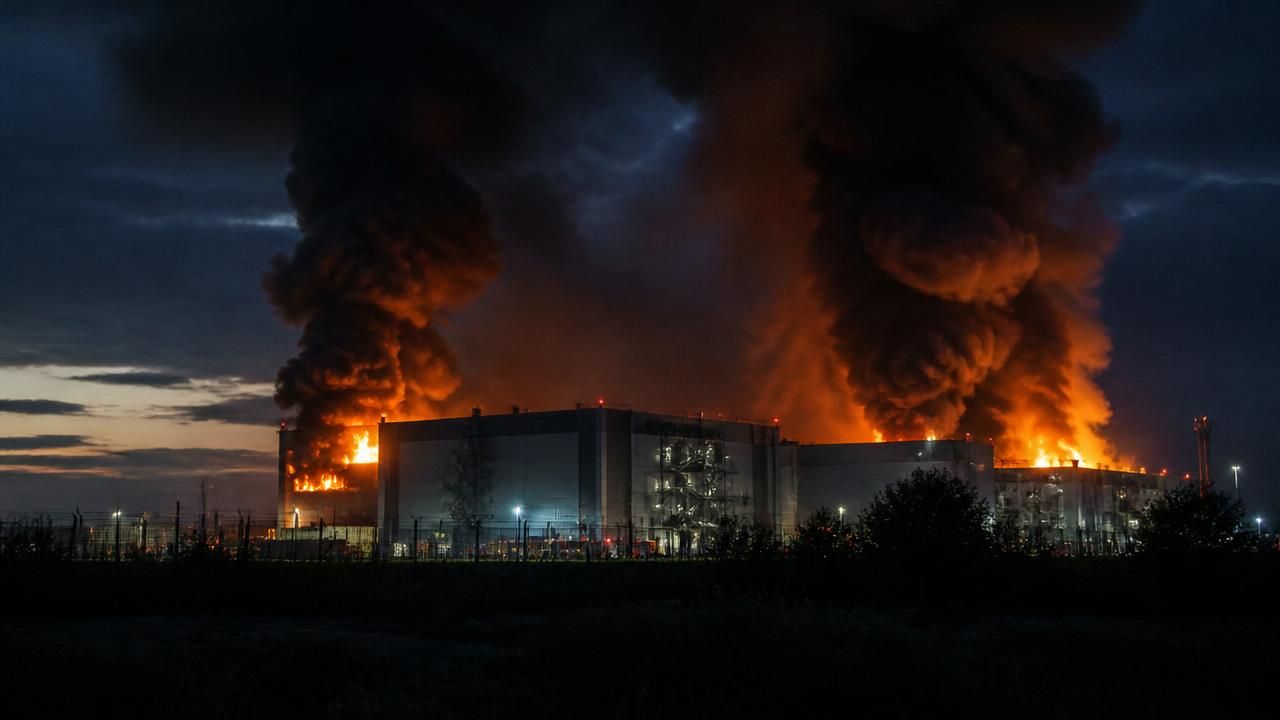
Ukrainian drone strikes knocked out two of five data centers belonging to Yandex, the Russian technology giant widely described as "Russia's Google," in attacks on October 8 and October 9 — the first major strikes on Russian data-hub infrastructure of the war. The facilities, located in the Sasovo area of Ryazan Oblast and in the Kaluga region, housed two of the company's most powerful supercomputers, and their loss has forced the company to scramble to keep its flagship services online.
The strikes were confirmed by multiple outlets citing Reuters reporting and were acknowledged by Ukrainian President Volodymyr Zelenskyy, who framed them as a direct and deliberate answer to a sustained Russian campaign against Ukrainian data infrastructure that has disrupted mobile phone and internet service for thousands of Ukrainians since late September.
A New Front in the Drone War
For most of the conflict, drone exchanges have focused on energy grids, refineries, military airfields and port infrastructure. The targeting of commercial data centers represents a notable escalation in kind rather than degree: it marks the first time data-hub infrastructure — the physical backbone of a belligerent's consumer internet and artificial intelligence economy — has been treated as a strategic military target.
"We continue to respond to Russia's attacks on Ukraine, and we're doing so with high precision," Zelenskyy wrote in a post on X. "Another data center was hit as well—our symmetrical response."
The phrase "symmetrical response" is the operative one. Kyiv is not describing the strikes as an opportunistic attack on soft commercial targets but as a calibrated reciprocal action, matching Russian strikes on Ukrainian data facilities blow for blow.
What Was Hit — and Why It Matters
Yandex is not a peripheral player in the Russian internet economy. It operates the country's most popular search engine, its dominant mapping and email services, and its leading consumer AI assistant. That assistant, along with Yandex's broader machine-learning products, depends on the very data centers now damaged.
- Two of five Yandex data centers were struck, per Reuters-sourced reporting, significantly degrading the company's compute capacity.
- Sasovo (Ryazan Oblast) and Kaluga Oblast hosted the affected facilities — both regions lie within reach of Ukraine's expanding long-range drone program.
- Two top supercomputers were reportedly housed at the targeted sites, meaning the strikes hit not just hosting capacity but the training and inference infrastructure behind the company's AI products.
- Operations were halted at at least one major facility, and Yandex has since struggled to maintain its AI chatbot and other online services.
The loss of a fifth of its data-center fleet is not a trivial redundancy problem. Hyperscale facilities of this kind are typically provisioned years in advance, with power, cooling, networking and specialized silicon that cannot be replaced quickly — particularly in a country under heavy Western export controls on advanced semiconductors.
The Tit-for-Tat Campaign
Context matters here. Since late September, Russian drone strikes have systematically targeted Ukrainian data centers, an effort reportedly designed to exploit gaps in Ukraine's air defenses. The result has been measurable civilian harm: mobile and internet outages affecting thousands of Ukrainians, degrading both daily communication and the digital coordination that underpins wartime logistics.
Analysts have noted the asymmetry that preceded this week's strikes. Ukraine's energy infrastructure has been hit for three consecutive winters; its telecom and data infrastructure has been an increasingly frequent target. By striking Yandex, Kyiv appears to be signaling that Russia's digital infrastructure is no longer exempt.
Yandex's AI Ambitions Interrupted
Yandex has spent the past two years positioning itself as Russia's national AI champion, an ambition complicated by the company's forced restructuring of its international assets and its increasing dependence on domestically sourced hardware. The strikes land precisely on that vulnerability: a company can write competitive models, but it cannot conjure compute.
The operational consequences are twofold. In the near term, users may see degraded performance or outages across Yandex search, mail, maps and its AI assistant. In the longer term, the cost of hardening and dispersing data infrastructure — redundant sites, underground capacity, air defenses — will divert resources from the very AI development the facilities were built to serve.
How the Story Is Being Framed
Coverage of the strikes has diverged along familiar lines. English-language technology outlets, including Ars Technica, have framed the story primarily as an AI-infrastructure story — the vulnerability of hyperscale compute to cheap, expendable weapons. Wire-service-derived aggregators, including MSN's syndication network and regional outlets such as the Detroit News and the Herald Corporation, have emphasized the military escalation and the "first major attack on a Russian data hub" angle.
The availability of Dutch-language versions of the same reporting on MSN underscores how broadly the story has traveled: this is being read internationally less as a tech curiosity and more as a milestone in wartime targeting doctrine. Notably, at least one source in the same cluster — a piece on Russian drones striking Ukrainian data centers by exploiting air-defense gaps — illustrates the reciprocal nature of the campaign, though the page itself was inaccessible at the time of writing.
What Comes Next
Three questions now dominate assessments of the strikes. First, whether Russia will respond by further intensifying attacks on Ukrainian telecom infrastructure, which — given Ukraine's dependence on Starlink and hardened domestic networks — could prove more damaging than the strikes on Yandex. Second, whether data centers become a recurring target class, a development that would force every state-linked technology provider to rethink the physical security of its compute. Third, whether Yandex can absorb the loss without visible degradation of its AI services — a test of how resilient Russia's self-styled technological sovereignty really is.
What is already clear is that the boundary between commercial technology infrastructure and military-relevant targeting has effectively dissolved. Data centers powering chatbots and search results are now, in the eyes of at least one combatant, legitimate targets — and cheap drones have proven sufficient to reach them.