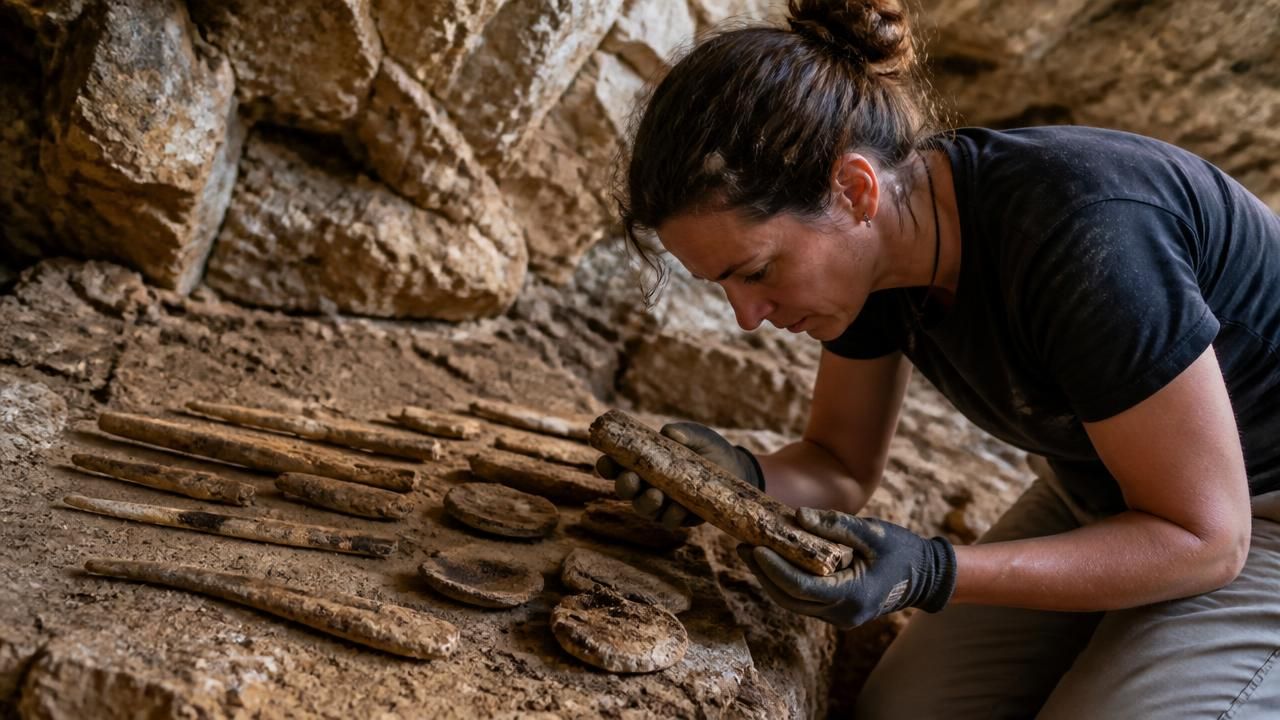
Neanderthals have long been cast as the Stone Age's also-rans: brutish, dim-witted cousins of Homo sapiens who scraped by with flint while modern humans edged toward culture. A new study from a rock shelter in northeastern Spain suggests that picture was always a distortion, shaped by what happens to survive in the ground rather than by what actually mattered in daily life. The material Neanderthals worked most intensively was wood, and at Abric Romaní, near the town of Capellades west of Barcelona, they left behind an extraordinary record of it.
Writing in the journal Science Advances, a team of Spanish archaeologists catalogued 597 wooden remains recovered from Neanderthal living floors dated between 62,000 and 40,000 years ago. The assemblage includes spears, digging sticks, bark trays, structural elements of shelters and a club unlike anything archaeologists have found before. Together, the objects point to a population that was not merely scavenging a living at the edge of survival, but manufacturing a varied toolkit in a material that is almost never preserved.
A limestone cast of a vanished world
The reason we know so little about Paleolithic woodwork is simple chemistry. Wood rots. It is consumed by fungi and bacteria within years in most environments, which is why the archaeological record skews so heavily toward stone, bone and antler. At Abric Romaní, however, mineral-rich water percolated through the shelter's deposits and coated wooden objects in a limestone-like crust. The wood itself eventually decayed, but the crust held its shape, leaving hollow molds that faithfully reproduce the form of everything from spear shafts to worked bark.
That preservation mechanism is what makes the site exceptional. Rather than recovering fragments of charred or waterlogged timber, researchers are effectively reading a plaster cast of Neanderthal carpentry, taken tens of thousands of years ago by geology itself.
What they were making
The inventory reads less like a survival kit and more like a workshop's output:
- Spears, shaped and thinned for hunting.
- Digging sticks, pointed implements used to pry up tubers and roots.
- Bark trays, suggesting containers or processing surfaces.
- Structural elements, likely posts or supports for simple shelters.
- A club of a form with no known parallel in the archaeological record.
The digging sticks and trays are especially telling. Weapons dominate the handful of wooden artifacts known from elsewhere in Europe simply because weapons are what researchers have gone looking for, and because spears are the objects most likely to end up in the sediments that preserve them. Finding everyday tools and shelter components suggests the full range of Neanderthal woodworking has been invisible to us, not absent.
The Stone Age was also an age of wood
The oldest wooden artifacts known to science are overwhelmingly weapons. They include the famous spears from Schöningen in Germany, a spear tip from Clacton-on-Sea in England, and a spear found alongside an elephant skeleton at Lehringen, Germany. Most of those survived because they were buried in waterlogged sediments where a lack of oxygen slowed decay. Abric Romaní's mineral molds open a second preservation pathway and, with it, a second window onto the period.
That has prompted a reframing in how the finds are described. Some outlets announced that Neanderthals were master woodworkers who crafted spears, trays and even tripods, urging readers to forget stone tools. Others emphasized the sheer scale of the discovery at Abric Romaní, or noted that Neanderthal Europe was as much a wooden age as a stone one. Coverage from science desks stressed that these are rare traces revealing skilled woodworkers, while one outlet highlighted a parallel finding: roughly 1,500 animal remains at the site, evidence that Neanderthal groups returned to this same shelter again and again across generations.
Each framing is accurate but partial. The weapons-first narrative reflects where evidence has historically been found. The woodworking narrative reflects what the new assemblage actually contains. The repeated-occupation narrative reflects what the cave's sediments say about land use over millennia.
The finds suggest Neanderthals were likely much more than just Homo sapiens dumber cousins, as coverage of the study in Ars Technica put it.
Why it matters
The study lands in the middle of a long-running reassessment of Neanderthal cognition. Over the past two decades, researchers have documented pigment use, symbolic burials, marine resource exploitation, complex hafting and, most recently, evidence that some Neanderthal groups interbred with and lived alongside modern humans for thousands of years. Woodworking fits neatly into that revision. Crafting a straight spear shaft or a bark tray requires selecting species, understanding how green wood splits and dries, and sequencing steps over days: planning depth that the older caricature denied.
It also cuts at a methodological bias. If the defining technology of the Middle Paleolithic was perishable, then the label Stone Age describes our evidence, not their lives. Archaeologists have argued this for years; Abric Romaní supplies 597 data points.
What remains unsettled
Important caveats remain. The team is studying molds, not the wood itself, so species identification and fine-grained traces of manufacture are harder to read than they would be on preserved timber. The dating brackets a long occupation, meaning the assemblage accumulated over more than 20,000 years and cannot be treated as a single moment. And the unusual club will require comparison with other sites before its significance is clear.
Still, the direction of travel is unmistakable. Every time researchers find a way to see what Neanderthals made from soft, perishable materials, the gap between them and us narrows. The next step is to search for similar mineral-crust preservation at other limestone shelters, where the same geological accident may be holding an entire wooden toolkit in plain sight.