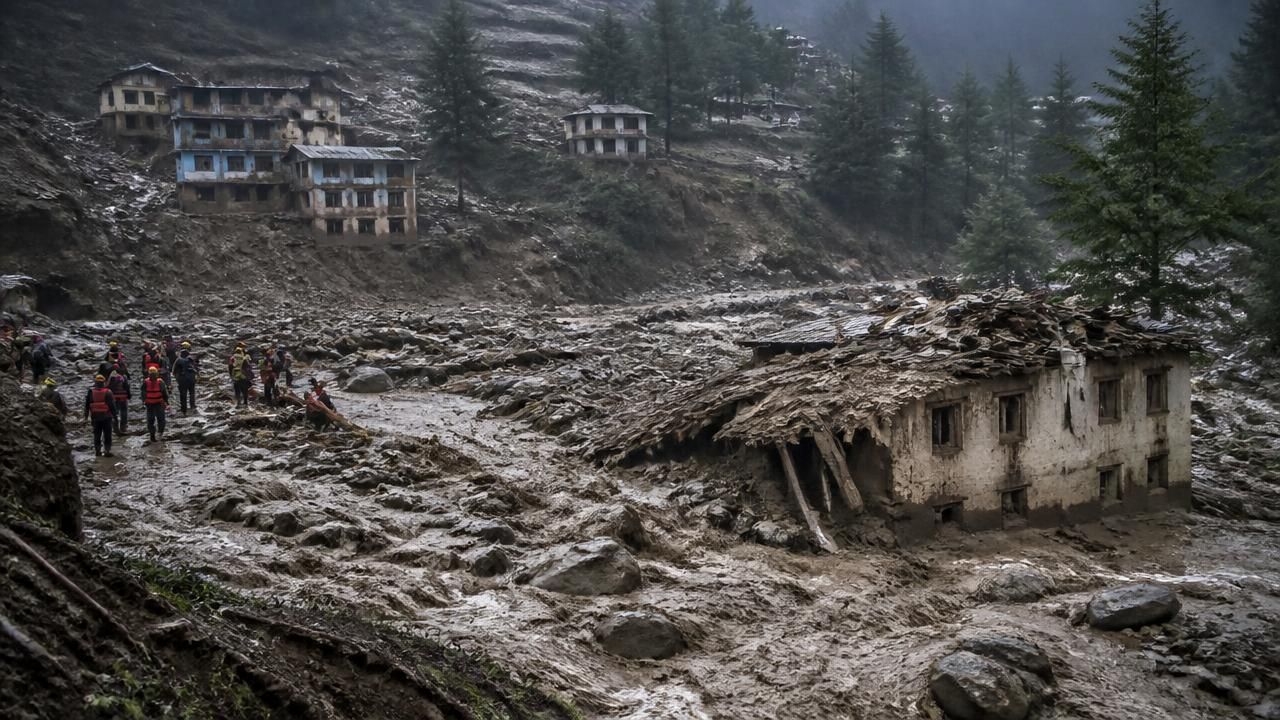
A catastrophic flash flood tore through a Himalayan river valley along the Nepal-Tibet border over the weekend, killing at least 160 people and leaving hundreds more missing, including dozens of foreign tourists. The deluge, described by witnesses as a “wall of water,” swept away entire villages, destroyed bridges, and inundated buildings in a matter of minutes, according to officials and video footage verified by news agencies.
The disaster struck the region where Nepal meets Tibet, an autonomous region of China. Local authorities in Nepal reported that at least 157 bodies have been recovered so far, while the New York Times cited official figures putting the death toll at 160. The number is expected to rise as rescue teams reach remote hamlets cut off by landslides and damaged roads. Nearly 400 people are listed as missing, according to the Kathmandu Post, including 291 foreign tourists. Among the missing are at least 54 Americans and over 100 Indian nationals, as reported by the New York Post and Mashable respectively.
Survivors and harrowing escapes
One survivor, a Nepali labourer, recounted his ordeal to Reuters, describing how he was saved by clinging to a mango tree as the floodwaters surged past. “I thought I was going to die. The water was so strong, it uprooted trees and houses like they were twigs,” he said. “I grabbed a mango tree and held on for my life. I don’t know how long it lasted, but when the water receded, I was alive, but everything else was gone.”
Video footage shared on social media and verified by NBC News shows crushing walls of water overtaking buildings and bridges in the border region. One clip captures a bridge collapsing into the churning torrent as onlookers scream. Another shows entire structures being swept away in seconds. The videos have been widely circulated, underscoring the sudden and violent nature of the event.
Rescue efforts and challenges
Rescue teams from Nepal and China are racing against time to locate survivors, but efforts are hampered by treacherous terrain, downed communication lines, and continuous rainfall. The Nepalese army has been deployed, and helicopters are airlifting the injured from remote villages. In Tibet, Chinese authorities have also launched search-and-rescue operations. However, the lack of coordination between the two sides has drawn criticism, with local officials calling for a joint response.
“We are doing everything we can, but the scale of this disaster is enormous,” a Nepalese disaster management official told the Guardian. “Many villages are only accessible by foot, and the flood has washed away the only bridges.” The official added that the death toll is likely to rise significantly.
International tourists caught in the deluge
The region is a popular trekking destination, attracting adventurers from around the world. The missing foreign tourists include hikers from the United States, India, China, and Europe, many of whom were on multi-day treks near the border. The U.S. State Department confirmed it is aware of reports that 54 Americans are unaccounted for and said it is working with local authorities. India’s foreign ministry has set up a hotline for families of missing nationals, with over 100 Indians feared swept away in the flood.
Kate Saunders, a British mountaineer who narrowly escaped by climbing to high ground, told the BBC: “We saw a massive wave coming down the valley. It was like a tsunami. We scrambled up the hillside, but I saw people and tents being carried away. It was terrifying.”
Climate context and historical precedent
Scientists point to climate change as a key factor in the increasing frequency and severity of flash floods in the Himalayas. The region is home to thousands of glacial lakes, many of which are at risk of bursting due to melting glaciers. A glacial lake outburst flood (GLOF) occurs when a lake dammed by ice or moraine breaks, releasing a massive volume of water downstream. While the exact cause of this flood is still under investigation, experts say it bears the hallmarks of a GLOF triggered by heavy rainfall or an earthquake.
“This is a stark reminder that the Himalayan cryosphere is changing rapidly,” said Dr. Anurag Kulkarni, a glaciologist at the Indian Institute of Science. “We are seeing more intense rain events and faster glacier melt, which together create conditions for catastrophic floods. The countries in this region must invest in early warning systems and cross-border cooperation.”
The Nepal-Tibet border has a history of deadly floods, including a 2012 event that killed dozens. But the current disaster is among the worst in recent memory.
Differing media framings
The story has been covered with varying emphases. American outlets like the New York Post and Mashable have highlighted the missing U.S. and Indian nationals, while Reuters focused on the human story of survival, and the WSJ and Kathmandu Post provided detailed casualty numbers. In Nepal, the media is calling for greater accountability and preparedness. The Guardian’s coverage notes that about 100 people are missing in the town of Darchula in northern India, illustrating that the disaster’s impact extends beyond the immediate border area.
As the search continues, the world watches with bated breath. For the families of the missing, every hour is agonizing. The flood has not only claimed lives but has also laid bare the vulnerability of mountain communities in the face of a changing climate. International aid organizations are mobilizing, but the immediate need is for rescue teams to reach the most isolated areas before it is too late.
- Death toll: At least 160, with over 157 bodies recovered.
- Missing: Nearly 400, including 291 foreign tourists.
- Nationalities among missing: At least 54 Americans, over 100 Indians, plus others.
- Cause: Likely glacial lake outburst flood or extreme rainfall.
- Rescue: Joint efforts underway, but hampered by terrain and weather.
The coming days will be critical for determining the full scale of this tragedy. One thing is clear: the Himalayas, long revered as a pristine wilderness, are now a frontline of climate-induced disasters.