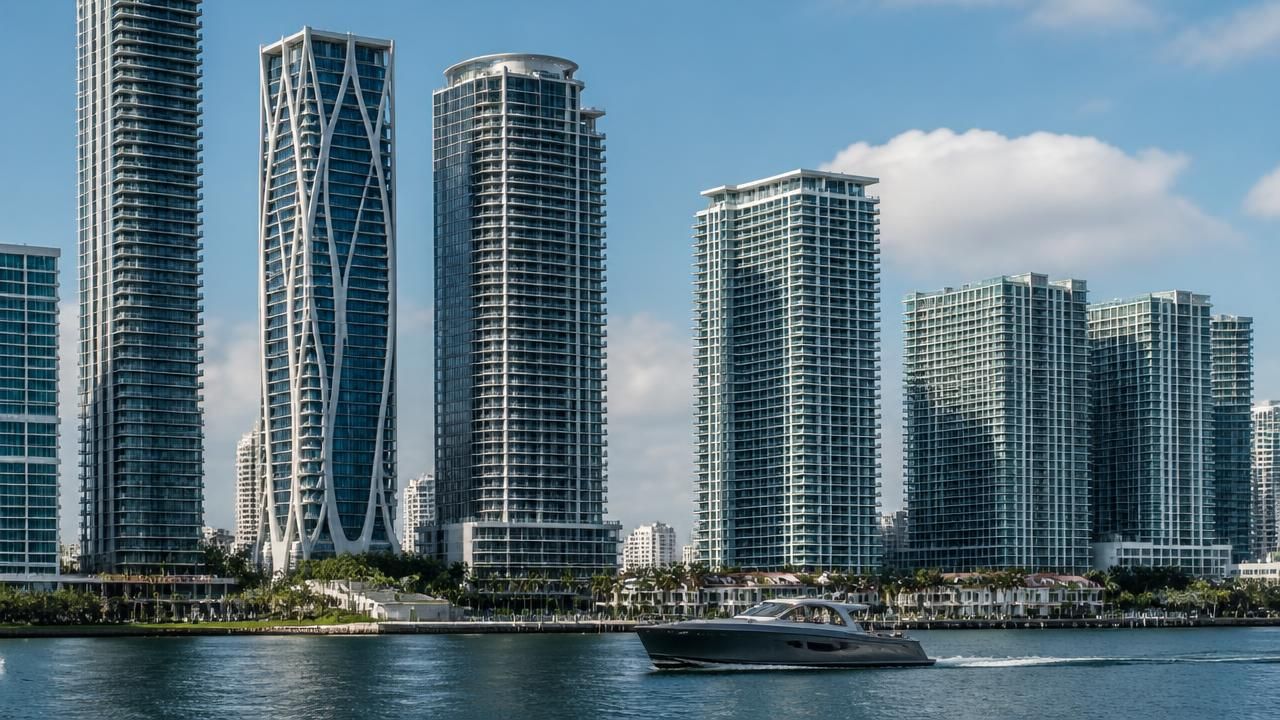
Miami’s skyline is no longer just a canvas for glass towers and penthouse penthouses. It has become the proving ground for a new kind of branded luxury: residences co-signed by some of the world’s most coveted automotive marques. Porsche, Bentley, Pagani, Aston Martin, and even Bugatti are lending their names—and design DNA—to condo towers, turning the city into the epicenter of car-branded living.
According to a New York Times report, high-end automakers are teaming up with residential developers, solidifying Miami as having the most branded residences associated with car brands in the nation. The phenomenon, once a niche curiosity, has exploded into a multi-billion-dollar segment of the luxury real estate market.
The Race to the Top
The most prominent player in this space is developer Gil Dezer, who has successfully sold condos branded after Porsche and is now bringing a Bentley tower to Sunny Isles Beach. Dezer’s portfolio includes the Porsche Design Tower, which famously features a robotic parking system that delivers cars directly to a resident’s apartment. Now, his upcoming Bentley Residences—a 62-story, $1 billion tower—is set to take the concept further with the patented “Dezervator,” a car elevator that allows residents to drive into their living rooms.
“This is not just about parking,” Dezer told Robb Report. “It’s about the experience of living with your car.” The tower, designed by Dezer Development and licensed by Bentley Motors, will feature 216 units priced from $4.7 million to over $30 million, with a limited number of penthouses exceeding $40 million.
Meanwhile, Pagani Residences—announced in 2023—will be located in Miami’s Allapattah neighborhood, a collaboration between the Italian hypercar maker and developer Related Group. Designed by Arquitectonica, the 70-story tower will include a private car club, a racing-inspired wellness center, and a “hypercar lounge” with direct elevator access to each residence.
Aston Martin and Bugatti Entries
Aston Martin has also entered the fray, partnering with the Coto family to launch its first branded condo tower in downtown Miami. The 391-unit project, designed by the award-winning firm Bodas Mian Anger, will feature interiors by Aston Martin’s design team, including signature elements like hand-stitched leather walls and carbon-fiber detailing. Bugatti, meanwhile, has inspired a $13 million residence in a standalone villa—the brainchild of Dezer and Bugatti International—that channels the French marque’s design language into a private home.
The trend extends beyond Miami. Porsche Design has unveiled a luxury residential tower in Bangkok, and fashion houses like Fendi, Armani, and Bulgari have also entered the branded residence market, as noted by Robb Report. But Miami remains the densest concentration of car-branded developments, with at least five major projects either completed, under construction, or announced.
Why Miami? Why Now?
Real estate analysts point to a confluence of factors: Miami’s tax advantages, its status as a Latin American gateway for wealthy buyers, and a post-pandemic surge in migration of finance and tech elites. But the deeper driver is the “passion economy” of superfans. As one MSN article put it, “For superfans of luxury brands from Porsche to Fendi, there's a condo for that.”
Branded residences offer a triple win for developers, brands, and buyers, according to Forbes. Developers command a premium of 20-30% over comparable non-branded units; brands extend their lifestyle narrative beyond products; and buyers gain cachet plus a promise of design excellence and service. “It’s not just a home—it’s a membership in a brand family,” says Jonathan Miller, a real estate appraiser who tracks the luxury market.
The Sinking Sensation: A Cautionary Tale
But the race has not been without scandal. The Porsche Design Tower in Miami is sinking, as reported by Motor1 and other outlets. The 60-story building has sunk several inches into the limestone bedrock, prompting lawsuits from condo owners who allege structural defects and fraudulent concealment by the developer. The issues have cast a pall over the entire branded-residence movement, raising questions about engineering, oversight, and the risks of rapid construction in South Florida’s unique geology.
Designer names, shoddy builds, and sinking buildings—that’s the darker side of the designer condo mess, as one Medium headline put it. Critics argue that the frenzy for branded towers has sometimes prioritized marketing over good construction, leading to a potential crisis for buyers who paid millions for a lifestyle, not a sinking liability.
Perspectives and Pushback
Different outlets frame the story differently. Dezeen asks, “Why are luxury car brands suddenly building skyscrapers?” and sees it as a convergence of design and mobility. Robb Report sees it as an evolution of luxury, noting that branded residences are “flooding the prime market—and selling.” Meanwhile, Page Six offers a celebrity-gossip angle, revealing that “mega-millionaires” and celebrities often ask for free apartments in Miami’s most luxurious new building, calling it “crazy.”
“We get requests from A-list actors, sports stars, and heads of state,” a sales representative told Page Six. “They want a deal, or a freebie, or a discount. It’s constant.” The developer Dezer has acknowledged the phenomenon, but stresses that demand is robust enough that discounts are rare.
On the design side, the Dezeen roundup of five luxury residential projects by car brands highlights not just car lifts but also architecture that plays on automotive cues—curved facades, exposed carbon-fiber, and lighting inspired by headlight arrays. The Wallpaper* piece on Pagani Residences notes that the tower’s twisting silhouette “mimics the aerodynamic curves of a hypercar.”
What It Means for the Future of Cities
The branded-residence boom is not just a Miami story; it is a global one. Hospitality Investor reports that non-hotel names are muscling in on the branded-residence market. Tatler Asia has covered the state of the luxury car industry in the high-end real estate race track, from Mercedes to Bugatti. As more automakers and fashion houses seek to deepen their relationship with consumers, the lines between product, place, and lifestyle are dissolving.
For cities, the trend brings both glamour and risk. Branded towers can be architectural landmarks and economic catalysts, but they also concentrate wealth and can strain infrastructure. The sinking Porsche Tower is a stark reminder that labels alone do not guarantee quality.
Still, for now, demand shows no signs of cooling. Dezer reports that Bentley Residences is 60% sold ahead of its planned 2026 completion. “There are more billionaires than ever, and they all want to live in a building that makes a statement,” he says. “A car brand is one of the strongest statements there is.”
Whether this race accelerates or hits a speed bump may depend on how developers address the engineering and ethical challenges that have emerged. But one thing is certain: the intersection of horsepower and high-rise is no longer a sideshow—it is the main event.