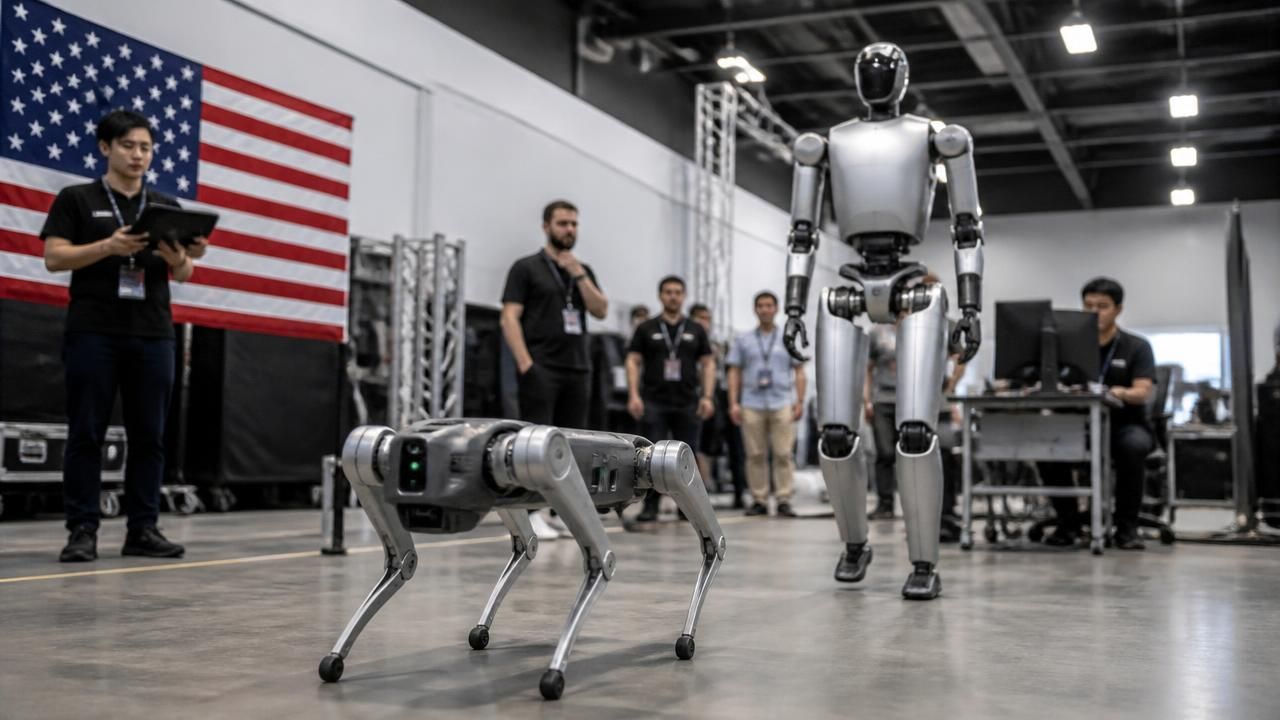
The US government's decision to ban the import of Chinese-made humanoid and quadruped robots has sent shockwaves through the robotics industry, forcing a rapid recalibration of strategies on both sides of the Pacific. The move, framed as a national security measure, has upended the business model of RoboStore, the leading US distributor of Unitree Robotics' popular robot dogs and humanoid robots, and accelerated a broader pivot toward domestic manufacturing and artificial intelligence across the global automotive and tech sectors.
The Ban and Its Immediate Aftermath
RoboStore, which had become the primary North American gateway for Unitree's affordable robots used by universities and tech giants alike, has announced plans to manufacture its own robots at a facility on Long Island, New York. Teddy Haggerty, founder and CEO of RoboStore, revealed the scale of the disruption: “We’ve sold over 1,500 robots and deployed them and worked with customers like Cisco, OpenAI, Nvidia, and over 150 universities.” The ban, first reported by Ars Technica, has forced the company to pivot from being a distributor to a producer, a move that underscores the far-reaching consequences of the escalating US-China tech war.
CNN framed the ban as a defining moment: “China's humanoid robots have been taking over the global market. Now the US is banning them.” Forbes independently confirmed that the restrictions target both humanoid and quadruped models, citing national security concerns over data collection and potential dual-use applications. The ban is part of a broader pattern of US export controls aimed at curbing China's technological ascendancy.
China's Humanoid Robot Ascent
Despite the US crackdown, China's robotics sector continues to surge. Chinese companies dominated the recent World Robot Conference in Beijing, with six of the top ten humanoid robot manufacturers now hailing from China, according to a report highlighted by MSN. However, the same analysis noted that US-made robots still lead in quality, a nuance often lost in the geopolitical narrative.
Chinese robots have also become cultural spectacles. Reuters reported on humanoid robots taking centre stage for Lunar New Year shows, performing traditional dances and interacting with crowds. The robots, including Unitree's models, have become symbols of China's technological prowess and its push into “embodied AI” — a term for AI systems that can perceive, reason, and act in the physical world. Chinadaily.com.cn hailed this as a new growth driver, with Beijing’s policy push accelerating the “smart economy.”
Yet, the bubble warnings are growing. The Next Web reported that 150 companies are now chasing a market where only 23% of buyers are satisfied, signalling an overheated sector ripe for consolidation. Meanwhile, Unitree’s Shanghai listing has drawn comparisons to Boston Dynamics, with investors debating whether the valuations reflect genuine promise or speculative fervor.
Global Corporate Pivots to Robotics
The robotics revolution is not confined to China or the US. Tesla has been the most prominent example, with CEO Elon Musk pivoting the company’s focus away from traditional car models toward Optimus humanoid robots and AI. Reuters detailed Tesla’s planned $20 billion capital spending spree to support this shift, while Axios noted that Tesla’s “center of gravity is shifting away from EVs.” Tesla’s first-quarter results beat expectations, according to Forbes, thanks largely to excitement around its robotics and AI initiatives.
Other players include Chinese automaker BYD, which Forbes reports has a bold plan to challenge Tesla in the humanoid robot race. Startups like Agile Robots are attracting massive capital — SoftBank is reportedly in early talks to anchor an $800 million round. Even traditional auto suppliers are pivoting: Germany’s Bosch, struggling in the automotive sector, is turning to robotics, and South Korea’s humanoid supply chain has added $68 billion in market value as parts makers reinvent themselves. The race is global, with funding surpassing $466 million in robotics investments in a single month, as tracked by The Robot Report.
Market Realities and Geopolitical Tensions
While the US ban aims to protect American interests, some argue it could backfire. A ThinkChina analysis notes that China’s fluid humanoid designs stun observers, but “US still rules robot brains” — hinting that US dominance in AI software and chips provides a competitive edge despite China’s hardware prowess. The ban may push China to accelerate its own chip and software self-sufficiency, deepening the technological decoupling.
On the other hand, US companies are adapting. RoboStore’s move to domestic production is part of a broader “Made in America” trend, echoing similar shifts in semiconductors and electric vehicle batteries. The political dimension is unmistakable: the Trump administration’s ban, as reported by vinanet.vn, escalates the tech race and adds urgency to China’s Five-Year Plan focus on “hard tech plus” industries, including embodied intelligence.
What Lies Ahead
The humanoid robot era is arriving faster than many expected, but it is also entering a phase of turbulence. The US ban has created both barriers and opportunities. For RoboStore and others, it’s a chance to build domestic capabilities. For China, it’s a catalyst to double down on innovation. And for the rest of the world, the race to bring humanoid robots into everyday life will likely reshape industries, labor markets, and geopolitical alliances.
As the dust settles, one thing is clear: the pivot to robotics is not just a corporate trend but a strategic imperative. Companies from Tesla to BYD, from Bosch to Baidu, are betting billions on machines that walk, talk, and work alongside humans. The US ban on Chinese robots may be just the opening salvo in a new front of the tech cold war, with innovation and security interests locked in a delicate dance that will define the future of automation.