Across the globe, a new wave of initiatives is reshaping how science is done—and who gets to do it. From NASA's hands-on communication workshops for undergraduate researchers to a multimillion-pound UK government investment in research infrastructure, the message is clear: the next generation of scientists must be not only technically brilliant but also skilled communicators, collaborators, and leaders. The story of this transformation is unfolding in laboratories, classrooms, festivals, and funding agencies alike.
Hands-On Training for Planetary Scientists
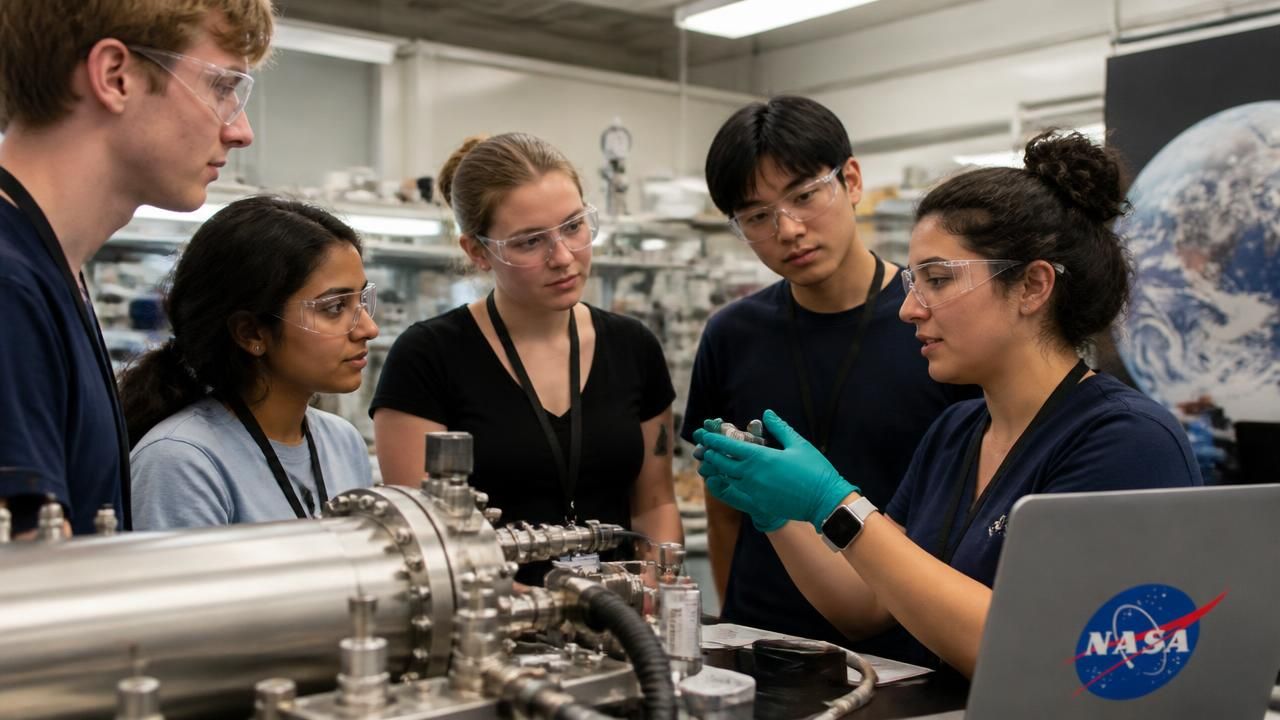
In summer 2026, NASA's Science Mission Directorate (SMD) Community of Practice for Education (SCoPE) partnered with Arizona State University's Facility for Open Research in a Compressed Environment (FORCE) Summer School to help seven undergraduate interns build the science communication skills needed to share their research with diverse audiences. FORCE is a world-class laboratory that uses high-pressure experimental equipment to recreate the extreme conditions found deep within Earth and other planetary bodies, enabling researchers to better understand how planets form, evolve, and behave under immense pressures.
As part of the Summer School, SCoPE facilitated two hands-on workshops on June 25 and 26, followed by office hours the following week, to help interns translate their technical findings into accessible narratives. The program reflects a broader trend in science education: training researchers to engage the public early in their careers, rather than as an afterthought.
Similar efforts are emerging in mission-focused outreach. A recent paper in Frontiers describes the outreach program embedded in NASA's Multi-slit Solar Explorer (MUSE) mission, which aims to inspire future generations of solar explorers across boundaries and backgrounds. By integrating education and public engagement into the fabric of a space mission, scientists are ensuring that the excitement of discovery reaches far beyond the research community.
Taking Science to the Public
Public engagement is also flourishing in more traditional settings. European AstroFest, which recently brought astronomy to London, is a prime example of how science festivals can connect enthusiasts with cutting-edge research. Similarly, the BBC's Sky at Night magazine has curated a list of 40 best space and astronomy books, offering readers a pathway into the cosmos from their armchairs.
Digital platforms are expanding the reach of scientific dialogue. Astrobites, an online resource for early-career astronomers, continues to profile prominent researchers—such as AAS keynote speaker Dr. Meredith Hughes—making their work accessible to students and the public. Meanwhile, interactive tools like ESRI StoryMaps engage users with stories like “Sensing Our Earth from Above,” demonstrating how remote sensing data can be visualized and understood by non-experts.
TheHumanist.com's recent article, “Things Are Looking Up: Uniting to Explore Our Universe,” captures the optimistic spirit driving these efforts. The headline itself signals a community that sees science as a unifying, collaborative endeavor rather than a solitary pursuit.
Investing in the Next Generation
Behind the scenes, governments and institutions are making substantial investments to ensure that this momentum is sustainable. The UK government, for instance, has announced a multi-million pound investment in the future of UK science, underscoring the strategic importance of research and development. This is complemented by a steady stream of funding opportunities: a June 2026 compilation lists 25 new opportunities in innovation, research, and smart cities, reflecting a global appetite for science-driven solutions.
But investment goes beyond money. The Geneva Environment Network has highlighted the role of youth in environmental stewardship, emphasizing that younger generations are not just the beneficiaries of science but also its drivers. In the public health sector, a Frontiers article argues for refocusing training on effective leadership and communication skills to increase efficacy—a lesson that applies equally to Earth science, space exploration, and beyond.
Even institutions with deep historical roots are looking forward. The Lunar and Planetary Institute (LPI) continues its legacy in lunar science, bridging the Apollo era and the Artemis program, while independent researchers like Victor Udochukwu Akudoro are bringing fresh perspectives to Earth's tidal forcing and sedimentary rhythms, as reported by Guardian Nigeria. These stories, though varied, share a common thread: science is a intergenerational, interdisciplinary enterprise.
Framing the Story: One Narrative, Many Perspectives
Different outlets frame this movement in distinct ways. NASA emphasizes the training of skilled communicators; the UK government highlights economic investment; event organizers celebrate public engagement; and researchers focus on legacy and innovation. Pasadena Now's headline—“Space Exploration's Next Generation Starts Here”—echoes the sentiment that the future is being built right now, in the hands of students, early-career scientists, and the public who support them.
The convergence of these stories points to a fundamental shift in science policy and culture. As the challenges facing humanity become more complex—from climate change to space exploration—the ability to communicate, collaborate, and educate becomes as vital as the ability to compute and experiment. The next generation of scientists is not just inheriting the field; they are redefining it.
“Science is not a solitary pursuit but a shared journey.”
The initiatives highlighted here—NASA's SCoPE/FORCE partnership, the MUSE mission outreach, AstroFest, UK investment, and countless others—represent a holistic approach to securing the future of discovery. By investing in people, skills, and public engagement, the scientific community is ensuring that the wonders of the universe remain open to all.