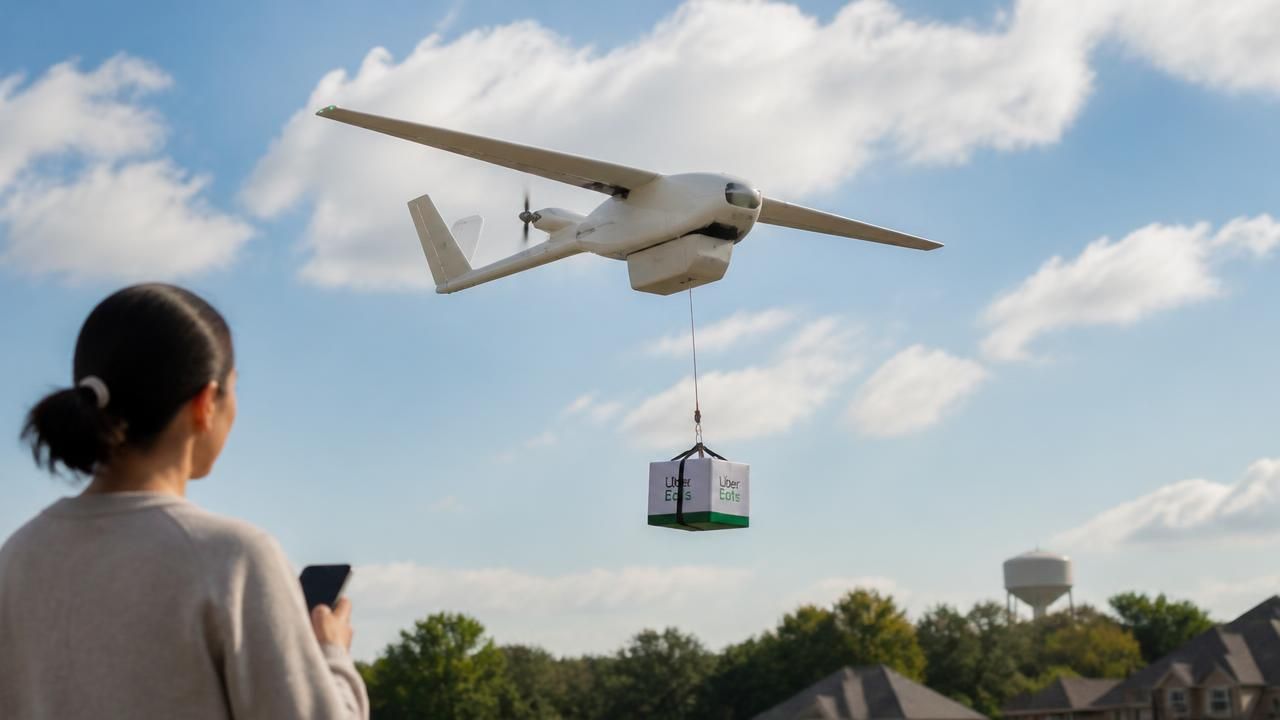
Uber Eats began flying orders to customers on Tuesday, officially opening its long-promised drone delivery service with partner Zipline in Spring, Texas, a suburb north of Houston. The launch marks the first commercial deployment of the partnership the two companies announced in August 2026 — a deal that included an undisclosed investment in Zipline by Uber — and the opening move in a plan the companies describe as nothing short of a national network.
Dallas is next on the rollout list, with dozens of additional U.S. cities planned. The companies have set a target of one million drone deliveries per day by the end of 2029, a figure that, if achieved, would represent one of the largest-scale autonomous logistics operations ever attempted in the United States.
How the Service Works
Residents inside the Spring coverage area will find a new "Drone" icon on the Uber app's home screen, which lets them browse participating restaurants. At checkout, customers must confirm delivery instructions specific to aerial drop-offs before the order is dispatched to a Zipline hub. From there, the aircraft — Zipline's fixed-wing, autonomous Platform 2 drones — fly to a designated drop point, lowering the package by tether rather than landing.
The Houston region is emerging as an early proving ground. In nearby Katy, local officials have approved a Zipline drone hub, and at least one area restaurant has already embraced aerial takeout deliveries, according to local reports — a signal that the infrastructure build-out is moving faster than the customer-facing rollout.
A Bet That Stretches Beyond Burritos
The Uber–Zipline tie-up is only one piece of a much larger capital story. Zipline has raised $1.5 billion at a $21.5 billion valuation, funding it intends to use to build out a nationwide drone delivery network. The company has also added 300 new Walmart drone delivery sites, deepening a retail partnership that pushes the business well beyond restaurant food and into groceries, pharmacy items, and household essentials.
The trajectory is a striking second act for Zipline, which built its reputation delivering blood, vaccines, and medical supplies in Rwanda and Ghana starting in 2016. That medical origin story gave the company something most drone startups lack: a decade of high-frequency flight data, regulatory relationships, and an operating record in austere environments. Translating that into suburban American takeout is the commercial test.
"The companies have set the ambitious goal to hit 1 million drone deliveries per day by the end of 2029." — as reported by The Verge on the Uber–Zipline rollout
Why Houston, and Why Now
Texas has become a favored launch market for drone logistics, owing to a combination of permissive local governance, relatively uncongested airspace in exurban corridors, and fast-growing populations with strong delivery demand. Spring and Katy — both sprawling, car-dependent communities — fit the profile Zipline needs: dense enough to generate order volume, spread out enough that road delivery is slow and aerial delivery looks comparatively fast.
Federal regulation remains the gating factor. The Federal Aviation Administration has been progressively widening permissions for operations beyond visual line of sight, the critical waiver that allows a single remote operator to supervise multiple aircraft across a wide area. Operators including Zipline, Alphabet's Wing, and Amazon's Prime Air have all pushed for expanded approval, and the pace of that rulemaking will largely determine whether the promised "dozens of cities" arrive on schedule.
The Skeptics' Case
Not everyone reads the announcement as a straightforward win. Investor-focused coverage, such as Seeking Alpha's framing of "what Uber's drone delivery bet may be signaling," tends to treat such launches as a question about capital allocation as much as technology — whether drone delivery is a durable margin driver or an expensive marketing exercise mounted while the core rides and delivery businesses face competitive pressure.
The open questions are familiar: cost per delivery versus a human courier, payload limits that constrain large grocery orders, noise complaints in dense neighborhoods, and safety records once fleets scale from dozens of aircraft to thousands. Zipline's $21.5 billion valuation implies extraordinary execution, and the one-million-per-day target is roughly three orders of magnitude above typical early commercial drone programs.
Competitive Landscape
- Wing (Alphabet): Operating drone delivery in parts of Texas, Australia, and Europe, and partnered with DoorDash in the U.S.
- Amazon Prime Air: Continuing a slow, patchy expansion of its own aerial delivery footprint.
- Zipline: Now the most capitalized pure-play drone logistics company, with both Walmart retail and Uber Eats distribution attached.
For Uber, the appeal is structural. The company has spent years arguing it is a platform rather than a fleet owner; drone delivery lets it add a high-speed tier to Eats without buying aircraft or hiring pilots. For Zipline, Uber supplies the demand funnel — millions of consumers already conditioned to order from an app — while Walmart supplies the volume and the warehouse footprint. Together, the pieces sketch a network that could eventually serve retail, restaurant, and medical customers on the same infrastructure.
What to Watch
The near-term indicators are concrete: how quickly Dallas comes online, whether the Katy hub begins commercial operations on schedule, how many of the promised dozens of cities materialize within a year, and whether FAA rulemaking keeps pace. The longer-term question is whether consumers will pay a premium for minutes saved — and whether Zipline can drive unit costs down far enough that the answer stops mattering to the business case.
For now, the drones are flying in Spring. Whether they fly a million times a day by 2029 is the bet that $1.5 billion, a $21.5 billion valuation, and two of America's largest consumer platforms have collectively placed.