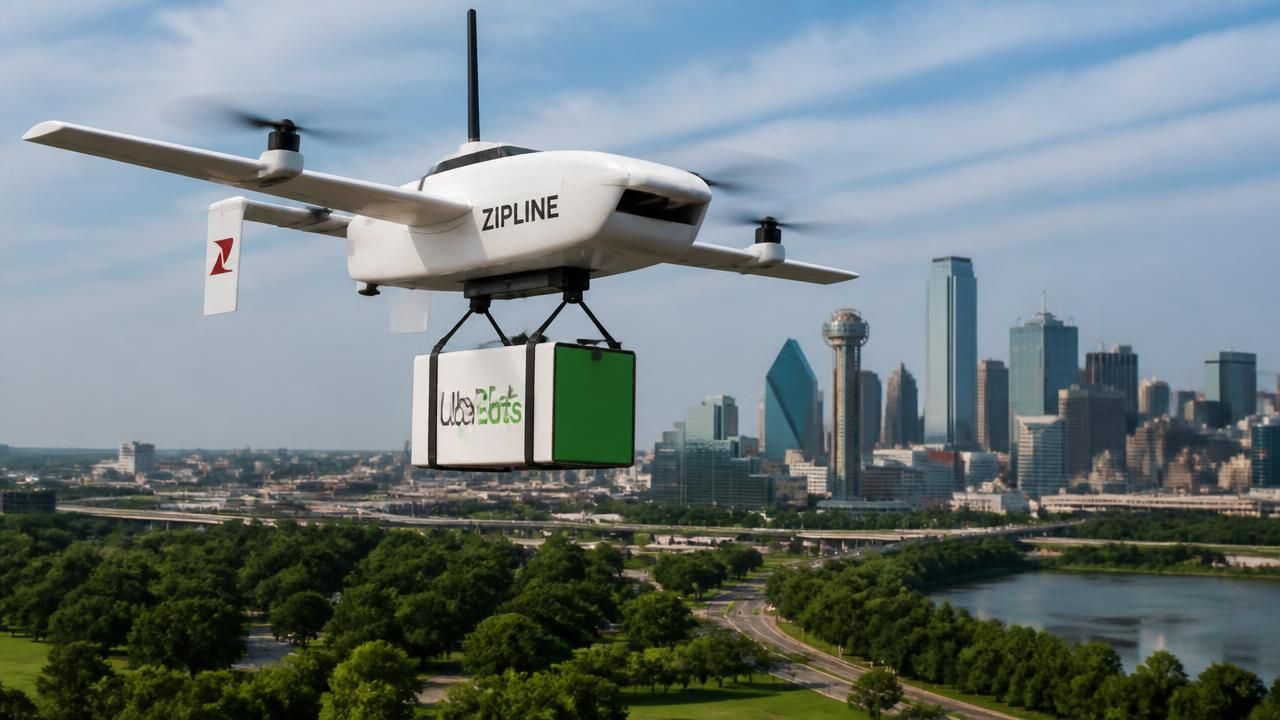
Uber and Zipline, the California-based drone delivery company, have announced a major partnership that could transform how Americans receive takeout meals. The collaboration, unveiled this week, pairs Uber's massive logistics network with Zipline's autonomous drone technology, with the ambitious goal of reaching 1 million drone deliveries per day by 2029. As part of the deal, Uber is making a strategic investment in Zipline, though financial terms were not disclosed.
The service will launch later this year in Dallas-Fort Worth, where Zipline has already been operating drone deliveries since 2025. From there, the companies plan to expand to dozens of additional cities across the United States, bringing airborne takeout delivery to millions of customers. The announcement reflects a broader industry shift as government regulations ease, allowing drones to fly farther, higher, and more cheaply than ever before.
A Powerful Partnership
Zipline, founded in 2014, first made its name delivering medical supplies in Rwanda and Ghana. It has since expanded to the United States, and its Texas operations have proven the viability of commercial drone delivery in a dense urban environment. Now, by teaming up with Uber, Zipline gains access to the ride-hailing giant's vast network of restaurants, couriers, and customers. Uber Eats, which commands a significant share of the U.S. food delivery market, will integrate Zipline's drones into its platform, offering customers a new, faster delivery option.
Uber's strategic investment signals its confidence in drone delivery as a long-term growth area. The company has been under pressure from competitors like DoorDash, which recently announced its own drone delivery initiatives. By partnering with Zipline rather than building its own fleet, Uber can leverage Zipline's proven technology and operational expertise while focusing on its core logistics strengths.
The Race to the Skies
Uber and Zipline are not alone in this race. DoorDash has been testing drones through partnerships with Alphabet's Wing, and Irish startup Manna is building a 1,000-person U.S. factory in Tulsa to take on Zipline and Wing directly. The competitive landscape is heating up as companies race to capture a share of the emerging drone delivery market.
"This is a pivotal moment for drone delivery," said an industry analyst quoted in The Verge. "With regulatory barriers falling and major players like Uber committing, we're likely to see a rapid scaling of drone-based logistics across the U.S."
Zipline has also been strengthening its leadership team, adding former executives from Tesla, Uber, and Waymo to help steer its expansion. These hires suggest the company is preparing for a major scale-up, and the Uber partnership is a clear catalyst.
Regulatory Tailwinds
A key factor enabling this expansion is the changing regulatory environment. The Federal Aviation Administration (FAA) has been gradually loosening restrictions on beyond-visual-line-of-sight (BVLOS) operations, which allow drones to fly without a human controller maintaining a direct line of sight. This is a game-changer for delivery drones, as it permits longer routes and broader coverage without the need for ground observers at every step.
Texas, where Zipline already operates, has been particularly proactive in welcoming drone testing. The state's favorable regulations and open skies have made it a testing ground for companies like Zipline, Wing, and Amazon Prime Air. The new partnership will likely push other states to accelerate their own regulatory frameworks to attract drone delivery operators.
What This Means for Consumers
For the average consumer, drone delivery promises faster, cheaper, and more convenient access to food. Instead of waiting 30 minutes for a driver to navigate traffic, a drone could theoretically deliver a hot meal in under 10 minutes. This could be especially appealing in suburban and rural areas where traditional delivery drivers are scarce. However, challenges remain: drones are currently limited in how much they can carry, cannot handle multi-floor apartment deliveries easily, and face privacy and noise concerns.
Restaurants also stand to benefit, as drone delivery could expand their reach and reduce dependence on human couriers. Uber Eats and Zipline plan to start with takeout food, but the infrastructure could eventually extend to groceries, over-the-counter medicine, and other essentials. Indeed, Zipline's broader vision is to create an instant logistics network that can deliver thousands of different products.
Market Reaction and Implications
News of the partnership was met with cautious optimism by investors. Uber's stock ticked up in early trading, reflecting confidence in the deal's long-term potential, though some analysts noted that profitability in drone delivery is still unproven. The goal of 1 million daily deliveries by 2029 is breathtakingly ambitious — it would represent a significant fraction of Uber Eats' current total deliveries — and achieving it would require massive infrastructure investment and flawless execution.
Zipline's existing operations in Texas are already profitable on a per-delivery basis, according to the company, thanks to low delivery costs and high utilization rates. If those economics can be replicated across dozens of cities, the project could become a major revenue stream for both companies.
Yet, competition is fierce. DoorDash, which has experimented with Wing, is also eyeing a larger role for drones. And Manna, which already operates in Europe, is building a factory in Tulsa to mass-produce drones for the U.S. market. The next few years will be pivotal in determining which company emerges as the leader in third-party drone delivery.
A New Chapter in Logistics
The Uber-Zipline partnership is more than just a new service — it's a landmark moment in the mainstreaming of drone delivery. With regulatory barriers falling and major corporations backing the technology, drones are poised to become an everyday sight in American skies. For consumers, the promise of instant delivery is quickly becoming a reality. For the industry, it marks the beginning of a high-stakes battle for control of the last mile — and the airspace above it.
As the service launches in Dallas-Fort Worth and expands, all eyes will be on whether Uber and Zipline can deliver on their ambitious promise. If they succeed, the way we receive food — and goods of all kinds — may never be the same.