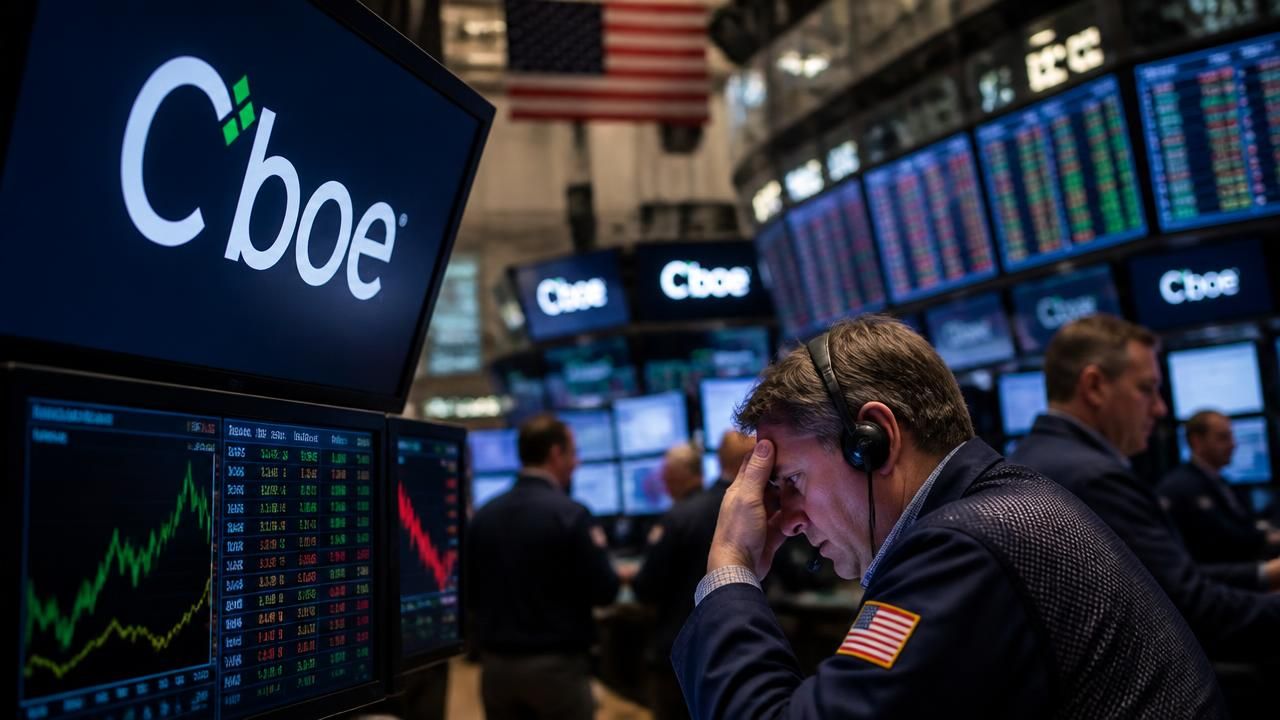
Cboe Global Markets Inc. is exploring the creation of perpetual futures tied to the Cboe Volatility Index, and has weighed converting its existing Bitcoin and Ether continuous futures contracts into perpetuals, according to reports — a move that would carry the crypto market's most heavily traded and most heavily levered instrument into the heart of regulated US derivatives trading.
The deliberations come days after US regulators approved perpetual futures for bitcoin, a decision that has reshaped the competitive calculus for the country's largest exchange operators and rattled investors in their shares.
A Crypto Native Arrives on Regulated Soil
Perpetual futures — known simply as "perps" — are contracts with no expiry date. Instead of settling on a fixed date like conventional futures, they remain open indefinitely and are tethered to spot prices through a periodic funding-rate mechanism that pays one side of the trade and charges the other. The structure was popularized by offshore crypto venues and now accounts for the overwhelming majority of digital-asset derivatives volume.
Bloomberg reported that Cboe is looking at listing perpetual futures based on the VIX, framing the effort as part of a broader push by US exchanges to bring the highly levered instruments that dominate crypto markets into new asset classes — including volatility itself. Cointelegraph, citing a report, said Cboe is weighing converting its BTC and ETH continuous futures into perpetual contracts following the regulatory shift.
Cboe Global Markets Inc. is looking at listing perpetual futures based on the Cboe Volatility Index, as US exchanges race to bring the highly levered instruments that dominate the crypto market to new asset classes.
Cboe is not a newcomer to the space: it listed the first US regulated bitcoin futures in late 2017 and has since built out a margin-based derivatives franchise. The VIX, meanwhile, is arguably its most valuable proprietary asset, underpinning a vast complex of volatility futures, options and exchange-traded products.
Exchange Stocks Under Pressure
The regulatory green light has not been read as unambiguously good news on Wall Street. MarketWatch reported that exchange stocks including Cboe and CME Group are sliding after regulators approved perpetual futures for bitcoin, while Seeking Alpha flagged that Cboe, CME and Intercontinental Exchange were trading lower amid competition concerns related to the instruments. Reuters described a broader selloff extending as the approval unnerved investors.
The anxiety centers on market structure rather than volume. Perpetuals are cheap to trade, capital-efficient and available around the clock. If they migrate onshore at scale, they could cannibalize existing listed futures and options franchises that have long been the profit engines of incumbent exchanges — while simultaneously inviting competition from venues that have spent years perfecting the product offshore.
The Hyperliquid Factor
That competitive threat is not hypothetical. In the same news cycle, reports noted that Hyperliquid, a decentralized perpetuals exchange, has seen open interest climb above $13 billion and is reportedly in talks with the parent company of crypto exchange Kraken. Hyperliquid's rise illustrates how quickly liquidity can concentrate around venues that offer perpetuals natively, without the friction of traditional clearing and settlement.
Meanwhile, Crypto Biz reported that CryptoQuant has issued warnings about Strategy — the bitcoin-heavy treasury company formerly known as MicroStrategy — underscoring how leverage now permeates every layer of the digital-asset ecosystem, from exchanges to corporate balance sheets.
Perpetuals Versus 0DTE
Trade publication Traders Magazine devoted a volatility report to demarcating perpetual futures from 0DTE options — the zero-days-to-expiry contracts that have themselves transformed US equity and index markets over the past several years. The comparison is apt: both products compress risk into very short time horizons, both attract retail and institutional flow, and both have raised questions among regulators about whether leverage is being priced correctly.
The difference is mechanical. A 0DTE option expires within hours, forcing a decision; a perpetual future never expires, allowing a position to be carried indefinitely as long as the trader can service the funding payments. That distinction matters enormously for risk management, margin models and clearinghouse design — the precise questions US regulators will have to answer as the products spread.
What Comes Next
- Product scope: Whether Cboe proceeds with a VIX perpetual, converts its crypto continuous futures, or pursues both.
- Competitive response: Whether CME, ICE and other venues launch rival perpetual products to defend share.
- Regulatory detail: How funding rates, position limits and margin requirements are tailored for a US regime that has historically favored dated contracts.
- Investor sentiment: Whether the recent selloff in exchange shares proves to be a short-term repricing or a durable reassessment of incumbent moats.
The bigger picture is one of convergence. Products born in the unregulated crypto periphery — perpetual swaps, funding rates, 24/7 margining — are being absorbed into the regulated mainstream at the same time that traditional volatility benchmarks are being repackaged for a new generation of traders. Cboe sits at the intersection of both trends, and its next move will help determine whether perpetual futures remain a crypto curiosity or become a standard building block of global derivatives markets.