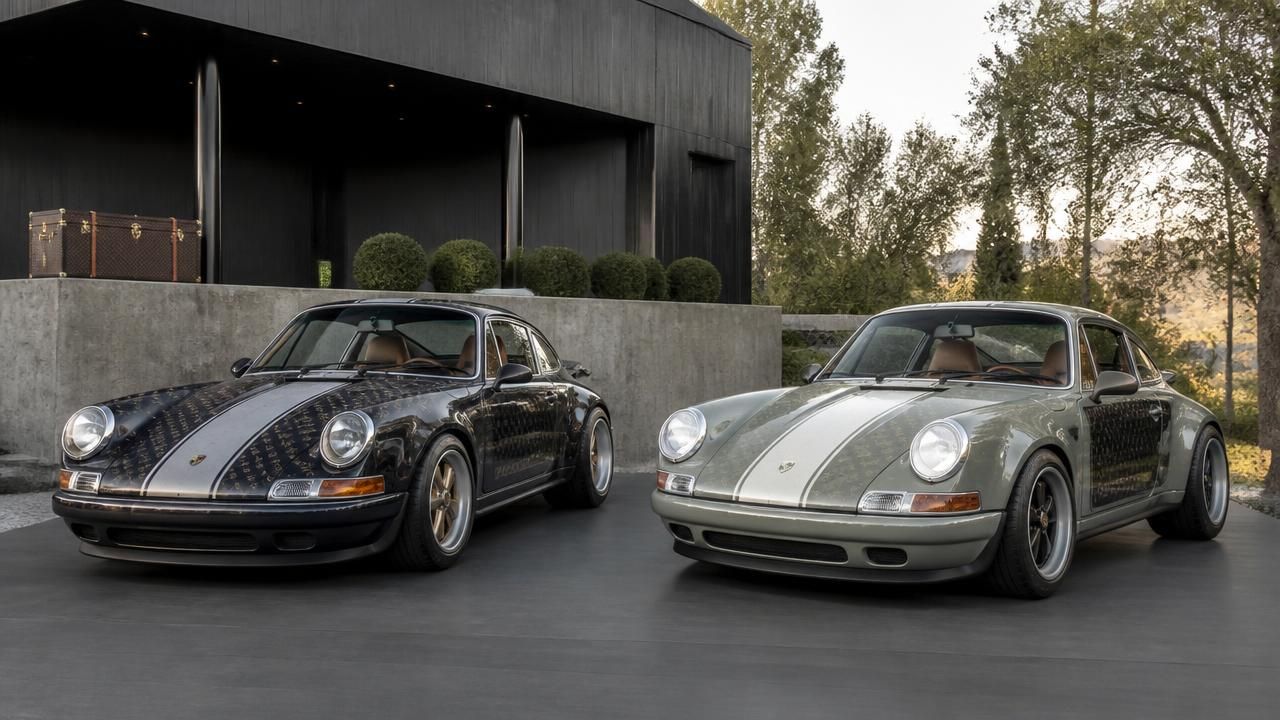
In a groundbreaking fusion of haute couture and high-performance automotive art, Louis Vuitton has joined forces with Singer Vehicle Design, the celebrated Porsche 911 restoration specialist, to create two bespoke reimagined 911s. The collaboration, announced this week, marks a historic first for both brands: it is Louis Vuitton's first-ever co-branded project, and Singer's inaugural partnership with a fashion house.
The announcement sent ripples through both the luxury and automotive worlds, with outlets from Bloomberg to Top Gear weighing in on the unexpected alliance. Bloomberg's coverage focused on the strategic significance, noting that Louis Vuitton has historically eschewed co-branding. WWD, which broke the exclusive story, highlighted the involvement of Nicolas Ghesquière, Louis Vuitton's artistic director of women's collections, who designed the custom touches for the cars.
A First-of-Its-Kind Collaboration
Rob Dickinson, Singer's British founder and a former Porsche racer, has spent over a decade perfecting the art of reimagining air-cooled Porsche 911s. His workshop in Sun Valley, California, transforms donor cars into bespoke masterpieces, often priced north of $1 million. The new partnership with Louis Vuitton elevates that concept to a new realm, blending the maison's leather craftsmanship and monogram heritage with Singer's mechanical and aesthetic precision.
According to sources, the collaboration yields two one-off vehicles, each tailored to a specific client. The cars are based on the 964-generation 911, Singer's favored canvas, and feature a host of Louis Vuitton design cues. While full specifications have not been released, early reports from Wallpaper* and Autoweek suggest the cars will showcase LV's iconic materials—including specially woven leather and hand-stitched interiors—alongside Singer's signature carbon-fiber bodywork and upgraded suspension.
The Timepiece Connection
Adding to the intrigue, MSN reports that the collaboration extends beyond the cars themselves to a limited-edition timepiece. Louis Vuitton's watchmaking division, based in Geneva, has crafted a bespoke chronograph that echoes the design language of the 911s. The watch is said to be "insane," according to MSN's headline, with a custom movement and dial inspired by the automotive collaboration. This dual launch underscores the brands' ambition to create a holistic luxury lifestyle package.
"This partnership was born from a shared obsession with perfection," said Rob Dickinson in a Bloomberg interview. "Louis Vuitton's artisans and our engineers speak the same language—the language of craft, precision, and timeless design."
Craftsmanship Meets Couture
For Louis Vuitton, the move into automotive co-branding is a significant strategic pivot. Historically, the maison—founded in 1854—has collaborated with artists like Yayoi Kusama, Jeff Koons, and Stephen Sprouse, but it has never put its name on another brand's product. Nicolas Ghesquière, who has been with Louis Vuitton since 2013, reportedly took a personal interest in the project, traveling to Singer's California workshop to oversee the design integration.
"Louis Vuitton has always been about travel and the art of movement," Ghesquière told WWD. "What better expression of that than a car? Singer has redefined the notion of the classic car, and together we are writing a new chapter in the story of luxury."
The collaboration also demonstrates how heritage brands can innovate by crossing industry boundaries. Singer, founded in 2009, has earned a cult following among car enthusiasts for its "restomod" approach—preserving the soul of the original 911 while enhancing performance and drivability. The company's client list includes celebrities and collectors, but this partnership opens doors to Louis Vuitton's vast global clientele.
The Business of Luxury Partnerships
Industry analysts view this collaboration as a mutual win. For Louis Vuitton, it reinforces its position at the intersection of luxury and exclusivity, while tapping into the lucrative automotive enthusiast market. For Singer, the association with a global fashion powerhouse elevates its brand visibility far beyond the car world.
- First-ever co-branding: Louis Vuitton has never before allowed another company's logo to appear alongside its own on a product.
- Two one-off cars: Each will be bespoke, with unique colors, materials, and personalization for its owner.
- Watch tie-in: A matching LV timepiece adds a collectible element, likely to appreciate in value.
According to Bloomberg's "Sector & Industry Performance" graph, luxury goods stocks have remained resilient, but the post-pandemic era demands fresh narratives. This collaboration creates a story that resonates with both traditional luxury buyers and a younger, experience-driven generation.
Different Lenses, One Story
Each outlet approached the story from a distinct angle. Bloomberg Markets framed it as a business milestone, interviewing Singer's leadership about the partnership's logistics. Wallpaper* focused on the design narrative, praising the "dialogue between couture and coachbuilding." Autoweek, ever the enthusiast publication, zeroed in on the technical specifications, noting Singer's renowned restoration process and the challenge of integrating LV's aesthetic without compromising the 911's driving dynamics. Top Gear, meanwhile, celebrated the sheer audacity of the collaboration, describing the cars as "two very special one-off creations" that push the boundaries of what a restomod can be.
What This Means for the Future
The collaboration is more than a novelty; it signals a growing convergence between luxury fashion and high-end automotive customization. As the automotive industry moves toward electric and autonomous vehicles, the emotional and artisanal value of classic cars becomes a premium commodity. Louis Vuitton's entry into this space could pave the way for similar partnerships—perhaps with other fashion houses or even automotive manufacturers.
For now, the two owners of these bespoke 911s will receive something truly singular: a car that embodies decades of automotive heritage and 160 years of Louis Vuitton craftsmanship. As Rob Dickinson put it in a statement to Top Gear, "We don't build cars for the mass market; we build them for the soul. This collaboration proves that soul has no boundaries."
Neither Louis Vuitton nor Singer has disclosed pricing, but given Singer's typical starting point of $300,000 and the extensive LV customization, each vehicle likely commands seven figures. The matching timepiece, if offered separately, will be a rare collector's trophy. For the rest of us, the collaboration is a tantalizing glimpse into a future where fashion and horsepower are not just compatible, but inseparable.