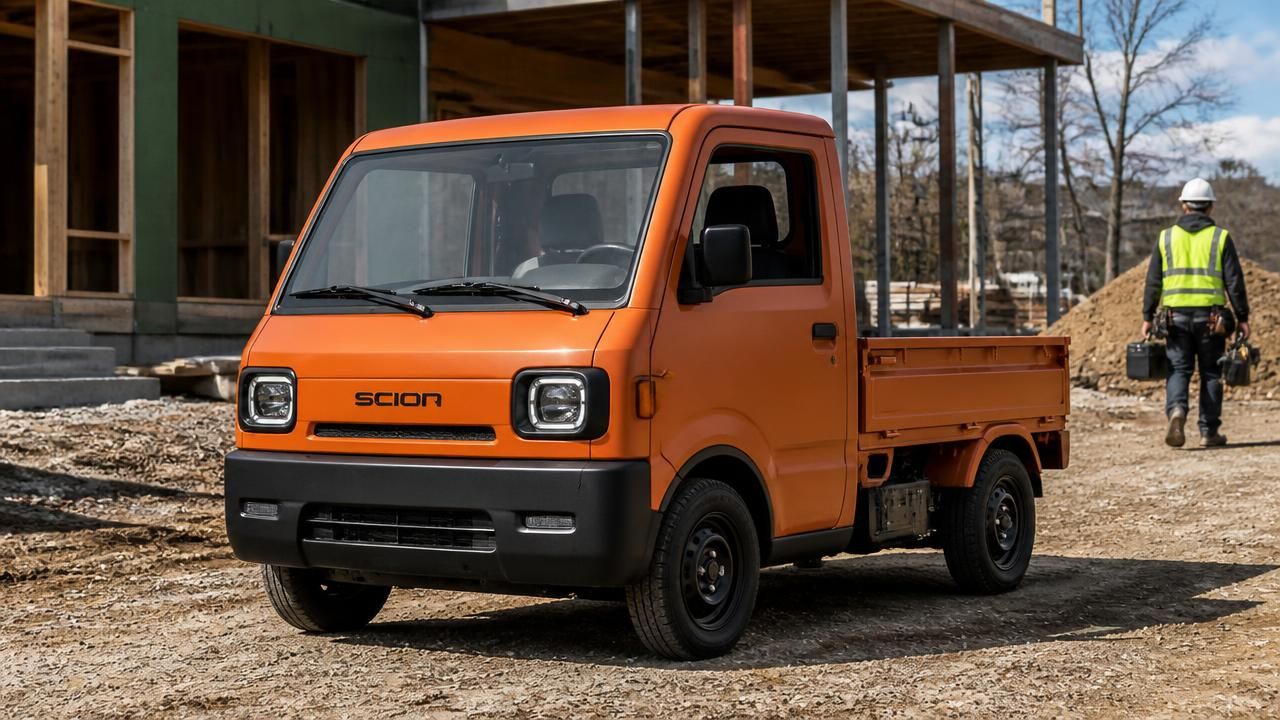
Toyota is resurrecting one of its most distinctive nameplates, but not in the way longtime fans might expect. The automaker is bringing back Scion as 'Scion by Toyota,' an experimental mobility incubator whose first vehicle is the 2028 Scion KEI-01, a compact kei-style pickup truck built in Indiana and limited to a top speed of 25 mph.
The move, reported by The Verge, Car and Driver, Hoodline and other outlets, marks a sharp pivot from Scion's original identity. Launched in 2003 as Toyota's youth-oriented brand, Scion built a following with affordable hatchbacks and boxy compacts before Toyota discontinued it in 2016. The new Scion will not chase young buyers with sporty small cars. Instead, it will serve as a test bed for unconventional mobility ideas, starting with a vehicle that looks more at home on a job site or college campus than on a highway.
A tiny truck with a very specific mission
The KEI-01 is an authentic Japanese-style kei truck, a category shaped by Japan's light-vehicle regulations, which favor tiny dimensions and modest power. According to Hoodline and Car and Driver, the truck will be built in Indiana and sold as a 2028 model. Its 25-mph top speed places it in low-speed-vehicle territory in the United States, not among conventional highway pickups. Toyota has not yet disclosed the powertrain, price, payload, range or battery details, and early Car and Driver coverage frames the KEI-01 as a 'what we know so far' model rather than a fully specified production vehicle.
Rather than targeting youth-market hatchbacks, 'Scion by Toyota' is being positioned as an experimental mobility incubator.
That framing, emphasized by The Verge, is central to understanding the revival. Toyota is not simply rebooting a dormant badge for nostalgia. It is using Scion as a lower-risk laboratory for vehicles and business models that might not fit under the Toyota or Lexus brands. A 25-mph kei truck is an unlikely mass-market product, but it could help Toyota learn how Americans use small, slow, highly maneuverable utility vehicles for local deliveries, campus fleets, industrial sites and short errands.
Why kei trucks are having a moment
Kei vehicles are enjoying a surge in global popularity, including in the United States. The Verge reported that more than 30,000 used kei trucks have been imported into the US since 2020, with roughly 7,500 units entering the country each year. Their appeal is easy to summarize: they are small, cheap to operate, easy to park and surprisingly useful for hauling light loads. For buyers who do not need highway capability, a kei truck can function as a hyper-efficient local workhorse.
But the used-import market has run into a patchwork of state rules. MSN's coverage notes that Toyota's 25-mph kei truck is coming to America while Georgia still restricts the imported ones. That contrast matters. Imported Japanese kei trucks can face registration, title and safety-compliance hurdles depending on the state. A model built in Indiana and engineered for the US market could sidestep some of those barriers, though its low top speed will still limit where it can legally travel.
Brand strategy and business stakes
The revival also shows how automakers are rethinking brand portfolios as they search for growth beyond traditional segments. The Verge casts Scion as an incubator, Car and Driver treats the KEI-01 as a future model to watch, and MSN and Hoodline emphasize the truck's American build and 25-mph cap. Those are different lenses on the same story: Toyota is testing a product category and a brand strategy at the same time.
Scion's original mission was to attract younger buyers with affordable, expressive vehicles. That experiment had mixed results. Reviving the name for low-speed utility vehicles may seem counterintuitive, but it gives Toyota a way to experiment without diluting its core badges. The Indiana manufacturing angle is also significant. It signals that Toyota is not treating the KEI-01 as a curiosity imported from Japan, but as a US-built project that could fit into local supply chains and regulatory frameworks.
What remains unknown
- Powertrain: Toyota has not confirmed whether the KEI-01 will be gasoline, electric or hybrid.
- Price: No MSRP or lease structure has been announced.
- Payload and dimensions: The truck's utility will depend on bed size, cargo capacity and towing.
- Availability: The 2028 model year is the only timing disclosed so far.
For now, the KEI-01 is less a conventional product launch than a signal. Toyota is betting that America's interest in tiny, low-speed utility vehicles is more than a novelty, and that Scion can serve as a credible umbrella for experiments that do not fit the mainstream market. If the truck succeeds, it could open the door to more unusual Scion-badged mobility projects. If it remains a niche curiosity, Toyota will have learned that at a relatively low cost, with one of its oldest youth brands doing the teaching.