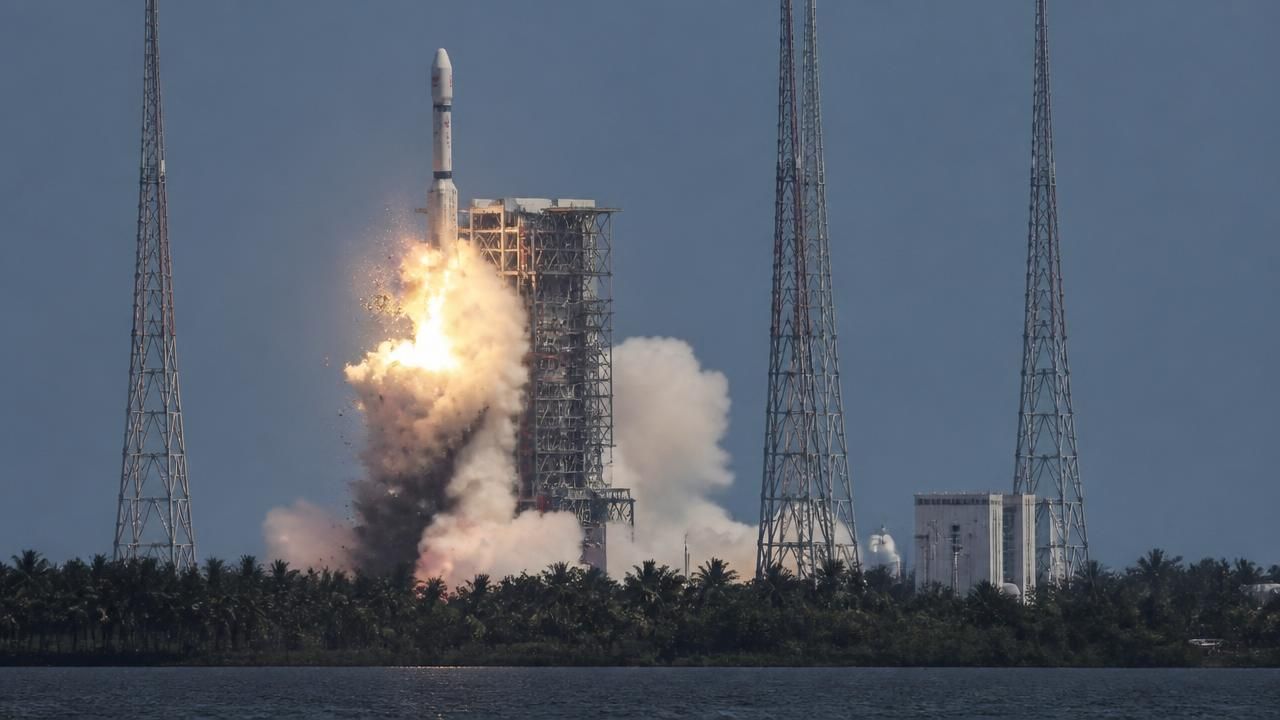
The global space launch industry witnessed a dramatic setback on Monday evening when one of China's most reliable rockets, the Long March 7A, exploded shortly after liftoff from the Wenchang Space Launch Site. The incident, captured in amateur video and reported by Ars Technica, occurred about 80 seconds into the flight, just as the rocket's first stage was expected to separate. The payload, believed to be a military communications satellite, was lost in the explosion. Chinese state officials have not yet commented, leaving the cause of the failure under investigation.
The Long March 7A, developed by the China Aerospace Science and Technology Corporation (CASC), is a medium-lift rocket designed to carry payloads to geostationary transfer orbit. It is a variant of the original Long March 7, which first flew successfully in 2016, and was expected to become a workhorse for China's space program. The failure is a significant blow to China's launch schedule, which includes ambitious plans for a lunar rocket debuting in 2026, as reported by universemagazine.com.
Long March 7A: A Workhorse Falters
The Long March 7A has been touted as a reliable, cost-effective option for both commercial and governmental missions. Its explosion on Monday, local time, marks the first failure of this variant. The rocket lifted off nominally, but video footage showed a sudden burst of light and debris about 1 minute and 20 seconds into the flight. The precise failure mode remains unclear, but experts point to potential issues with the first stage engines or structural integrity.
The Space Review, in a commentary titled "When a workhorse falters," emphasized the broader implications:
"The Long March 7A is central to China's plans for high-frequency launches, including crewed missions and space station resupply. A failure like this forces a reevaluation of timelines and raises questions about quality control across the program."
The payload, which was classified but widely reported to be a military communications satellite, underscores the strategic importance of the mission. While China has experienced past launch failures, the Long March 7A had been seen as a dependable vehicle. The loss could delay satellites needed for national security and civilian communications.
China's Expanding Launch Family
Despite the setback, China's space program continues to diversify. The Jielong 1, a small satellite launcher developed by the state-owned China Aerospace Science and Technology Corporation, completed a successful first flight in August 2019, as detailed by Spaceflight Now. That rocket is designed for quick, low-cost launches of small satellites into low Earth orbit, a growing market.
The original Long March 7 also had a successful debut in 2016, proving the design's core capabilities. The newer 7A variant, however, adds a third stage for higher orbits, increasing complexity. The failure may prompt a review of the entire Long March 7 family, potentially delaying crewed missions to China's Tiangong space station, which rely on the similar Long March 7.
Looking further ahead, China is developing a new heavy-lift rocket for lunar missions, with a debut expected in 2026. That vehicle, which remains unnamed in public reports, will be crucial for China's goal of landing astronauts on the Moon by 2030. Monday's failure could influence its design and testing schedule, as engineers seek to understand what went wrong with the 7A.
Global Launch Industry: A Mixed Bag
The Long March 7A failure is not the only recent setback in the space launch industry. On the commercial front, SpaceX suffered a Starship prototype failure during a suborbital test, with the vehicle breaking apart minutes after reaching space. However, SpaceX successfully salvaged wreckage from the ocean floor, providing valuable data for future iterations. The event was covered extensively by Reuters and Ars Technica's Rocket Report.
Meanwhile, United Launch Alliance (ULA) has been positioning its new Vulcan rocket as a competitor to SpaceX's Falcon 9. The Vulcan, which is set to debut with the Atlas 5's first mission of 2022, promises lower costs and higher performance. ULA touts the rocket's reusability and methane-fueled engines as key advantages in a crowded market.
Other Notable Launch Developments
- China's Jielong 1: A small satellite launcher successfully deployed several payloads on its first mission, showcasing China's ability to serve the booming smallsat market.
- ULA's Atlas 5: The unflown variant of the Atlas 5 will debut in 2022, but the rocket's future is tied to the Vulcan's success as ULA phases out older vehicles.
- SpaceX Starship: Despite the recent failure, SpaceX continues to iterate, with a focus on salvaging components and learning from fractures.
- Virgin Galactic: Pessimism surrounds the suborbital space tourism company, which is facing delays and financial hurdles, according to Ars Technica.
Differing Perspectives in the Media
Each outlet approached the Long March 7A story with a distinct angle. Ars Technica provided breaking news coverage with amateur video and technical details. The Space Review offered analysis of the rocket's role and consequences. Spaceflight Now, while also covering the failure, balanced it with reports on other Chinese launches and ULA's progress. Reuters, focused on SpaceX's Starship, included the incident in a broader context of spaceflight risk.
This diversity highlights a key truth: the space industry is inherently risky, and both successes and failures are essential learning opportunities. China's response to the Long March 7A failure will shape its trajectory in space, just as SpaceX's iterative approach to Starship and ULA's transition to Vulcan define their futures.
Looking Ahead
The investigation into the Long March 7A explosion will be closely watched. CASC has a strong track record of identifying and correcting issues, but the timeline for returning the rocket to flight remains uncertain. For now, the space community waits, knowing that each failure brings the world one step closer to safer, more reliable access to orbit.
In the meantime, the resilience of the global launch industry is evident. New rockets are emerging, old ones are being retired, and every mission—successful or not—contributes to the collective knowledge needed to explore beyond Earth.