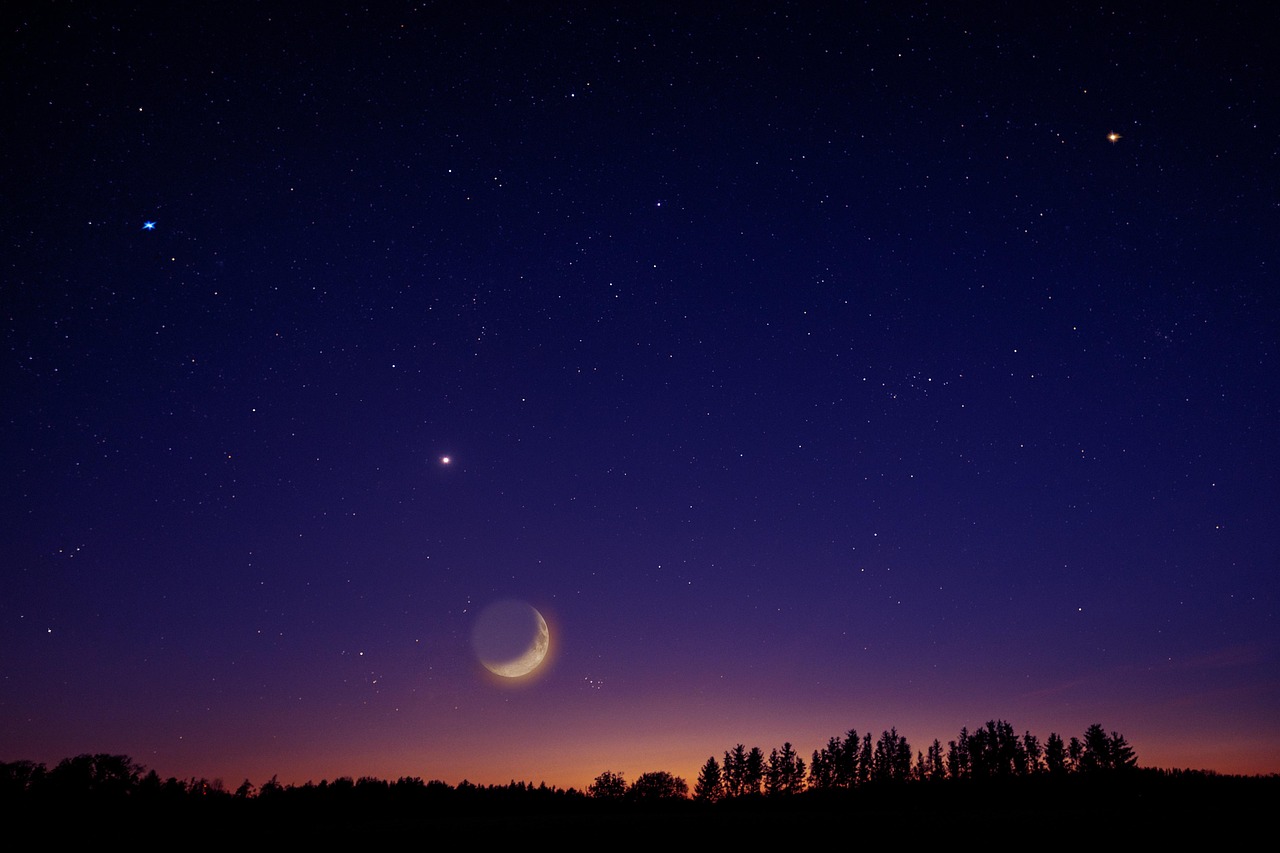
For a few nights in early-to-mid November 2026, skywatchers across the Northern Hemisphere were treated to a slow-motion celestial rendezvous involving three of the night sky’s most familiar characters: the crescent Moon, brilliant Venus and the blue-white star Spica. The event drew attention from NASA’s Astronomy Picture of the Day, which published a striking image on Nov. 12, and from daily skywatching columns that tracked the encounter step by step.
NASA’s APOD featured a photograph by Włod captured in Poland, showing a thin crescent Moon hanging above the Tatra Mountains. Bright Venus glowed nearby, a little lower on the horizon, while Spica in the constellation Virgo, the Maiden, shone to Venus’s left. The image turns a routine conjunction—an apparent close approach of celestial bodies along the same line of sight—into a serene landscape portrait.
A meeting written in orbital mechanics
Such encounters are not random. As NASA’s APOD explanation notes, planets wander against the fixed stars, and the word planet itself derives from the Greek notion of a “wandering star.” Venus, orbiting closer to the Sun than Earth, moves quickly through our sky. The Moon completes an orbit around Earth in about 27.3 days. Spica, meanwhile, is a distant stellar anchor some 250 light-years away. When these objects appear to gather, they are following precise laws of celestial mechanics rather than physically approaching one another.
‘Not all those who wander are lost,’ NASA’s APOD entry begins, using the familiar line to explain why planets appear to roam among the stars.
The result is a conjunction: a line-of-sight alignment that can be beautiful in a telescope, a camera or the unaided eye. In reality, the Moon is about 384,000 kilometers from Earth, Venus is millions of kilometers away and Spica is roughly 250 light-years distant. Their apparent closeness is a matter of perspective—a cosmic coincidence of geometry and timing.
A sequence of skywatching dates
The encounter unfolded over several nights. On Nov. 4, MSN’s sky column highlighted Venus and Spica standing close together. Three nights later, on Saturday, Nov. 7, the same outlet noted Venus meeting the Moon. By the time NASA published its APOD on Nov. 12, the scene had become a three-object tableau: Moon, Venus and Spica all within the same broad region of the evening sky.
Forbes framed the Moon-Venus pairing as the closest meeting of 2026, a headline that emphasized the event’s appeal to casual observers. The Forbes excerpt available did not include detailed observing guidance, but its title captured the competitive language often used in skywatching coverage: closest, brightest, best. MSN’s daily columns, by contrast, served as a calendar, breaking the event into dated steps and helping readers know when to look. NASA’s APOD supplied the reflective, educational centerpiece, combining a polished image with an explanation of the astronomy behind it.
Spica’s stellar surprise
The star to Venus’s left is more than a pretty backdrop. Spica is one of the brightest stars in the sky, and its proximity—about 250 light-years—makes it a useful marker in the constellation Virgo. In 1890, astronomers found that Spica is a binary star: two massive blue stars orbiting each other every four days. More recently, NASA’s APOD notes, it was reported earlier this year that Spica is actually a triple system. That detail adds a layer of scientific intrigue to a scene that many viewers might enjoy simply as a beautiful alignment.
News of the triple system also illustrates how even well-studied objects can yield surprises. Spica has been a fixture of the night sky for millennia, yet improvements in astronomical instruments and analysis can revise its classification. For skywatchers, the conjunction offered a chance to see a famous star in context, paired with the Moon and Venus—objects that are far closer and yet appear as neighbors.
Why the story resonated
Conjunctions are among the most accessible events in astronomy. They require no special equipment, encourage people to step outside and look up, and often produce striking photographs when paired with landscapes or landmarks. The APOD image from Poland, with the Tatra Mountains forming a dark silhouette below the crescent Moon, is a good example: it connects the clockwork of the solar system to a specific place and moment on Earth.
The coverage also shows how different outlets approach the same sky event. NASA’s APOD leans into explanation and wonder, using literary allusion and scientific detail. Forbes leans into anticipation, promoting the Moon-Venus meeting as the closest of the year. MSN’s sky columns lean into utility, telling readers what to look for on specific dates. Together, they form a rounded portrait of a news event that is, at heart, a reminder that the night sky remains a shared public spectacle.
For observers who missed the exact nights, the event is still a lesson in how the solar system works. The Moon, Venus and Spica did not actually converge in space; they converged in our view. That distinction is central to understanding conjunctions, and it is why astronomers can predict them with precision while still inviting the rest of us to enjoy the show.