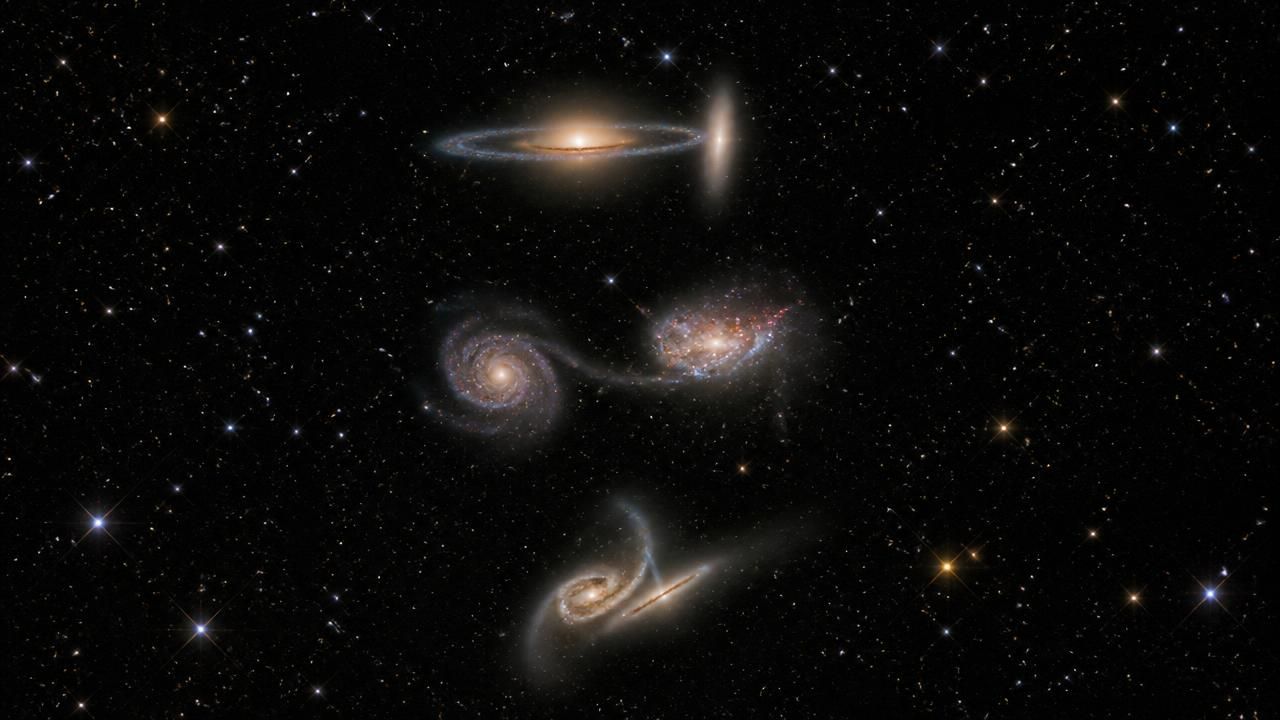
Every day, NASA's Astronomy Picture of the Day (APOD) delivers a new cosmic vista, and the August 10, 2026, installment is no exception. Titled "Three Galaxy Pairs," the featured image, captured by astrophotographer Rafael Sampaio, offers a stunning tableau of six galaxies arranged in three distinct pairs. The image is not just a visual feast but a scientific snapshot of galactic evolution, showcasing everything from polar-ring galaxies to systems on the verge of merging.
A Daily Cosmic Tour
APOD has been a beloved fixture for astronomy enthusiasts since 1995. Each day, the service highlights a different astronomical image or photograph, accompanied by a concise explanation written by a professional astronomer. The August 10, 2026, entry is part of a continuous stream that includes recent features such as "Contemplating the Sun" (August 9) and "Rubin's Cosmos Field" (August 7), underscoring the breadth of cosmic phenomena covered by the program.
The Three Pairs Explained
The image presents three pairs of galaxies, each with its own story. According to the official APOD explanation, these pairs are not merely random alignments; they represent different stages and types of galactic interactions.
The Top Pair: A Polar-Ring Mystery
At the top of the image, the galaxies NGC 4650A and a companion appear to be separate, with no current signs of interaction. However, NGC 4650A is a rare polar-ring galaxy, featuring a central disc perpendicular to a ring of gas and stars. Such structures are believed to form from past galactic collisions, where material is stripped and re-formed in a new orientation. This suggests that while the pair is quiescent now, it may be the aftermath of a violent cosmic merger.
The Middle Pair: A Visual Illusion
The central pair, consisting of the barred spiral galaxy NGC 4650 and a smaller companion, looks as though they might be gravitationally entwined. But the APOD explanation cautions that their relative velocities indicate they are likely not interacting. This serves as a reminder that line-of-sight alignments can be deceiving in astronomy, and what looks like a partnership may be a cosmic coincidence.
The Bottom Pair: On a Collision Course
The third pair, NGC 4622A and NGC 4622B, is actively interacting. The two galaxies are clearly disturbing each other's structure, likely through gravitational tides. The APOD text notes that in perhaps a billion years, these two will merge into a single galaxy, providing a live example of the process that shapes galaxy evolution across the universe.
The Centaurus Cluster Context
All six galaxies are likely members of the larger Centaurus Galaxy Cluster, one of the richest galaxy clusters in the nearby universe. This cluster is a cosmic laboratory for studying galaxy interactions, as its dense population increases the likelihood of collisions and mergers. The APOD image therefore offers a microcosm of galactic dynamics.
Other Recent APODs: A Broader Perspective
The APOD program is not limited to galaxies. On August 9, the featured image was "Contemplating the Sun," a look at our host star's activity, likely highlighting sunspots or prominences. On August 7, "Rubin's Cosmos Field" took viewers on a deep dive into a wide-field survey, possibly referencing the Vera C. Rubin Observatory's contributions to mapping the sky. Together with August 10's galaxy pairs, these entries demonstrate the program's commitment to covering phenomena from the solar system to the edge of the observable universe.
Reactions and Coverage
APOD's daily features are widely covered by science media outlets, each bringing its own editorial lens. Some emphasize the visual appeal, while others dive into the astrophysics. The "Contemplating the Sun" feature, for instance, may be framed as a reminder of solar cycles and space weather, while "Rubin's Cosmos Field" could be tied to ongoing surveys of dark matter and dark energy. In this way, multiple sources converge on the same astronomical events, enriching public understanding.
"Each of these pairs of galaxies is different." — APOD editors
For those inspired to explore further, APOD maintains an extensive archive, searchable by date and topic. It is a resource that continues to educate and inspire, one day at a time.
Why APOD Matters
APOD's power lies in its accessibility. Each day, professional astronomers distill complex concepts into understandable explanations, accompanied by captivating visuals. The program is a collaborative effort between NASA's Goddard Space Flight Center and universities, with editors Robert Nemiroff, Jerry Bonnell, Cecilia Chirenti, and Keighley Rockcliffe shepherding the content. As the August 10 entry shows, the universe is full of dynamic processes that are both beautiful and scientifically profound. Whether it's a polar-ring galaxy hinting at past violence or a pair on the verge of merging, every APOD image is a window into the cosmos.
Looking Ahead
Tomorrow's APOD promises another "many moons" view, as hinted in the August 10 post. The momentum of daily discovery keeps astrophysics fresh and accessible. In an era of rapid astronomical advancement, APOD remains a steady, reliable guide to the ever-changing sky.