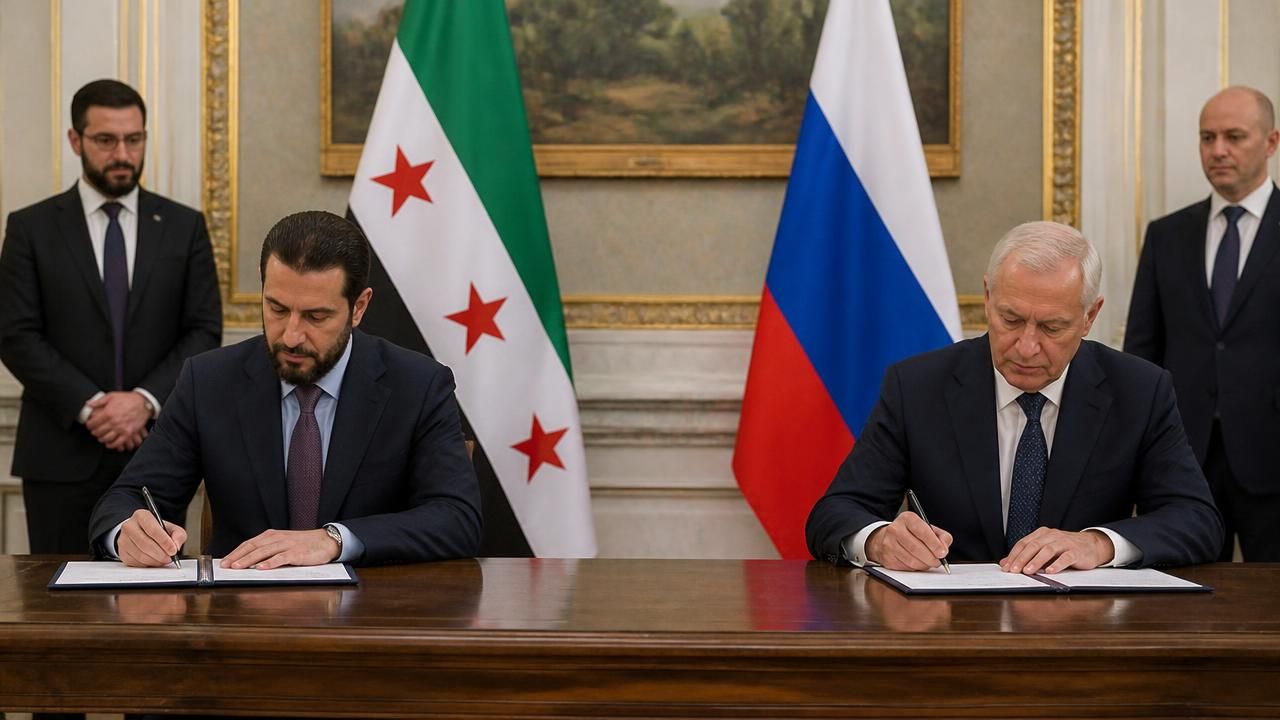
In a significant geopolitical development, Syria and Russia have signed a new memorandum of understanding to reorganize the Russian military presence on Syrian territory. The agreement, confirmed by multiple sources on Thursday, specifically addresses the future of two key Mediterranean installations: the Khmeimim air base in Latakia province and the Tartus naval base. After more than a year and a half of contentious negotiations, Damascus and Moscow have finally aligned on a framework that preserves Russia's military foothold on Syria's coast while reshaping the operational parameters of its forces.
A New Phase in Syrian-Russian Relations
The Syrian government described the accord as opening "the way for a new phase in relations between the two countries," according to The New York Times. The state-run Syrian Arab News Agency (SANA) echoed this sentiment, stating that the two sides agreed to "reorganize Russian military presence under a new memorandum." The memorandum effectively replaces earlier arrangements that had governed Russia's military footprint since its intervention in Syria's civil war in 2015.
Turkish media outlet Türkiye Today reported that the agreement commits both nations to "transform" the Khmeimim and Tartus bases, suggesting that the facilities will be modernized or repurposed. Ynetnews similarly framed the deal as a move to "preserve Russia's military foothold on the Mediterranean coast," underscoring Moscow's strategic interest in maintaining a warm-water naval and air presence near the eastern Mediterranean.
Negotiating for 18 Months
The path to this agreement was neither quick nor straightforward. Negotiations stretched over roughly a year and a half, reflecting the complexity of balancing Syria's post-war sovereignty ambitions with Russia's security demands. News.az highlighted the question on many minds: "What happens to Russia's Syria bases?" The answer, it reported, is a "new plan" unveiled by Damascus and Moscow. The prolonged talks suggest that thorny issues—such as the legal status of Russian personnel, rental terms, and the scope of operations—required extensive bilateral diplomacy.
The agreement also comes against a backdrop of shifting dynamics on the ground. The Syrian Observer reported that Russia is reducing its forces in the northern city of Aleppo and transferring part of them to Hmeimim (also spelled Khmeimim). This repositioning indicates a consolidation of Russian assets along the coast, likely to ensure more secure lines of communication and supply, while possibly ceding ground in less strategically vital areas.
Strategic Significance of Khmeimim and Tartus
Khmeimim air base, located south of Latakia, has been the hub of Russian air operations in Syria since 2015. It has played a critical role in turning the tide of the civil war in favor of President Bashar al-Assad's government. The Tartus naval base, further south, is Russia's only permanent naval facility in the Mediterranean and has been essential for projecting power into the Middle East, North Africa, and beyond.
The memorandum ensures that Russia retains access to both facilities, albeit under a reorganizational framework. According to Mezha.net (via its headline), the agreement aims to "reshape military presence on the Syrian coast." While the specifics have not been fully disclosed, the transformation is expected to include changes to force levels, equipment storage, and operational coordination with Syrian forces.
Official Tours Signal Approval
In a public display of approval, Syrian Foreign Minister Asaad Hassan al-Shaibani toured the Latakia airport and the Tartous port shortly after the agreement was announced, as reported by SANA. The visit served to reinforce the Syrian government's endorsement of the new terms and to demonstrate that the facilities remain under effective Syrian—and now jointly managed—control. Al-Shaibani's tour was widely interpreted as a signal that Damascus is comfortable with the reorganized presence and that the agreement is a cornerstone of its strategic partnership with Moscow.
Regional Reactions and Implications
Regional observers have viewed the deal with a mixture of pragmatism and concern. For Russia, the agreement secures its Mediterranean ambitions at a time when its military resources are stretched by the war in Ukraine. For Syria, it provides a continued security umbrella and economic backing from a powerful ally, even as the government seeks to rebuild diplomatic relations with the Arab world.
However, not all parties view the arrangement favorably. The Syrian Democratic Forces (SDF), which control parts of northeastern Syria, have sought to carve out their own understanding with the interim government. A separate report from ANHA (Hawar News Agency) quoted Fawza Youssef, an SDF official, explaining a distinct agreement between the SDF and the interim government—an unrelated yet simultaneous development that underscores the fragmented nature of Syria's political landscape. While that story is separate, it highlights that the Russian presence remains a touchstone for various factions within Syria.
Looking Ahead
The new memorandum is expected to be formalized in the coming days through an official signing ceremony, according to sources. Details on the duration of the agreement, the precise number of troops to be stationed, and the financial terms have yet to be made public. Yet, the very fact that both sides were able to reach common ground after such lengthy negotiations suggests a mutual recognition of their interdependence.
As Russia tightens its grip on the coastal enclave and Syria continues its delicate balancing act between international re-engagement and strategic reliance on Moscow, the reorganized bases will likely serve as a linchpin of stability—or contention—for years to come. The deal marks not the end of a story, but the beginning of a new chapter in the complex and often opaque alliance between Damascus and the Kremlin.