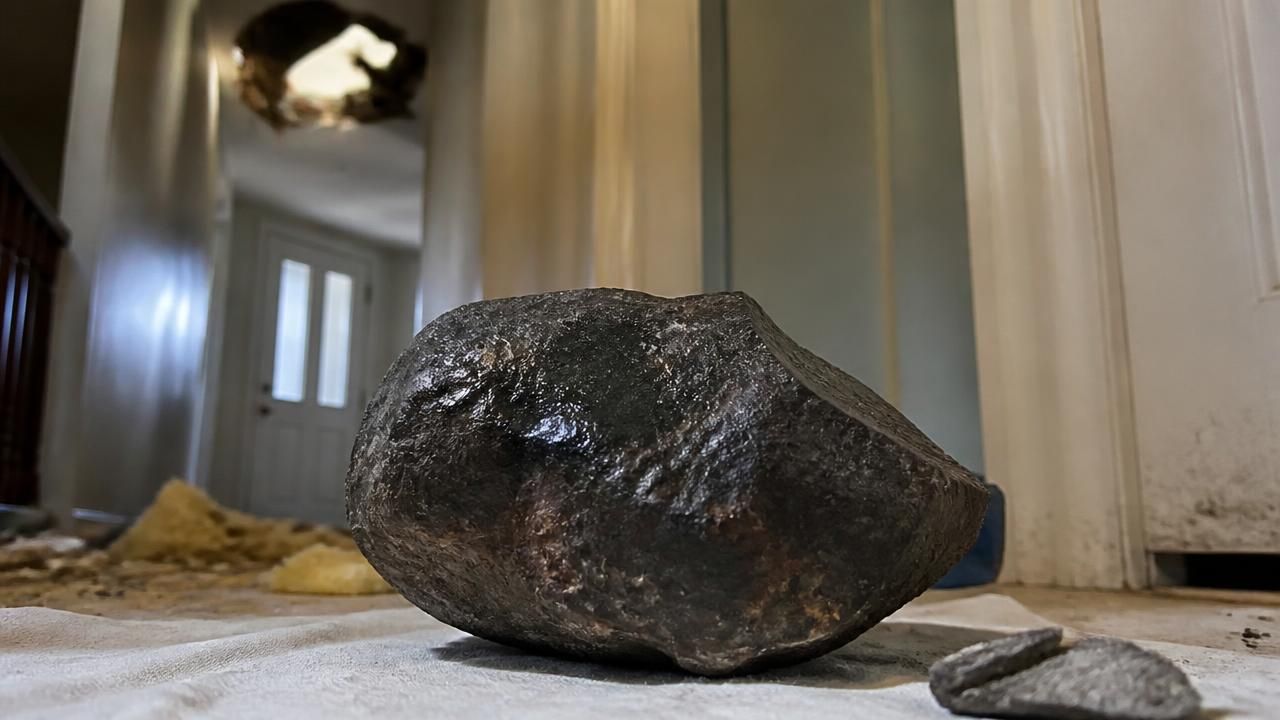
On a sunny afternoon in May 2021, a small rock crashed through the roof of a home in Hopewell Township, New Jersey, narrowly missing a resident who had been sitting in a nearby room. At first, the homeowner assumed it was a piece of asphalt or debris from a passing truck. But when the object was retrieved—still warm to the touch—it was quickly identified as something far more extraordinary: a rare meteorite, one of the most primitive types known to science.
Now, after more than a year of intensive study, researchers have revealed that this football-sized space rock, named the Titusville meteorite after its discovery location, holds a treasure trove of organic compounds, including amino acids, and evidence of ancient salty fluids. The findings, published in the journal Meteoritics & Planetary Science, offer a unique window into how the building blocks of life may have been delivered to early Earth.
An Unexpected Visitor
The meteorite's arrival on Earth was anything but typical. It punched through the roof of a private residence, bounced off a floor joist, and came to rest in a hallway. The homeowner, who has chosen to remain anonymous, contacted local authorities after noticing the object's unusual appearance. Within days, scientists from Rowan University and the American Museum of Natural History were dispatched to examine the specimen.
Because the meteorite was collected within hours of impact—unlike many falls that await recovery for years or decades—it offered researchers an exceptionally rare opportunity: a pristine, unweathered sample of a primitive asteroid. "This is a once-in-a-generation event," said Dr. Harold Connolly, a meteoriticist at Rowan University and a study co-author. "Meteorites that fall through a roof and are immediately recovered are incredibly rare. Most are weathered by rain, soil, or human handling, which contaminates their chemistry. This one is as clean as it gets."
A Rare Cosmic Relic
Analysis showed that the Titusville meteorite belongs to a class known as carbonaceous chondrites, which are thought to be remnants of the early solar system's building blocks. These meteorites are composed of primitive materials that have remained largely unchanged for 4.6 billion years, containing dust, ice, and organic matter that predates the planets.
Carbonaceous chondrites are rare amongst meteorite falls—only about 4% of all meteorites fall into this category. But they are particularly prized by scientists because they contain water and complex organic molecules. The Murchison meteorite, which fell in Australia in 1969, famously yielded dozens of amino acids, the building blocks of proteins. Since then, researchers have been searching for other carbonaceous chondrites to understand how such compounds form and how they might have seeded Earth with life's molecular precursors.
Evidence of Ancient Water and Organics
The Titusville meteorite did not disappoint. Using a range of advanced analytical techniques, including electron microscopy, X-ray diffraction, and mass spectrometry, the team detected mineral signatures that can only form in the presence of liquid water. These minerals, such as phyllosilicates and carbonates, were deposited by salty, alkaline fluids that once flowed through the asteroid's parent body billions of years ago.
More remarkably, the meteorite contained a suite of organic molecules, including several amino acids. The researchers identified both proteinogenic amino acids—which are used by life on Earth to build proteins—and non-proteinogenic ones, which are rare in biology but common in meteorites. The relative abundances suggest these compounds were formed by abiotic processes, possibly in the presence of water and ammonia.
"The combination of pristine organics and evidence of aqueous activity makes this meteorite a true time capsule," said Dr. Jessica Rodriguez, a planetary scientist at the American Museum of Natural History and lead author of the study. "It's like opening a freezer that's been sealed for billions of years."
Implications for Life's Origins
The discovery adds new weight to the theory that comets and asteroids delivered essential organic molecules to early Earth. During the heavy bombardment period, approximately 4 billion years ago, the inner solar system was pummeled by countless space rocks. If these impacts brought water and organic compounds to the surface, they could have contributed to the chemical 'soup' that eventually gave rise to life.
What makes Titusville particularly important is the absence of terrestrial contamination. Organic compounds from meteorites are often degraded by Earth's moisture and microbes, but because this sample was so quickly recovered, its chemistry is close to its original form. This allowed the team to confidently separate the meteorite's own organic inventory from any earthly fingerprints.
The findings also hint at the potential for life beyond Earth. "If these processes were common in the early solar system, then similar amino acids and salts could exist on other asteroids, moons, and possibly even planets," noted Dr. Connolly. "Missions like NASA's OSIRIS-REx and JAXA's Hayabusa2 are returning samples from asteroids that we hope will show similar chemistry. The Titusville meteorite is a preview of what they might find."
- The meteorite is classified as an ungrouped carbonaceous chondrite, distinct from other known meteorites.
- It contains evidence of a brine that could have catalyzed organic reactions.
- Amino acids identified include glycine, alanine, and valine, among others.
- The sample will be curated at the American Museum of Natural History and made available for further research.
Ongoing Research
While the current study provides a comprehensive look at the meteorite's chemistry, many questions remain. How exactly did the amino acids form? What kind of parent body did the asteroid come from? And could these compounds have interacted with minerals to create even more complex structures, such as nucleotides?
The research team hopes to continue analyzing the meteorite, using even more sensitive instruments to detect trace isotopes and organic polymers. They also plan to compare its composition with samples returned by spacecraft missions, which will help calibrate and interpret those findings.
For now, the Titusville meteorite stands as a remarkable reminder that life's ingredients are not unique to Earth. As the first and only carbonaceous chondrite recovered from a building roof in the United States, it has already earned its place in the history of science. But its true legacy may lie in the clues it holds to one of humanity's oldest questions: How did life begin?