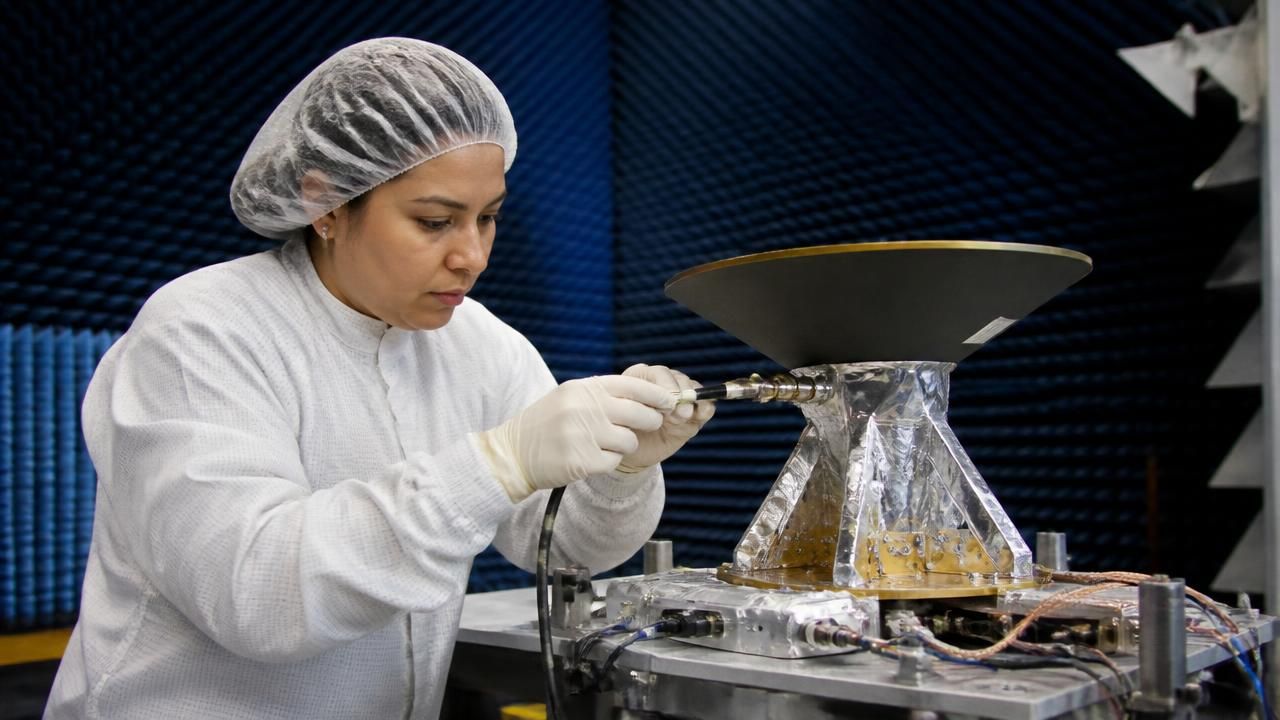
In a cleanroom at NASA's Jet Propulsion Laboratory in Southern California, engineer Maya Román carefully connects a coaxial cable to a test antenna, her hands steady as she prepares for a critical measurement. The antenna, destined for NASA's SkyFall mission, is being tested in the Environmental Test Lab's electromagnetic interference chamber—a facility designed to ensure that the hardware will operate flawlessly in the harsh, radio-quiet environment of Mars.
SkyFall is a bold new mission that will send three aircraft to the Red Planet, each equipped with four scientific instruments. Among them is a ground-penetrating radar that will study the Martian subsurface in unprecedented detail. The antenna testing at JPL marks a key milestone in the mission's development, bringing scientists one step closer to understanding Mars' hidden geology and water ice reservoirs.
Following Ingenuity's Flight Path
SkyFall's aerial approach builds directly on the legacy of NASA's Ingenuity Mars Helicopter, which made history as the first powered, controlled flight on another planet. Over nearly three years, Ingenuity flew 72 times, defying expectations and proving that flight in the rarefied Martian atmosphere is not only possible but also scientifically valuable. The little helicopter helped the Perseverance rover team plan time-saving routes and identify promising locations for sample collection, demonstrating the power of an aerial perspective.
SkyFall takes that concept to the next level. Instead of a single rotorcraft, the mission will deploy three aircraft, each carrying a suite of instruments designed to map the Martian surface and subsurface from above. The ground-penetrating radar, in particular, will pierce the planet's crust to reveal layers of rock, ice, and sediment that remain invisible to orbiting spacecraft.
The Role of Ground-Penetrating Radar
Ground-penetrating radar (GPR) works by transmitting radio waves into the ground and measuring the reflected signals. Different materials—such as ice, rock, or dry soil—reflect these waves differently, allowing scientists to create a cross-sectional image of the subsurface. On Mars, GPR is a powerful tool for locating water ice, which is essential for future human exploration and for understanding the planet's climate history.
The SkyFall GPR antennas are being tested at JPL to ensure they can operate in the extreme conditions of Mars, including the planet's thin atmosphere and intense temperature swings. The test chamber at the Environmental Test Lab is designed to minimize electromagnetic interference, giving engineers a controlled environment to measure antenna patterns and performance.
“This is where we confirm that the antenna will perform exactly as designed once it reaches Mars,” said Maya Román, SkyFall ground-penetrating radar engineer. “Every reflection, every reading we get here on Earth helps us predict what the radar will see millions of miles away.”
Why the Antenna Points Up
During the test, the antenna was pointed upward to minimize reflections and interferences with the antenna pattern. In the enclosed chamber, radio waves bouncing off floors and walls could distort the measurements. By orienting the antenna upward, engineers can isolate the antenna's true radiation pattern, ensuring that the data collected during the test is clean and accurate.
This meticulous attention to detail is characteristic of NASA's approach to planetary missions, where every component must be tested and retested to survive the journey and the harsh environment at the destination.
The Road to Launch
SkyFall is expected to launch aboard NASA's Space Reactor-1 Freedom in late 2028. This upcoming mission will carry the trio of aircraft to Mars, where they will be deployed to explore regions that are difficult for rovers to reach—steep canyon walls, polar ice caps, and other scientifically tantalizing terrains.
The use of multiple aircraft allows for simultaneous observations and cooperation between platforms. One aircraft could spot an interesting geological feature while another swoops in for a closer look, creating a coordinated aerial survey that would be impossible with a single vehicle.
Scientific Implications
The data collected by SkyFall's ground-penetrating radar could have profound implications for our understanding of Mars. Subsurface ice is a critical resource for future crewed missions, providing water for drinking, oxygen production, and rocket fuel. Mapping these ice deposits is a top priority for NASA, and SkyFall is poised to make a major contribution.
Additionally, the radar could reveal buried layers of sediment and ancient riverbeds, offering clues about Mars' past climate and the potential for past life. By probing beneath the surface, SkyFall will complement the work of orbiters and rovers, painting a more complete picture of the Red Planet.
Expert Perspectives
Beyond Román, other mission scientists see SkyFall as a game-changer. Dr. Elena Vasquez, a Mars geologist and SkyFall science team member, explains: “The ability to fly multiple aircraft with radar gives us a bird's-eye view that is also a subterranean view. It's like having a fleet of flying geologists that can see beneath the surface.”
The mission also represents a technological leap in autonomy. The three aircraft will need to navigate Mars' challenging terrain without real-time human control, relying on onboard sensors and algorithms to avoid obstacles and adjust their flight paths. This autonomy builds on the lessons learned from Ingenuity, which required frequent commands from Earth but still demonstrated remarkable resilience.
Looking Ahead
As the antenna tests at JPL continue, the SkyFall team is moving forward with other aspects of spacecraft assembly and testing. The successful completion of these tests will clear the way for integration into the launch vehicle and ultimately for a journey that will expand humanity's reach on Mars.
While much work remains, the sight of Román and her colleagues in the cleanroom is a reminder of the meticulous engineering that underpins every successful space mission. SkyFall is not just about flying—it's about peering into the unseen, revealing what lies beneath the Martian surface, and bringing us closer to a future where humans can live and work on another planet.