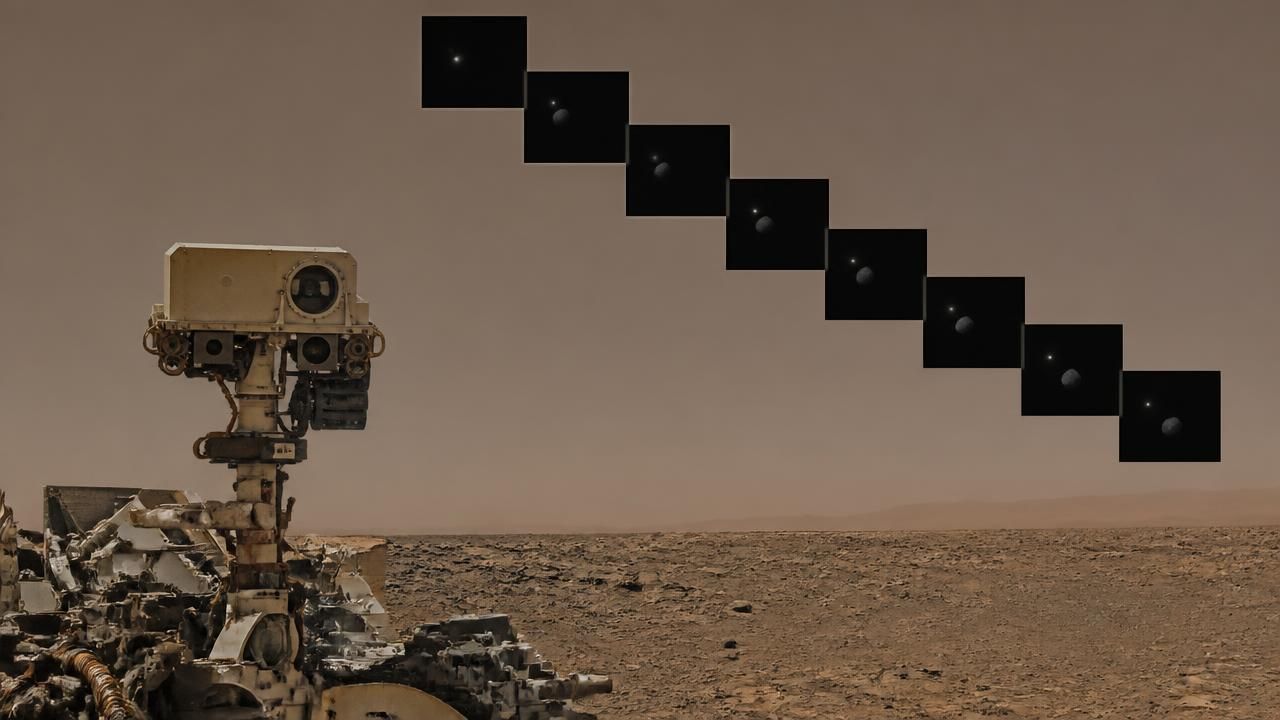
NASA's Perseverance rover has once again turned its cameras skyward, capturing a dramatic solar eclipse on Mars and a rare composite showing Earth passing behind the Red Planet's moon Phobos. The new images, taken by the rover's Mastcam-Z instrument, are both visually stunning and scientifically valuable, providing fresh data on Phobos's ever-changing orbit.
What Happened
On July 2, 2026 — the 1,907th Martian day, or sol, of the mission — Perseverance snapped a series of images showing Earth, a bright dot, moving from upper left to lower right and slipping behind Phobos. NASA released the composite as a seven-image mosaic, with the background blacked out to enhance detail. It marks the first time Earth and Phobos have been captured together from the surface of another planet, a milestone highlighted by Space.com.
Days earlier or later, the rover also recorded Phobos crossing the Sun's disc. Videos and stills from that event, shared widely by outlets like USA Today and BBC Newsround, show the lumpy moon creating a "googly-eye" effect — a silhouette that looks like an eye peering down at the rover. PetaPixel dubbed it "an eye looking back down," while Live Science noted that Phobos is "death-spiraling" into Mars.
"This composite of seven images from the Mastcam-Z instrument aboard NASA’s Perseverance Mars rover shows Earth, visible as a small bright dot moving from upper left to lower right, passing behind the Martian moon Phobos on July 2, 2026." — NASA/JPL-Caltech/ASU/MSSS/SSI description
A Rare Celestial Alignment
Perseverance has been watching Phobos for years. In March 2024, the rover captured an even rarer triple transit: Phobos, Deimos, and the planet Mercury all passing in front of the Sun, as Universe Today reported. That observation helped refine the moons' orbits, but the new July 2026 images are unique because they include Earth in the same frame as Phobos.
Phobos is a small, irregular moon, roughly 22.5 kilometers (14 miles) across, with a lumpy, cratered surface that resembles a potato. It is tidally locked to Mars, always showing the same face to the planet. As with Earth's Moon, Phobos transits produce a partial solar eclipse, but the experience is very different: Phobos covers only a fraction of the Sun's disk, and the entire transit takes about 30 seconds — a blink of an eye compared to Earth's minutes-long eclipses.
Why Scientists Care
The observations are more than cosmic eye candy. By precisely timing when Phobos crosses the Sun, scientists can measure how its orbit is decaying. Phobos is spiraling slowly inward, doomed to eventually crash into Mars or break apart into a ring within about 50 million years. Each transit provides a data point that reveals the moon's orbital drift, helping researchers understand its internal structure and the tidal forces acting on it.
"These transits allow us to refine the ephemeris of Phobos with incredible precision," explained a NASA scientist during a recent briefing. "Each observation reduces uncertainty and sharpens our predictions of the moon's fate." This data is critical as agencies plan future missions to Phobos, including JAXA's Martian Moons Exploration (MMX), which aims to collect samples and return them to Earth.
How Outlets Framed the Story
Coverage of the event varied across publications. The Smithsonian Magazine focused on the aesthetic spectacle, asking "What Does a Solar Eclipse on Mars Look Like?" and answering with Perseverance's photographs. Live Science highlighted the moon's grim fate, while Inverse marveled at the "sparkling sight" from the Martian surface. USA Today and TechEBlog emphasized the "googly-eye" likeness, making the story accessible to a broad audience.
NASA's own release kept a scientific tone, emphasizing the composite technique and the precise date of the Earth-Phobos conjunction. The agency also provided an annotated version (Figure A) and a series of images showing the transit sequence. Meanwhile, BBC Newsround aimed at younger readers with straightforward language, and Mashable directly asked NASA what an eclipse on Mars looks like — the answer was a collection of breathtaking views.
Mars as Seen from Jezero Crater
Perseverance has been exploring Jezero Crater, a 45-kilometer-wide ancient lakebed, since February 2021. Its primary mission is astrobiology — hunting for signs of ancient microbial life and caching samples for future return to Earth. But Mastcam-Z, a pair of zoomable cameras, doubles as an astronomical observatory, letting the rover look up between drives.
The black background of the new composite is not a mistake; it's the result of image processing that removed extraneous light to highlight the faint dots of Earth and Phobos. This technique was used in previous images of transits as well, including the March 2024 triple transit.
Earth as a Pale Dot
In the composite, Earth is just a tiny bright speck, about the size of a grain of sand. Seeing our home world from the Martian surface is a humbling reminder of the vastness of space. It also offers a preview of what future Martian astronauts might see as they watch their home planet transit the Sun — a rare sight that only a robotic explorer has witnessed so far.
The Bottom Line
As Phobos continues its slow death spiral, every observation is both a scientific boon and a beautiful relic of a moon that may one day be gone. Perseverance's latest images offer a double delight: a solar eclipse unlike any seen on Earth and a never-before-captured view of Earth slipping behind another moon. They remind us that even as humanity explores the cosmos, we can still be amazed by the simple sight of a shadow crossing the Sun.