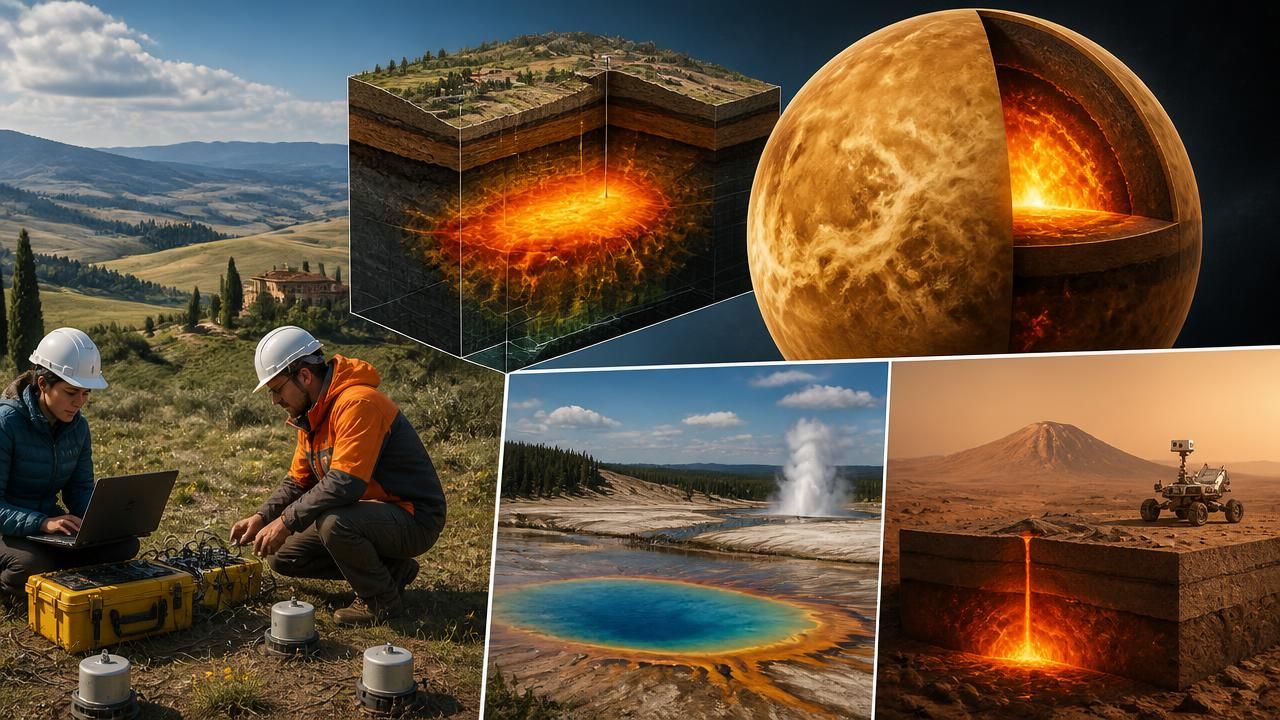
Some of the most powerful volcanic forces in our solar system operate quietly beneath our feet—and beneath the dusty plains of distant planets. This week, a series of scientific reports highlighted hidden magma systems on Earth’s Tuscan region, on Venus, beneath Yellowstone National Park, and on Mars. Together, these findings are forcing a rethink of how volcanic systems evolve, how they remain concealed, and how they might influence everything from geothermal energy to planetary habitability.
A Colossal Reservoir Lurking Beneath Tuscany
The most surprising discovery comes from Tuscany, Italy, where researchers have detected a massive magma reservoir spanning roughly 6,000 cubic kilometers—about the size of 2,400 Great Pyramids of Giza. The finding, reported by ScienceDaily, was made not by spotting a smoking crater or vent, but by analyzing natural ground vibrations recorded by dozens of seismic sensors. This technique, known as seismic tomography, allowed scientists to image deep underground structures that show no obvious surface signs.
Despite its enormous size, the magma body is thought to be in a cooling or crystallizing state, meaning it poses no immediate volcanic threat. However, the discovery is significant for what it represents: a hidden powerhouse that could be tapped for geothermal energy and critical minerals. As the study authors noted,
"It poses no immediate danger, but the discovery reveals how enormous volcanic systems can remain hidden and could transform the search for geothermal energy and critical minerals."
The Tuscan reservoir sits in a region already known for its geothermal activity, yet its scale was previously unrecognized. This suggests that other quiet, non-volcanic areas might also be underlain by similar magmatic bodies—waiting to be discovered with the right seismic tools.
Yellowstone's Supervolcano: An Unexpected Fuel Source
In another echo from Earth’s oneof the most monitored volcanic systems, scientists studying Yellowstone National Park’s supervolcano have uncovered evidence that its fuel source may be more complex than once thought. The new research, also covered by ScienceDaily, hints at "something unexpected" feeding the Yellowstone hotspot—the vast plume of hot rock that powers its geysers, caldera, and seismic activity. While the exact details remain under wraps, the implication is that the supervolcano’s plumbing system draws on deeper, possibly mantle-sourced material mixed with crustal melting in ways that current models don’t fully explain.
Yellowstone’s last major eruption occurred some 640,000 years ago, and monitoring efforts are intense. Understanding what drives the system is critical for assessing future hazards—and for distinguishing between natural fluctuations and detectable warning signs. The new findings echo the Tuscan theme: even the most-studied volcanic regions can defy expectations at depth.
A Massive Lava Tube on Venus
Moving off-world, radar data from Venus have suggested the presence of a massive lava tube beneath the planet’s volcanic plains. Lava tubes are subsurface conduits formed by flowing lava that cools on top while the molten interior drains away, leaving a hollow channel. On Earth, these tubes can be meters to tens of meters wide; the newly reported Venusian feature is far larger, likely a testament to the planet’s immense gravity and volcanic history.
This is not just a curiosity. If confirmed, lava tubes on Venus could serve as stable habitats for future robotic or even human missions, protected from the planet’s scorching surface temperatures, crushing pressure, and corrosive clouds. They also offer a window into the planet’s volcanic past and how major eruptive events have shaped its surface. The radar evidence, combined with previous orbital measurements, points to a world that may still be geologically restless.
Mars: A Young Volcano with a Powerful Magma Engine
Meanwhile, on Mars, researchers have identified a relatively young volcano whose activity is driven by a still-powerful magma chamber below the surface. The discovery challenges the long-held view that Mars is volcanically dead. The volcano—reportedly one of the youngest known on the planet—shows evidence of recent resurfacing, suggesting that magma has been ascending to the surface in geologically recent times. This "magma engine" could be responsible for episodic eruptions that deposit fresh material, potentially altering the planet’s climate and providing localized heat sources that might support microbial life in subsurface water systems.
Understanding Martian volcanism is crucial for determining the planet’s thermal evolution and habitability. If Mars retains hot, partially molten pockets deep beneath its crust, then future drilling or sensing missions might find environments where liquid water could persist—and perhaps signs of past or present life.
Synthesis: A Solar-System-Wide Perspective
Taken together, these separate studies paint a coherent picture. Volcanic and magmatic systems are not static, isolated features; they are dynamic, deeply rooted, and often invisible. On Earth, the hidden Tuscan reservoir underscores the untapped potential of crustal magma bodies for sustainable energy and mineral wealth. At Yellowstone, an unexpected deep source reminds us that hazard assessment must account for deep-Earth complexities. On Venus, lava tubes hint at a geologically active world and offer practical opportunities for exploration. And on Mars, a young volcano signals a planet whose interior may still be alive.
From a broader perspective, these findings illustrate the power of geophysical and remote-sensing techniques—seismic waves, radar, and orbital imaging—to pierce the veil of planetary surfaces. As these methods improve, we are likely to discover more hidden magma systems, perhaps even in places we thought we knew well.
- Geothermal potential: Hidden magma bodies like Tuscany’s could be harnessed for clean energy, but require advanced drilling and heat-extraction technologies.
- Hazard preparedness: Understanding Yellowstone’s deep plumbing is essential for distinguishing between ordinary background activity and a genuine precursory signal.
- Planetary exploration: Venusian lava tubes and Martian magma engines offer natural shelters and potential astrobiological targets for future missions.
- Resource extraction: Magma systems concentrate rare metals and critical minerals, making hidden reservoirs economically important.
As Italian volcanologist Giovanni Orcetti—not involved in the Tuscan study—told reporters, "We are only beginning to appreciate how much magma resides beneath quiet landscapes. Each hidden reservoir we find is a piece of Earth’s internal puzzle." While that statement may be speculative, it captures the spirit of this unprecedented week of discovery. The ground beneath us—and beneath our neighboring worlds—is far from silent.
These findings will be detailed in forthcoming papers in geological and planetary science journals, and further research is expected to refine the models. For now, the hidden magma systems of Tuscany, Yellowstone, Venus, and Mars stand as powerful reminders that the most profound discoveries often lie out of sight.