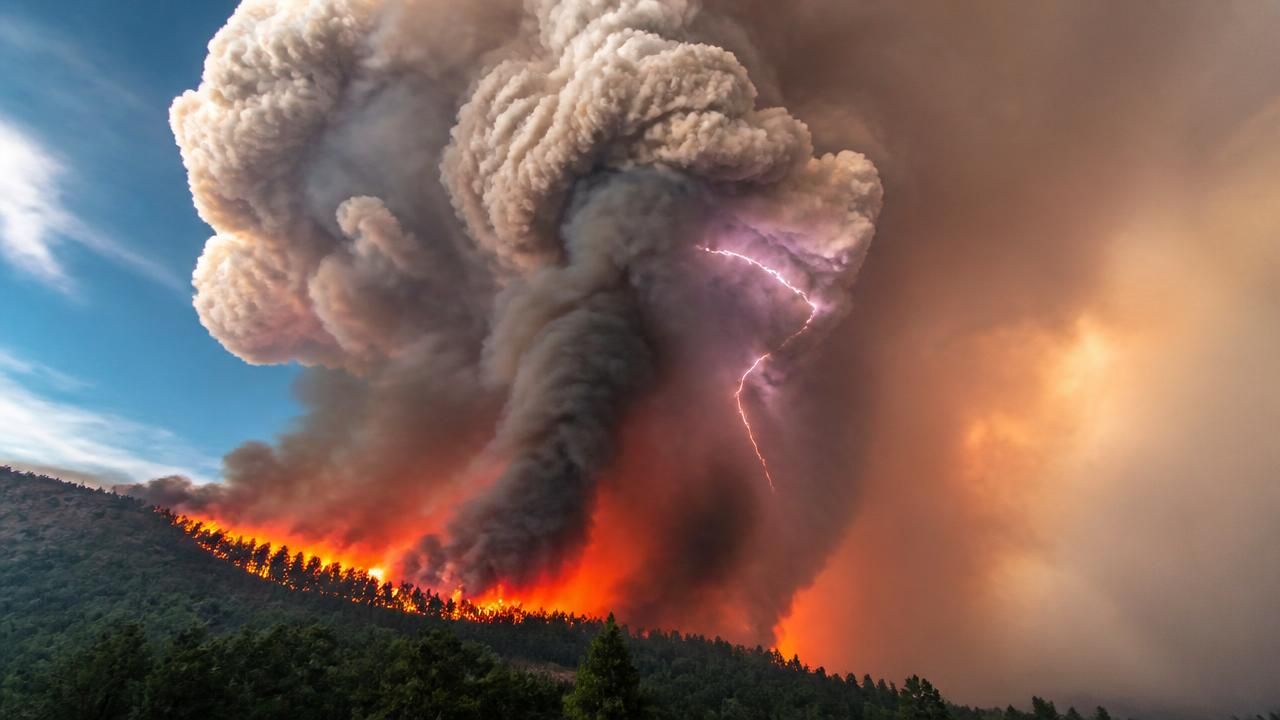
The wildfires that have been ravaging Europe this summer have become so intense that they are creating their own weather. In France, a towering pyrocumulonimbus cloud—commonly called a “fire cloud”—formed above the flames in the Gironde region, unleashing lightning that sparked additional fires. Across the border in Spain, a blaze in the Zaragoza province burned an area roughly the size of New York City, forcing thousands from their homes. This is not just a typical wildfire season; it is, as many experts and outlets have declared, a new era of mega fires.
A Continent Ablaze
For weeks, southern Europe has been baking under record heat, with temperatures exceeding 40°C in parts of Spain and France. The heat, combined with a severe drought and weeks of dry vegetation, turned vast landscapes into explosive fuel. According to Science Daily, a dangerous combination of lush winter growth—which later dried out—severe heat, and strong winds helped the fires spread with terrifying speed. In France, more than 30,000 people have been evacuated from the Gironde and neighboring regions, while Spain has seen hundreds of thousands displaced, with some reports putting the total across both countries at nearly 300,000.
Satellite images have shown smoke plumes stretching for hundreds of miles, and the scale of the destruction is unprecedented. The blazes have been described by MSN as burning with the intensity of “atomic bombs,” a phrase that captures the sheer energy released by these fires. Firefighters from across Europe have been deployed, but the fires are so large and so intense that traditional ground crews are often powerless. France has called in water-bombing aircraft, and Spain has used military units to combat the flames in rugged terrain.
What Is a Fire Cloud?
At the heart of the story is a meteorological phenomenon known as a pyrocumulonimbus (pyroCb) cloud—a fire-generated thunderstorm. As The Guardian explains, a fire cloud forms when intense heat from a wildfire causes air above the fire to rise rapidly. This updraft carries water vapor and smoke particles high into the atmosphere, where they condense into a cumulus cloud. If the updraft is strong enough, the cloud can grow into a full thunderstorm, with lightning, strong winds, and even tornado-like vortices.
France 24 reports that a fire cloud was observed in France for the first time during this wildfire season. The sight is both awe-inspiring and terrifying. The Times of India called it the “fire-breathing dragon of clouds,” an apt description for a phenomenon that seems almost alive in its ability to spread destruction. The cloud can persist for hours, and it can produce lightning that strikes miles away from the main fire, igniting new blazes and making containment even harder.
“A fire cloud is essentially a thunderstorm born from the fire itself. It can create its own weather, including wind and lightning, that causes the fire to behave erratically and dangerously,” said atmospheric scientist Dr. Sarah Johnson, a wildfire expert.
The Perfect Storm for Fire Weather
Fire clouds are not just a curiosity; they are a deadly amplifier. According to the BBC, these “fire-generated thunderstorms” make wildfires more deadly by producing downdrafts that spread embers and flames chaotically. The Independent notes that wildfires can even create tornadoes and extreme weather miles away from the main burn zone. In the recent French fires, lightning from the fire cloud ignited dozens of spot fires, trapping firefighters in a dangerous feedback loop: the more the fire burns, the more extreme weather it creates, which fuels even more fire.
This phenomenon has been observed in other parts of the world, including the United States and Australia. The Dixie Fire in California in 2021 and Australia’s 2019–2020 “firestorms” both produced pyrocumulonimbus clouds. Scientists have even recreated such fire-driven weather in controlled experiments, as reported by Science Daily. But the frequency and intensity of these events are increasing, driven by climate change.
Climate Change Supercharges Everything
Climate change is the underlying factor that turns an ordinary wildfire season into a catastrophe. Rising global temperatures are leading to more frequent and severe heatwaves, which dry out vegetation and create the perfect conditions for fires. Greenpeace notes that heatwaves, wildfires, storms, and flooding are all connected through climate change, which is causing the atmosphere to become more energetic. As Inside Climate News points out, Europe is experiencing a supercharged cycle: heat and drought fuel fires, fires release carbon dioxide, and that CO2 further warms the planet.
The fires themselves are also contributing to the next crisis. MSN reported a story titled “Flames to floods,” highlighting that the same climate conditions that cause wildfires are also leading to devastating downpours. Already, as the BBC showed in aerial footage, parts of Spain that were recently burned are now facing flooding, as bare slopes cannot absorb water. This cascading chain of disasters is becoming the new normal.
The Challenge of Fighting Extreme Fires
Firefighters are facing an unprecedented challenge. Traditional firefighting techniques, such as creating firebreaks or dropping water from planes, are less effective against megafires that can switch direction in an instant. As the BBC asks, “How do you fight extreme wildfires?” The answer, many experts say, is that we must focus on prevention and climate mitigation. This includes managing forests more effectively, creating more resilient communities, and drastically reducing greenhouse gas emissions.
The recent fires have also highlighted the social and economic costs. Thousands of homes have been destroyed, and the economic toll is mounting. An article from Econofact discusses the “perfect storm” in home insurance, as insurers are increasingly unwilling to cover properties in fire-prone areas. The human cost is immeasurable: families have lost everything, and communities are being uprooted.
What Comes Next?
As Europe battles these fires, a new heatwave is looming, which threatens to worsen the situation. Firefighters are making some headway, as reported by the Detroit News, but the risk is far from over. The fires in France and Spain are a stark reminder that climate change is not a distant threat; it is here now, transforming the natural world and challenging our ability to cope.
The “fire clouds” over Europe are a symbol of this new reality. They are a sign that nature’s forces, amplified by human activity, are reaching extraordinary levels. As we rebuild and recover, we must also address the root causes. Otherwise, the next fire season will be even worse, and the clouds of fire will continue to gather on the horizon.