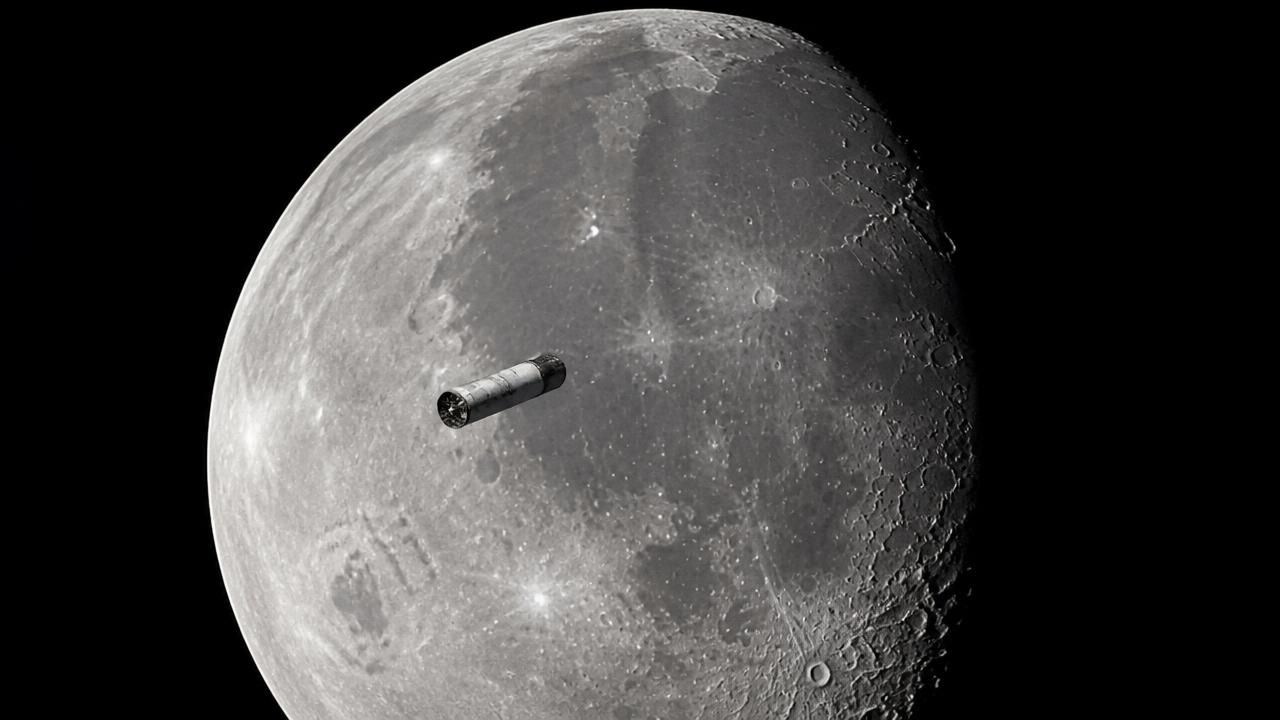
A discarded SpaceX Falcon 9 upper stage is set to crash into the Moon on Wednesday, Aug. 5, 2025, creating a new crater and providing scientists with a rare opportunity to observe an accidental lunar impact. NASA confirmed this week that the spent rocket booster, which helped launch Firefly Aerospace's Blue Ghost 1 lunar lander in January, will impact the lunar surface near the Einstein and Bell craters with 100% certainty.
How did a rocket stage end up on a Moon collision course?
The upper stage was part of a Falcon 9 rocket that launched on Jan. 15, 2025, from Cape Canaveral, Florida, under NASA's Commercial Lunar Payload Services (CLPS) initiative. After deploying Firefly's Blue Ghost 1 lander toward the Moon, the upper stage was left in a high Earth orbit. Over the following months, gravitational perturbations from the Earth, Moon, and Sun, combined with solar radiation pressure, altered its trajectory and sent it on a collision path with the Moon.
"Solar activity and gravitational forces caused the stage's unplanned return to the Moon," NASA said in a statement. The agency noted that the stage poses no danger to Earth and remains safely tracked by NASA and SpaceX.
An unprecedented tracking effort
The rocket body was first flagged by independent astronomers who used publicly available data to identify the trajectory. NASA's Center for Near Earth Object Studies (CNEOS) at the Jet Propulsion Laboratory later confirmed that the stage has a 100% chance of impacting the Moon, making the event a valuable training exercise for planetary defense tracking.
NASA is coordinating observations using ground-based telescopes and space-based assets, including the Lunar Reconnaissance Orbiter, to record the impact and analyze the resulting crater. The agency plans to collect data that will help refine models of impact physics and improve techniques for tracking objects in deep space.
"This is an exciting opportunity to learn more about the Moon's composition and how impacts alter its surface," said a NASA scientist involved in the effort, speaking on condition of anonymity.
What happens when a rocket hits the Moon?
Since the Moon has virtually no atmosphere, the 3,900-kilogram (4-tonne) upper stage will strike the surface at an estimated 5,400 mph (2.4 kilometers per second). Unlike Earth, there will be no fiery breakup—the stage will simply slam into the regolith, likely carving out a crater roughly 10 to 20 meters wide and up to 5 meters deep. Some reports estimate the crater will be about 16 feet deep.
The impact will eject a plume of lunar dust and rock, which scientists hope to study remotely. The location on the far side of the Moon will make direct observation from Earth impossible, but orbiting spacecraft like LRO will be able to photograph the fresh crater afterward. The exact time of impact is expected to be around 7 a.m. EDT (12:00 UTC), though NASA notes that timing could shift slightly as the object is tracked.
A growing concern: space debris in cislunar space
This is not the first time a human-made object has hit the Moon, but accidental impacts are rare. In 2022, a Chinese rocket stage crashed into the lunar far side, creating a double crater. The increase in lunar missions—both governmental and commercial—has put more abandoned hardware in orbit around the Earth and Moon, raising concerns about sustainability in cislunar space.
The event comes as NASA and its partners accelerate plans for long-term lunar exploration. The Artemis program aims to return astronauts to the Moon later this decade, and commercial landers like Blue Ghost are paving the way for a permanent presence.
"With more launches to the Moon, we can expect more of these events," said space debris expert Dr. Alice Gorman of Flinders University. "While this impact is harmless, it underscores the need to track and mitigate debris beyond low Earth orbit."
Media framings: from 'space junk' to 'science bonanza'
News organizations around the world have reacted with a mix of awe and caution. CNN noted that a "new crater is likely to form," while Forbes called the stage "space junk." Scientific American emphasized the scientific value, reporting that "scientists will be watching." The BBC asked what will happen when the rocket collides, explaining the physics of the impact. This variety of perspectives underscores the dual nature of the event: a debris problem and a research windfall.
As the Moon becomes a busier destination, learning from events like this—even if they are accidents—helps ensure future missions are safer. In the meantime, sky-watchers and space enthusiasts can take comfort that, by all calculations, the impact will be a spectacular but harmless addition to the Moon's already cratered landscape.