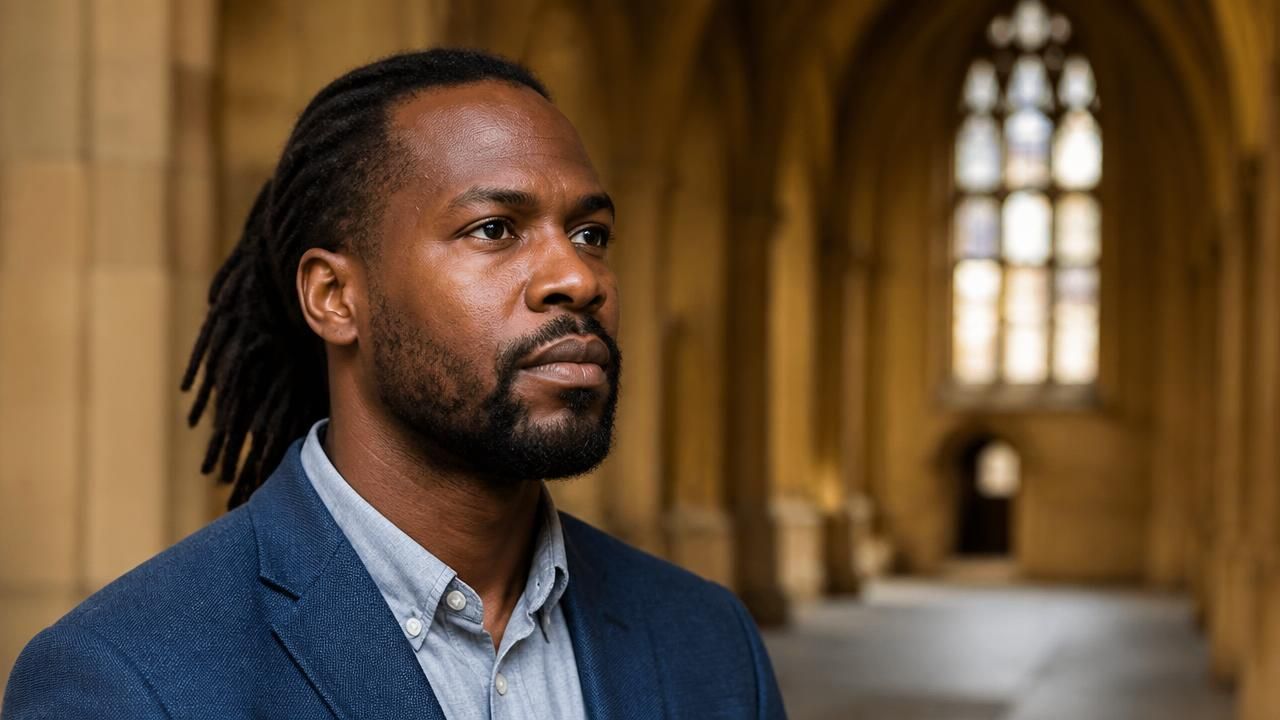
Dr. Jason Arday, celebrated as Cambridge University's youngest ever Black professor, is at the center of a deepening academic controversy just days before his book launch. Accused of plagiarism in his scholarly work, Arday has responded with a dramatic litany of personal harassment, including a knife-wielding masked man and a pig's head left outside his parents' home. Meanwhile, a senior Cambridge college president has rescinded support for him, and fresh questions are being raised about the very achievements that made him a symbol of diversity in elite academia.
The New York Times reported that Arday, a sociologist known for his research on education and inequality, says he has been through what he describes as a campaign of intimidation. In addition to the threats, he claims to have run 30 marathons in 35 days, a seeming testament to the physical and emotional toll of his ordeal. Arday insists the plagiarism allegations are fabricated, characterizing them as a concerted effort to undermine his credibility and his historic appointment.
The Plagiarism Allegations
Specific details of the alleged plagiarism remain murky, but the accusations have already triggered significant fallout. Arday, who joined Cambridge in 2023 from Durham University, has been a rising star in the field of sociology, focusing on racial justice, widening participation, and the philosophy of education. The allegations threaten to overshadow his contributions and his powerful personal narrative, which has inspired many young scholars from underprivileged backgrounds.
The claims have prompted calls for a transparent investigation. Supporters argue that Arday is being held to a harsher standard because of his advocacy for racial equality and his status as a trailblazer. Critics, however, insist that academic integrity must take precedence over diversity symbolism, and that all scholars must be held equally accountable for their work.
A College President Withdraws Support
In a sign of fraying confidence, the president of a Cambridge college has formally asked to remove their name from an open letter that had initially expressed solidarity with Arday. The letter, signed by a group of academics, defended Arday against what he has called a "witch hunt." The withdrawal, reported by MSN, suggests that the controversy is causing even some of his would-be defenders to reconsider their stance, potentially fearing for their own reputations or the institution's standing.
"I've been through it all," Arday said, referencing the alleged harassment and reflecting on the personal toll of the public dispute.
Skepticism from Within Cambridge
The academic community is clearly divided. A provocative commentary on Yahoo News, titled "In my Cambridge days, Jason Arday's 'truths' wouldn't have lasted five minutes," captures a sentiment of deep skepticism. Although the article's full content is unavailable due to a server error, the headline itself suggests that doubting Arday's narrative is not merely a fringe view. It implies that in the rigorous, competitive environment of Cambridge, self-crafted stories and extraordinary claims are regularly subjected to relentless scrutiny—and often found lacking.
This skeptical framing contrasts sharply with the New York Times' sympathetic portrayal, which centered Arday's experiences of harassment. The divergence in how outlets frame the story highlights the polarizing nature of the case: is Arday a victim of a smear campaign, or a scholar whose house of cards is collapsing? The answer may depend on which account is believed.
Fresh Questions Over Achievements
MSN reported that "fresh questions" are mounting over the legitimacy of Arday's achievements, including his historic appointment. Some academics are quietly asking whether the rapid trajectory of his career was merit-based or accelerated by diversity targets. While no concrete evidence of impropriety has been presented, the questions themselves are enough to cast a shadow over his professional standing.
Arday's defenders caution that such questioning is itself a form of bias, a familiar trope faced by Black scholars who achieve prominence. They note that his research on race and education, the book he is about to launch, and his advocacy for social mobility are substantial contributions that should not be dismissed by unsubstantiated insinuations.
Context and Implications
The controversy arrives at a moment when universities worldwide are grappling with how to address historical underrepresentation while preserving academic rigor. Cambridge, which has historically been slow to diversify its senior ranks, appointed Arday as a symbol of change. His ordeal now becomes a stress test for the institution's commitment to both equity and accountability.
Arday also claims to have run 30 marathons in 35 days during this period. Whether this was a coping mechanism, a charity endeavor, or a publicity stunt remains unclear. But it adds a surreal dimension to a story already filled with dramatic assertions—a knife-wielding attacker, a pig's head, and superhuman feats of endurance. If true, these events paint a picture of an individual under unprecedented siege. If exaggerated or fabricated, they raise serious doubts about his credibility.
As the book launch approaches, the academic world is watching with bated breath. Will the investigation vindicate Arday, or will the mounting questions end his career? For Cambridge, the episode is a delicate balancing act: how to support a trailblazing scholar while upholding the principle that no one is above scrutiny.
The differing perspectives in media coverage—from sympathetic profiles in The New York Times to sharp skepticism elsewhere—ensure that this story will continue to generate debate. In an era of heightened sensitivity about race, power, and institutions, the Arday case is a reminder that when ancient universities meet modern controversies, the truth is often as tangled as the narratives spun around it.