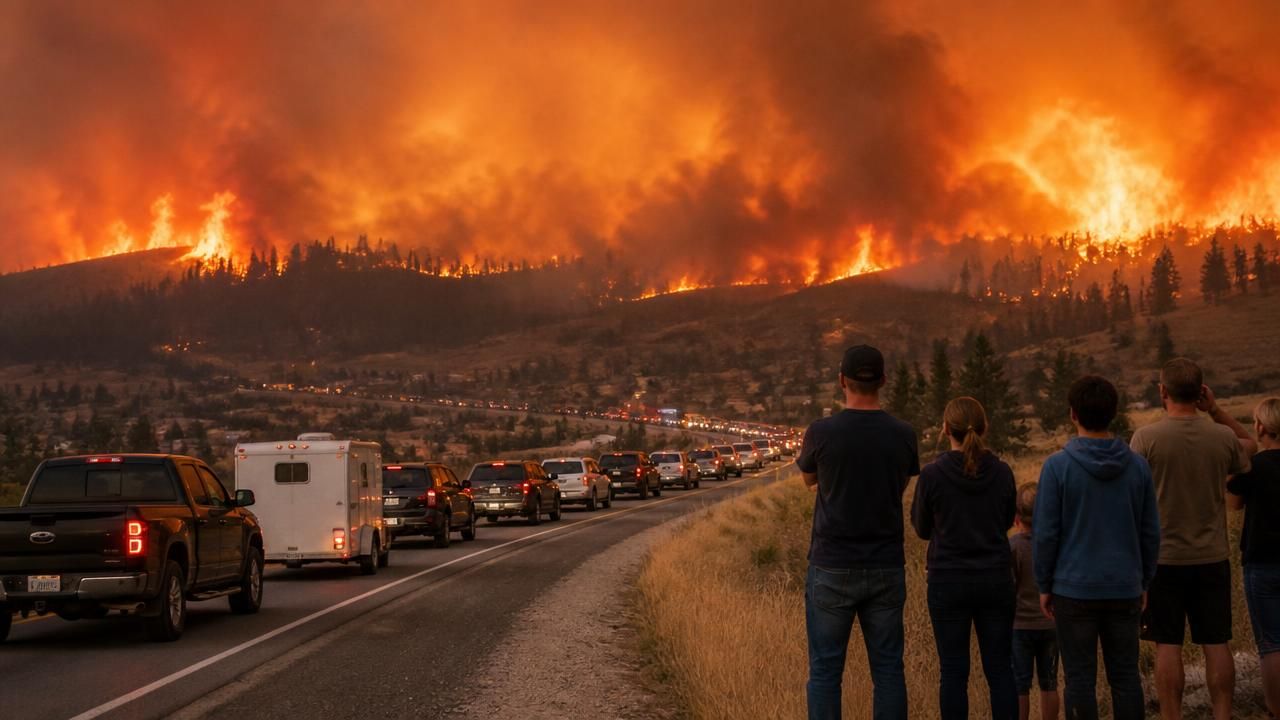
Firefighters in Washington state are battling a catastrophic cluster of wildfires that has become the largest natural disaster in Spokane's recorded history. The fast-moving blazes—collectively referred to as the Spokane Complex—have destroyed more than 600 structures, forced over 60,000 residents to flee their homes, and left a trail of devastation across the region. As of Friday morning, improving weather conditions offered a glimmer of hope, but officials warn that the crisis is far from over.
A Region Engulfed
The fires erupted with terrifying speed on Thursday afternoon, driven by intense winds and parched vegetation. What began as a brush fire near the community of Mead quickly spiraled into a series of infernos that swept through the outskirts of Spokane, including the towns of Elk, Medical Lake, and Airway Heights. Within hours, towering columns of smoke darkened the sky, and embers carried by gusts ignited homes, businesses, and farmland with little warning.
Spokane County Sheriff's Office officials described the scene as "unprecedented," with firefighters overwhelmed by the sheer scale of the blaze. "This is the worst natural disaster our region has faced," said Spokane County Commissioner Mary Kuney during an emergency briefing. "We are witnessing history, but it is a history written in ashes and heartbreak."
Mass Evacuations and Shelter Efforts
More than 60,000 residents received evacuation orders across several counties, with some areas under Level 3 "Go Now" directives. Emergency shelters were hastily opened at local schools and community centers, including one north of Airway Heights, as evacuees streamed in with pets, children, and whatever belongings they could grab. The American Red Cross and local volunteers are working around the clock to provide bedding, meals, and comfort to displaced families.
"We left with just the clothes on our backs," said one evacuee at a shelter in Spokane. "The smoke was so thick you couldn't see ten feet ahead. We thought we were leaving for an hour, not for good."
Federal Emergency Requested
Washington Governor Bob Ferguson has formally requested a federal emergency declaration from the White House, seeking federal funds and resources to support firefighting efforts and aid recovery. In a statement, Ferguson said the scope of destruction "strains every local and state resource," and called on the federal government to act swiftly. "Our first responders are exhausted, our communities are shattered, and we need every available asset to protect lives and property," he said.
Structures Lost, Lives Upended
The exact number of destroyed structures remains fluid as crews conduct initial damage assessments, but early estimates put the total at over 600. That figure includes hundreds of single-family homes, apartment buildings, and commercial properties. In the town of Medical Lake, a historically significant community of about 4,000 people, blocks of homes were reduced to smoking rubble. Entire neighborhoods, many of them middle-class suburban developments, now resemble ghost towns.
Among the most tragic losses is the area around the Fairview Fire, which has burned nearly 1,000 acres in Mead. Level 3 evacuations were expanded there late Thursday, and residents were urged to leave without delay. Meanwhile, the nearby Oregon Road Fire has scorched thousands of acres, and the Liberty Fire—though smaller—has forced closures of major highways, including U.S. Route 97 over Blewett Pass.
The Long Road to Containment
By early Friday, containment remained at zero percent for all three major fires, according to Washington State Department of Natural Resources. However, a shift in weather brought cooler temperatures, higher humidity, and lighter winds, offering firefighters a critical window to establish control lines. "The weather is finally turning in our favor," said Incident Commander Dave LaFlamme. "But with ground so dry and fuels so volatile, a single spark could reignite the entire situation."
Firefighters from across the Pacific Northwest have been deployed, including hotshot crews and aerial tankers. The U.S. Forest Service and the National Guard have also been called in to assist. Despite the improved conditions, officials caution that the fire season is far from over, and climate scientists point to a troubling trend: the Western U.S. is experiencing more frequent and intense wildfires due to prolonged droughts and rising temperatures.
A Community in Shock
The psychological toll on the community is immense. For many survivors, the devastation is reminiscent of the Paradise, California, Camp Fire in 2018, which killed 85 people and destroyed nearly 19,000 structures. While Spokane's fires have not yet claimed any confirmed lives, officials acknowledge that the sheer speed of the flames leaves little margin for error.
Local pastor and longtime resident Daniel Whitfield summed up the mood: "We've lost homes, but we haven't lost hope. People are already opening their doors to strangers. That's who Spokane is. We will rebuild, but we will never forget those who lost everything."
Why This Fire Is Different
Several factors combined to make this event exceptionally dangerous. A rare "fire weather emergency" was declared by the National Weather Service—one of only a handful ever issued. Winds gusted up to 50 mph, causing flames to leapfrog from ridge to ridge, and relative humidity dropped to as low as 8%. These conditions, coupled with an ongoing drought that left vegetation bone-dry, produced what fire scientists call "extreme fire behavior."
- 600+ structures destroyed or damaged
- 60,000+ individuals evacuated
- Zero percent containment as of Friday morning
- Federal emergency declaration requested by Governor Ferguson
- Multiple Level 3 "Go Now" evacuation orders still in effect
- Highway closures including U.S. 97 and Blewett Pass
Outlook and Recovery
The immediate priority is life safety and containment. Authorities are urging residents to heed evacuation orders and stay clear of affected areas. Meanwhile, insurance companies have begun mobilizing, and local real estate agents are reminding homeowners that standard policies typically cover fire damage—though the claims process will be lengthy.
For now, Spokane looks to the sky for rain and to the firefighters on the front lines for a miracle. As one emergency dispatcher said in a recorded message to residents: "We will get through this. We will get through this together." The coming days will test that resolve, but if the community's spirit is any indication, Spokane will rise from the ashes.