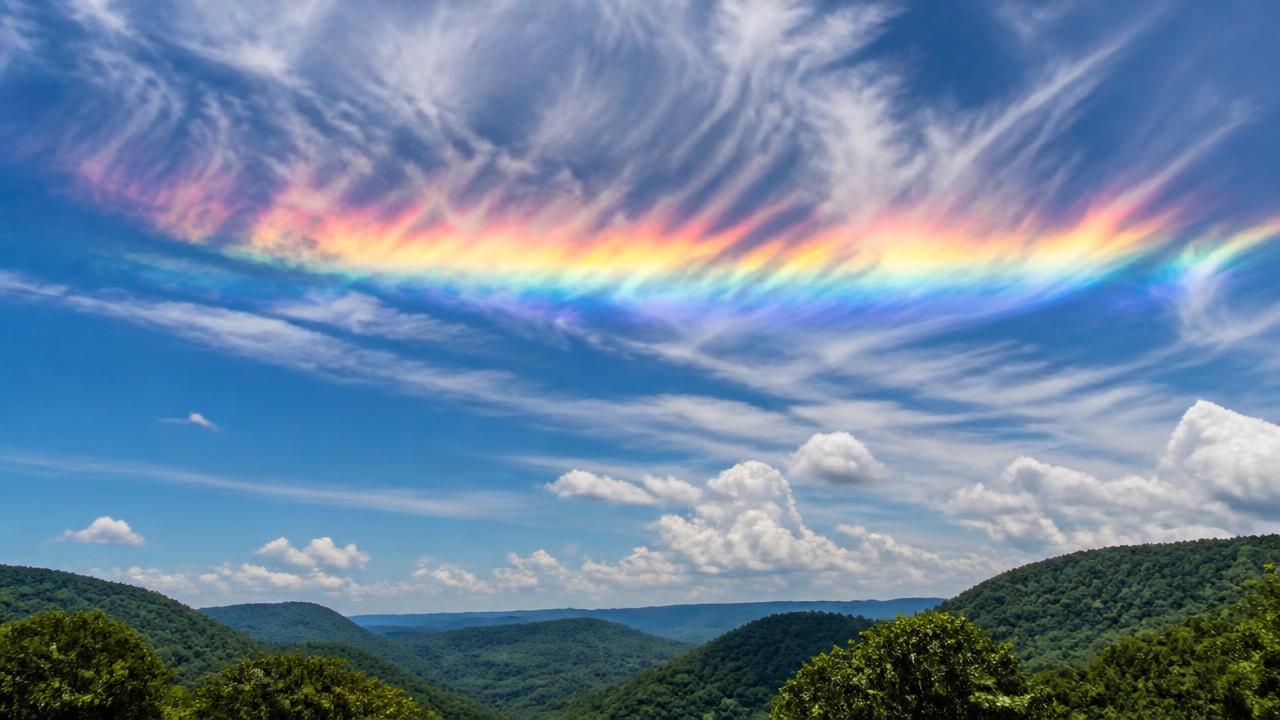
What looks like a celestial flame licking across the sky is actually a rare optical illusion created by ice crystals. On August 2, 2026, NASA's Astronomy Picture of the Day (APOD) featured a breathtaking image of a circumhorizontal arc — popularly known as a fire rainbow — captured over the rugged landscape of West Virginia. The photograph, taken by Christa Harbig in 2021 near North Fork Mountain, has now reached a global audience through the space agency's daily astronomy showcase.
The APOD feature, titled A Fire Rainbow over West Virginia, explains the science behind the spectacle: high-altitude cirrus clouds composed of flat, hexagonal ice crystals act as tiny floating prisms, refracting sunlight into a vibrant band of color that runs parallel to the horizon. The result appears as a rainbow-like sheet of flame, though no fire is involved.
What Is a Circumhorizontal Arc?
A circumhorizontal arc is a halo phenomenon that occurs when sunlight enters horizontally oriented flat hexagonal ice crystals through a vertical side face and exits through the bottom face. The light is refracted much like through a prism, splitting into its constituent colors. The arc appears as a broad, colored band at a specific angle in the sky, parallel to the horizon.
“Ice crystals in a distant cirrus cloud are acting like little floating prisms,” reads the APOD explanation. “Known informally as a fire rainbow for its flame-like appearance, a circumhorizon arc appears parallel to the horizon.”
The phenomenon is often confused with other atmospheric optics, such as iridescent clouds or sundogs, but the circumhorizontal arc is distinct: it requires a specific combination of solar altitude, cloud type, and crystal orientation to be visible.
The Perfect Conditions
For a circumhorizontal arc to form, the Sun must be at least 58 degrees above the horizon. In the West Virginia image, the Sun was high in the sky while a layer of cirrus fibratus clouds drifted below. The ice crystals within these clouds must be aligned horizontally to refract sunlight collectively and uniformly. This precise alignment makes the phenomenon rare in most parts of the world, though it is more common at latitudes closer to the equator.
Harbig's photograph is notable for its clarity and vibrant color separation. The arc appears to stretch across the sky like a brilliant ribbon, contrasting with the soft blue backdrop and the wispy texture of the cirrus clouds. The image was captured in 2021 but selected for APOD on the 2026 August 2 edition, underscoring the timeless appeal of atmospheric beauty.
APOD's Daily Inspiration
NASA's APOD has been featuring a different image or photograph of the universe every day since 1995. While many pictures focus on deep-space objects like galaxies, nebulae, and planets, APOD also regularly highlights atmospheric phenomena that can be seen from Earth's surface. This particular edition was authored and edited by Robert Nemiroff, Jerry Bonnell, Cecilia Chirenti, and Keighley Rockcliffe, with credit going to the photographer.
Notably, the day before the fire rainbow feature, APOD showcased a completely different celestial event — the Buck Moon and the Belt of Venus. That image, while not available in full detail in our aggregated sources, serves as a reminder of the variety found in APOD's daily offerings. The Buck Moon, the full moon of July, and the Belt of Venus, a pinkish band of sky near the horizon, are both familiar sights to skywatchers.
Several news outlets and science aggregators, including Mirage News, picked up the APOD story, bringing the fire rainbow to broader audiences. While some syndicated pages encountered security checks, the core information from NASA's original post was widely shared, demonstrating the public's continuing fascination with both space and Earth's atmospheric wonders.
Why Fire Rainbows Matter
Beyond their aesthetic appeal, circumhorizontal arcs offer scientists and weather enthusiasts a glimpse into the physics of light and cloud microphysics. Understanding how ice crystals form and align in the atmosphere helps researchers improve cloud models and weather predictions. The phenomenon also serves as a dramatic reminder of the hidden complexity in the skies above us.
For photographers, capturing a fire rainbow requires timing, luck, and knowledge of local conditions. Harbig's success near North Fork Mountain is a testament to the rewards of persistence. The location, which is part of the Appalachian Mountains, provides a pristine natural backdrop that enhances the visual impact of the arc.
Observing Tips
If you want to see a fire rainbow yourself, the best chances occur during the summer months when the Sun reaches high altitude in the midday sky. Look for thin, wispy cirrus clouds and aim to view them while wearing polarized sunglasses, which can enhance the colors. The arc will appear roughly 58–60 degrees above the horizon, directly below the Sun.
- Seek clear skies with cirrus clouds, especially cirrus fibratus
- Observe when the Sun is above 58 degrees altitude — typically within a couple hours of noon in summer
- Look in the direction of the Sun, but protect your eyes; never stare directly at the Sun
- Use polarized sunglasses to boost visibility
Fire rainbows are not just beautiful; they are a visible connection between the Sun, the atmosphere, and the ice crystals that drift silently miles above our heads. As APOD's feature demonstrates, even a single photograph can illuminate the fascinating science of our sky.
For more daily astronomy images, visit NASA's Astronomy Picture of the Day website. The archive remains a treasure trove of celestial and atmospheric beauty, with a new surprise every day.