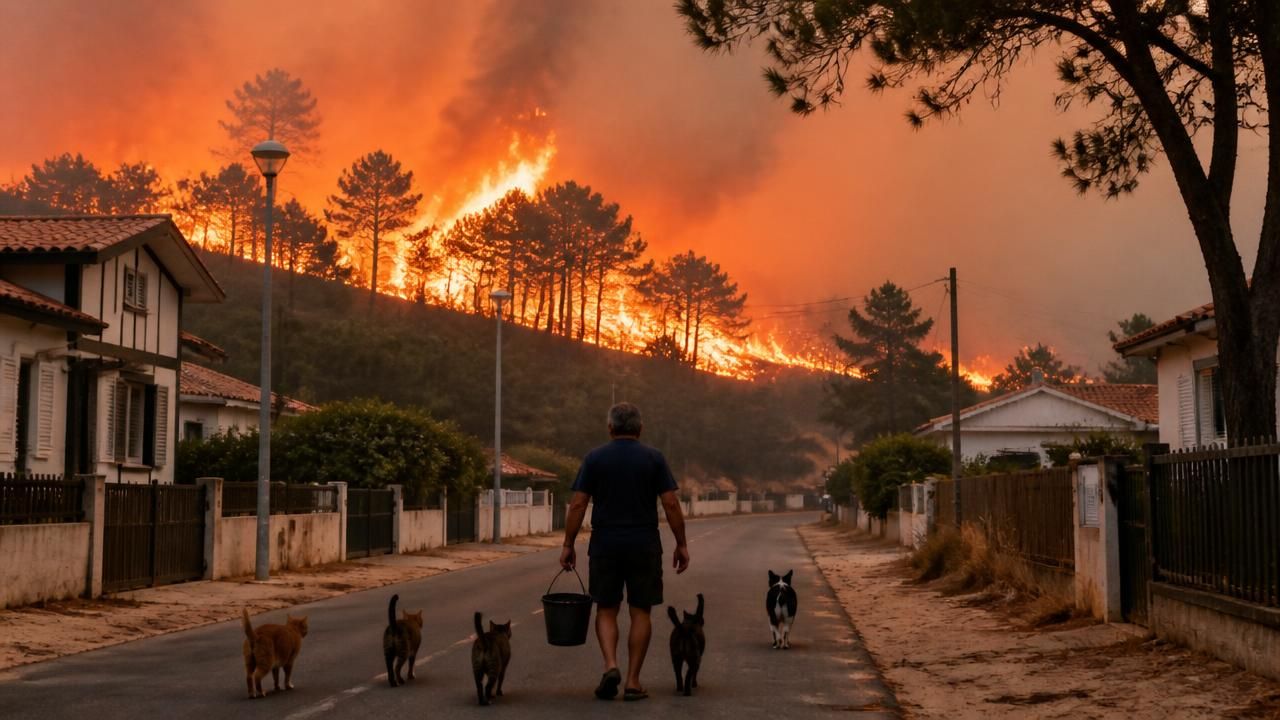
The roar of flames, the crackle of burning pines, the relentless advance of heat—for thousands of residents along Europe's southwestern coast, these were the sounds of an apocalypse. As catastrophic wildfires swept through France and Spain, entire communities were reduced to ash, and one French beach town, Claouey, became a ghost town. But amidst the desolation, a handful of residents refused to leave, including one man who turned his mission to caring for the village's abandoned pets.
A Village Emptied, but Not Abandoned
Claouey, a small seaside hamlet in the Gironde region of southwestern France, was rapidly evacuated as flames encroached. The New York Times visited the empty town and found a surreal scene: shuttered shutters, vacant streets, and a lone figure—a resident who had made it his personal mission to feed and shelter the cats, dogs, and other pets left behind by fleeing families. 'I couldn't just leave them,' he told reporters, his voice echoing in the silence. 'They have no one else.' His determination highlights the human and animal toll of a disaster that has upended lives across the region.
The Pyrenees Inferno: 'I Didn't Think I'd Make It Out Alive'
Further south, in the Pyrenees mountains, the fires have been even more ferocious. In an interview with Le Monde, a local resident recounted a harrowing escape: 'I didn't think I'd make it out alive.' The flames moved with terrifying speed, leaping from ridge to ridge, consuming pine forests, farmhouses, and entire livelihoods. Firefighters battled through the night, but the combination of drought, high winds, and record-breaking temperatures—exceeding 40°C in some areas—created conditions that one expert described as 'a perfect firestorm.'
Spain's Destruction and Return
Across the border in Spain, residents are only now beginning to return to what is left of their homes. Video footage from the region shows charred landscapes, melted vehicles, and the skeletal remains of houses. 'It's all gone,' one woman said, sifting through rubble. 'We have nothing left.' The Spanish authorities have confirmed that thousands were evacuated from coastal resorts and inland villages, with the fires leaving a trail of devastation that will take years to rebuild. In total, wildfires across Europe—including a separate blaze in the Gironde that burned for days—have prompted the displacement of tens of thousands of people, according to officials.
Why This Fire Season Is Different
Experts point to a confluence of factors: an unusually dry winter, three consecutive heatwaves, and a warming climate that has turned the Mediterranean region into a tinderbox. 'We are seeing fire behavior that is beyond anything in the historical record,' said a climatologist. 'These fires are not just events; they are symptoms of a planetary shift.' The fires have also overwhelmed local resources, prompting calls for a coordinated European response, including water-bombing aircraft and additional firefighting crews from neighboring countries.
Elsewhere in the World
While Europe's wildfires dominate headlines, several other major stories unfolded around the globe this week:
- Ukraine: Ukrainian forces struck warehouses belonging to Russia's largest online retailer in a long-range attack, according to video reports, adding a new dimension to the ongoing conflict.
- Germany: Berlin locals were left shaken after a terror attack targeting an L.G.B.T. pride event, prompting increased security for future rallies.
- Monaco: A manhunt is underway after a parcel bomb exploded in the principality, with authorities treating it as a deliberate act.
- Spain/Morocco: Spanish officials said most migrants who crossed into Ceuta have returned to Morocco, easing a temporary border crisis.
- United Kingdom: Prime Minister Keir Starmer accepted responsibility for significant losses in election results, leading to his resignation announcement and a leadership test for the Labour Party.
Ghost Towns of Europe: A Broader Phenomenon
The image of Claouey as a ghost town resonates with a wider European trend. Across the continent, villages are being abandoned for economic, environmental, and even cultural reasons. Italy, for instance, has launched initiatives to repopulate its rustic villages, offering incentives for new residents to revive centuries-old communities—including a ghost town that has become a home for the poor. In Spain, the abandoned set of the soap opera 'Eldorado' now stands as a tourist curiosity, a skeleton of a fictional world. And in Wales, a content creator using a drone recently discovered a 'mini ghost village' hidden in the hills, a silent testament to depopulation. These stories, while distinct, underscore a shared rural fragility that the wildfires have thrust into sharp relief.
Looking Ahead
As firefighters continue to battle the blazes, the immediate focus is on saving lives and containing the inferno. But the longer-term questions are inescapable: How will Europe adapt to a future of more frequent and more intense wildfires? How will communities rebuild—and will they rebuild in the same places? For the lone pet caregiver of Claouey, these questions are distant. For now, he is focused on the present, on the meowing and barking that signal a small, defiant life amid the ashes. 'We have to keep going,' he said. 'They need us.'
In a week of global turmoil, from Kyiv to Berlin, Monaco to Minsk, the European wildfires are a stark reminder that nature, in its fiercest mood, can turn the familiar into the unrecognizable—and turn a busy village into a ghost town in a matter of hours.