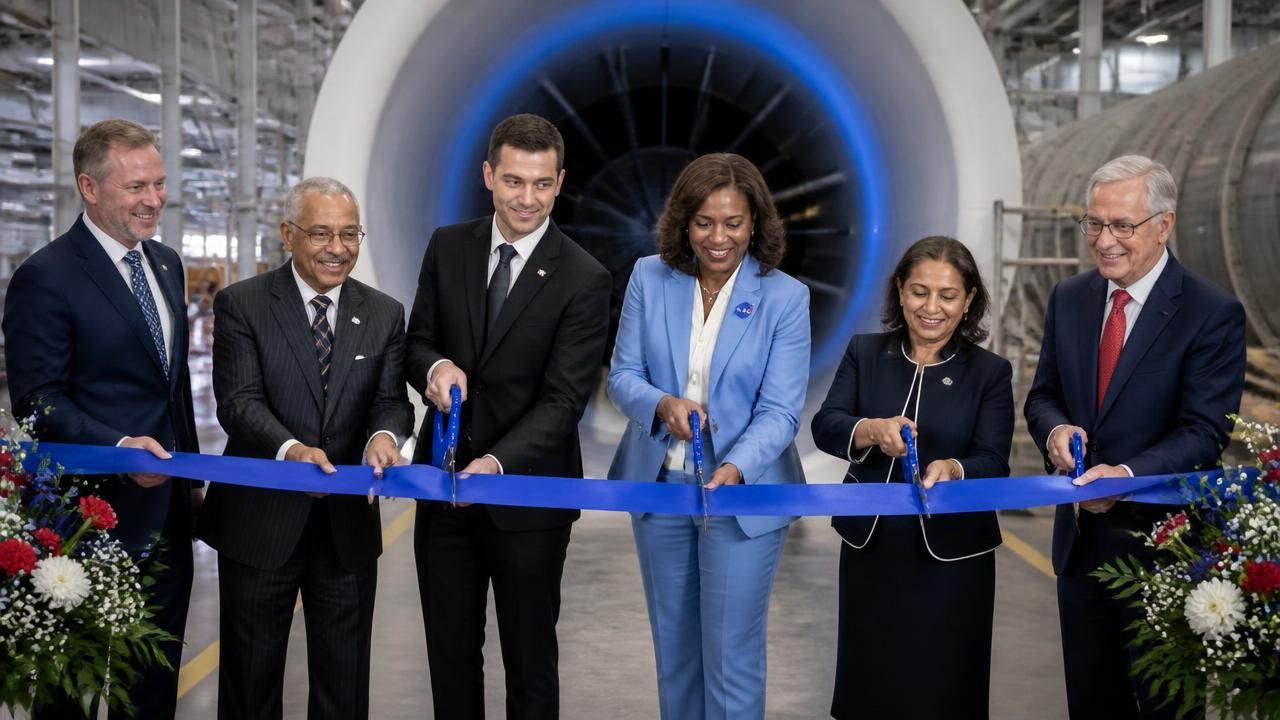
On Friday, July 31, 2026, NASA and state officials gathered at the Langley Research Center in Hampton, Virginia, to cut the ribbon on the agency's first major new wind tunnel in more than four decades. The Flight Dynamics Research Facility (FDRF) promises to reshape the future of aviation and space exploration, with direct ties to NASA's Artemis program and the planned development of a lunar base.
This state-of-the-art facility represents a generational leap in testing capability. Wind tunnels have long been essential tools in aerospace engineering, allowing researchers to simulate the effects of air moving over aircraft and spacecraft. Langley itself has been at the forefront of this work since 1917, and this new addition continues a proud legacy of innovation.
A Historic Milestone
The opening ceremony was attended by a host of dignitaries, including NASA Administrator Jared Isaacman, Langley Research Center Director Dr. Trina Dyal, Virginia Lt. Gov. Ghazala F. Hashmi, and Rep. Robert “Bobby” Scott (D-Va.). Also present were Mike Waller, vice president of BL Harbert International Federal Division, and Edward C. Forst, administrator of the U.S. General Services Administration. The crowd posed for photos before jointly cutting the ribbon to officially open the facility.
“The state-of-the-art facility will support research and technology development that will advance the agency’s aeronautics, exploration, and science goals, including establishing a sustained human presence on the lunar surface through the Artemis program and the development of a Moon Base.”
That statement from NASA underscores the dual-purpose nature of the new wind tunnel. It is not just a tool for improving aircraft efficiency or safety; it is also a critical step in humanity's return to the Moon and eventual journey to Mars.
What Is the Flight Dynamics Research Facility?
Wind tunnels work by forcing air past a stationary model to measure aerodynamic forces, pressure distributions, and flow patterns. The FDRF is designed to handle a wide range of test conditions, from subsonic to supersonic speeds. According to NASA, the facility will support research into next-generation aircraft designs, launch vehicles, and spacecraft entry systems.
Notably, the FDRF replaces aging infrastructure at Langley that has served the agency for decades. With modern instrumentation, improved data acquisition, and the ability to test larger models, the new tunnel will be a magnet for both government and commercial research. This is especially important as the aerospace industry increasingly embraces electric propulsion, autonomous flight, and advanced air mobility.
Technology and Capabilities
- Modular test sections that allow for quick configuration changes.
- Advanced flow visualization systems for detailed aerodynamic analysis.
- Enhanced data collection and real-time monitoring capabilities.
- Designed to accommodate a wide range of model scales and test conditions.
These features will enable engineers to validate designs more quickly and cost-effectively, accelerating the transition from concept to flight.
Supporting Artemis and a Moon Base
The Artemis program aims to land the first woman and the next man on the lunar surface, and NASA has consistently emphasized the importance of sustainable exploration. A Moon Base would require landing systems, habitats, rovers, and other infrastructure that must operate in a harsh environment. The FDRF will help engineers test these systems in realistic aerodynamic conditions, reducing risk and improving performance.
For lunar landers, aerodynamic stability during descent is critical. For crew capsules, controlled reentry and parachute deployment are vital. The FDRF can simulate all of these phases, providing data that no computer model alone can offer. This is why the new wind tunnel is seen as a cornerstone for future deep-space missions.
Community and Political Support
The ribbon-cutting event highlighted broad bipartisan and local support. Virginia Lt. Gov. Ghazala F. Hashmi praised the facility as a testament to the state's role in aerospace innovation. Rep. Bobby Scott noted the jobs and economic benefits that come with a world-class NASA facility in his district. Hampton Mayor Jimmy Gray also participated, reflecting the strong community relationship with Langley Research Center.
This enthusiasm is echoed in local media coverage. News outlets such as 13NewsNow and MSN framed the opening as “a new chapter for aviation and space research,” emphasizing not only the historical significance but also the forward-looking mission of NASA. Other coverage focused on the milestone itself: the first new wind tunnel in over 40 years.
Looking Ahead
The Flight Dynamics Research Facility is more than just a building; it is a symbol of NASA's commitment to pushing the boundaries of what is possible. As the agency prepares for sustained human presence on the Moon and the next generation of aircraft, this wind tunnel will be an indispensable partner in the journey.
With its advanced capabilities and strategic partnerships, the FDRF stands ready to shape the next century of flight. The ribbon has been cut, the fans are spinning, and the future of aerospace research is already taking shape in Hampton, Virginia.