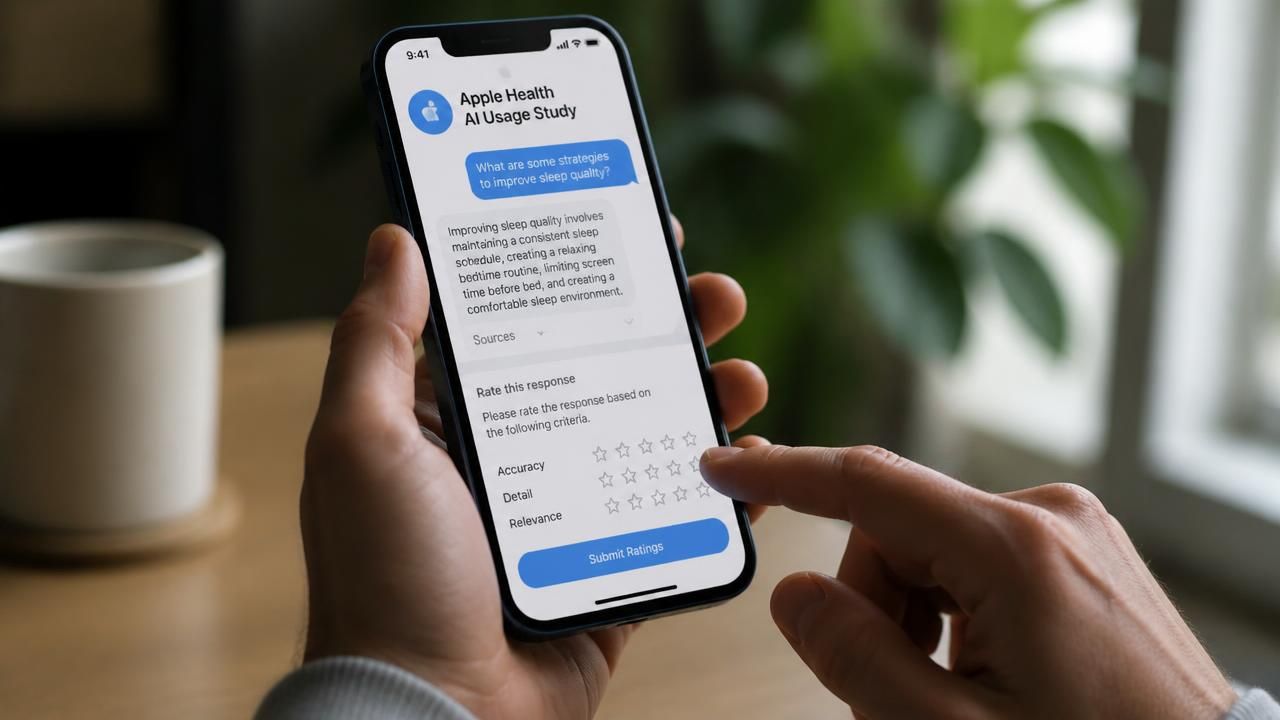
Apple is moving deeper into the conversational health space — cautiously. The company announced a new research initiative, the Apple Health AI Usage Study, aimed at understanding how people actually interact with AI-powered health tools and, more importantly, whether the answers those tools give are any good. Enrollment opened today, and the study app is now available for download.
The effort, first reported by The Verge and confirmed across technology and markets outlets, pairs Apple with OpenEvidence, a clinical AI platform already used by healthcare professionals. OpenEvidence generates responses grounded in medical literature, drawing on sources that include The New England Journal of Medicine — a detail that signals Apple's interest in building health AI on vetted clinical material rather than open-web guesswork.
How the study works
Participants will use a dedicated iOS app to ask medical questions in a conversational format, then evaluate the responses they receive. The rating criteria are explicit: accuracy, detail and relevance. In effect, Apple is turning early users into evaluators, collecting structured human judgment on outputs that automated benchmarks struggle to capture.
The stated goal is to better understand how people interact with conversational AI health tools and how useful their responses actually are — a question that has become central as chatbots increasingly field medical queries.
The design reflects a broader truth about health AI: model performance on medical exam questions is not the same as usefulness to a real person asking a messy, anxious, half-formed question at midnight. Apple appears to be studying the human side of that equation — how people phrase questions, which answers they trust, and where conversational interfaces help or mislead.
Why Apple is doing this now
Apple has spent a decade positioning the iPhone and Apple Watch as health devices, and its Research app has hosted large-scale studies on heart health, hearing, women's health and mobility. This study fits that template — a branded research program that generates evidence while quietly informing product direction.
The timing is not accidental. Health has become one of the most contested frontiers in generative AI, with Google, Microsoft and a wave of startups all pitching assistants that summarize symptoms, explain lab results or draft patient questions. Regulators have been watching closely, and clinicians have warned that plausible-sounding but wrong answers carry real risk. By framing its chatbot as a research instrument rather than a shipping product, Apple keeps a firewall between experimentation and clinical claims — a characteristically conservative posture for a company that markets privacy and reliability.
Differing frames across outlets
Coverage of the announcement diverged in emphasis. The Verge treated it as a product-and-research story, focusing on the mechanics of the app and the OpenEvidence partnership. Aggregator coverage on MSN distilled it bluntly — "Apple launches an AI health chatbot as part of a research study" — framing the news around the chatbot itself. Unite.AI emphasized trust, describing the initiative as a U.S. study of confidence in conversational health AI, which captures the underlying stakes: adoption of these tools depends less on raw capability than on whether patients and clinicians believe what they read.
Financial and market outlets, meanwhile, slotted the study into Apple's broader AI narrative, treating it as another signal that the company intends to compete in the assistant era while hedging on medical liability. Some sources offered only headline-level detail, underscoring how early the program is: there is no published timeline, no disclosed enrollment target, and no indication that findings will translate directly into a consumer feature.
The open questions
- Privacy: Health questions are among the most sensitive data users can share. How Apple and OpenEvidence store, anonymize and retain study data will be scrutinized.
- Validation: Self-reported user ratings are subjective. Whether they correlate with clinical correctness is itself an open research question.
- Regulation: Any tool that appears to diagnose or treat moves into FDA territory. Framing the chatbot as research helps Apple avoid that line — for now.
- Commercial intent: A study today could seed a Siri-based health assistant tomorrow, a long-rumored ambition.
What to watch
The study's real value may be methodological. If Apple can show a reliable way to measure whether conversational AI gives good health answers, that framework could matter as much as any product. For now, the message is measured: Apple is asking users to judge its AI's medical advice before it asks them to rely on it.