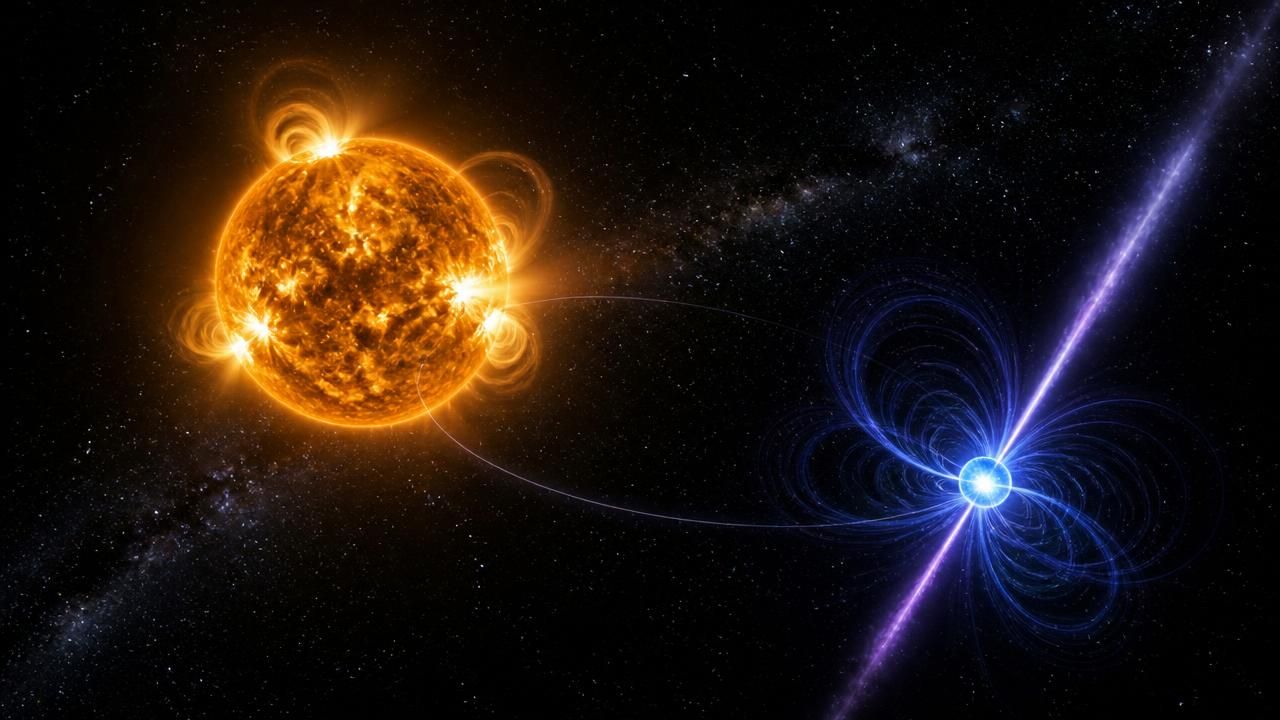
Astronomers have found a dead star more than 5,000 light-years away that spins once every eight minutes and emits radio pulses in a repeating beat, while orbiting a Sun-like companion. The discovery, reported across science and general-news outlets this week, describes a rare stellar pair in which a compact stellar remnant—the collapsed core of a star—acts like a cosmic lighthouse with an unusually slow, steady rhythm.
The signal arrives every 7.9 minutes, a cadence rounded to eight minutes in many headlines. That detail matters: the pulse period is tied to the dead star’s rotation, making the object a member of a growing but still poorly understood class of long-period radio emitters. The system is located in our Milky Way, though early coverage described it as coming from “deep space,” a phrase that emphasizes distance but can obscure the fact that the source is a galactic neighbor on astronomical scales.
A rare pair and a magnetic surprise
According to Science Daily’s account, the dead star is not alone. It orbits a star similar to the Sun, and observations revealed massive magnetic storms on that companion. The combination is unusual: compact remnants are often studied as isolated pulsars or in tight binaries where mass transfer dominates. Here, the interplay between a rapidly rotating dead star and an active stellar companion may be driving both the radio pulses and the companion’s violent magnetic weather.
The radio emission is not thought to be a message or a technological signal. Instead, it is a natural astrophysical process, likely produced by the dead star’s magnetic field and rotation. Still, the words “mysterious radio signals” traveled quickly. NY Post framed the finding as “mysterious radio signals coming every eight minutes from deep space,” while MSN’s headlines compressed the story to a “zombie star” sending a signal every 7.9 minutes. Discover magazine emphasized the rarity of the duo and its potential to shed light on a bright space phenomenon. Each framing captures a different part of the same discovery: the strange object, the clockwork signal, and the wider puzzle it may help solve.
Why the eight-minute beat matters
Radio pulsars are spinning neutron stars that sweep beams of radiation past Earth, producing regular pulses. But not all dead stars are neutron stars, and not all radio transients fit the classic pulsar picture. In recent years, astronomers have identified a handful of long-period radio transients—sources that flash on timescales of minutes to hours rather than seconds or milliseconds. Their origins remain debated. Some may be highly magnetized white dwarfs, some may be neutron stars with unusual magnetic fields, and some may involve interactions with a companion.
The new system is important because it offers a clean test case. The dead star’s eight-minute rotation is slow enough to challenge simple models but fast enough to produce a measurable beat. The companion’s magnetic storms add another layer. Stellar magnetic activity can affect the space environment around a binary, potentially shaping the radio emission or modulating it over time. If researchers can connect the timing of the radio pulses to the companion’s storms, they may learn how binary interactions power long-period radio sources.
“Dead star spinning every 8 minutes emits radio pulses” — the headline captures the discovery’s most striking feature, but the science lies in the pairing.
How the discovery was made
The finding relied on radio observations that revealed a repeating signal, followed by follow-up work to identify the source and its companion. Astronomers measured the pulse period at 7.9 minutes and determined that the dead star is in orbit with a Sun-like star. The same observations turned up evidence of massive magnetic storms on the companion, according to Science Daily. No named observatory or research team appears in the brief source material, but the result fits a broader campaign to monitor periodic radio sources and match them to stellar counterparts.
The system’s distance—more than 5,000 light-years—makes it a challenging target for detailed follow-up. Yet that distance is modest in galactic terms. The Milky Way spans roughly 100,000 light-years, so the source sits well inside our galaxy. Describing it as “deep space” is not wrong in everyday language, but it can make the object sound more exotic and remote than it is. For astronomers, the more meaningful distinction is that the source is close enough to study its companion and environment, but far enough to require sensitive radio telescopes.
What comes next
Several questions remain. Is the radio emission generated by the dead star itself, by its interaction with the companion’s stellar wind, or by a combination of both? How stable is the 7.9-minute period over months and years? Do the companion’s magnetic storms follow a cycle that matches changes in the radio signal? And are there more systems like this one waiting to be found?
Answering those questions will require timing campaigns across radio, optical, and X-ray wavelengths, plus searches for similar periodic sources. If the system is representative, it could help astronomers classify long-period radio transients and understand how dead stars influence living ones. If it is an outlier, it may force a rethink of how compact remnants spin, radiate, and interact in binaries.
For now, the discovery is a reminder that “dead” stars can remain dynamic. A collapsed core spinning every eight minutes, a Sun-like companion wracked by magnetic storms, and a radio signal arriving like clockwork together make a compelling case for continued listening—not for alien messages, but for the natural physics of stellar remains.